
(949) 954-8181 Free Case Review No recovery, no fee.
(949) 954-8181 Free Case Review No recovery, no fee.
If you work in Westminster and your employer fired, demoted, or pushed you out because of a disability, or refused to adjust your job so you could keep doing it, California law is on your side. It is stronger than federal law in several ways that matter: it covers smaller employers, defines disability more broadly, gives you more time to act, and does not cap punitive damages. Below we explain what counts as disability discrimination, what your employer owes you, the deadlines that apply, and the steps to take now.
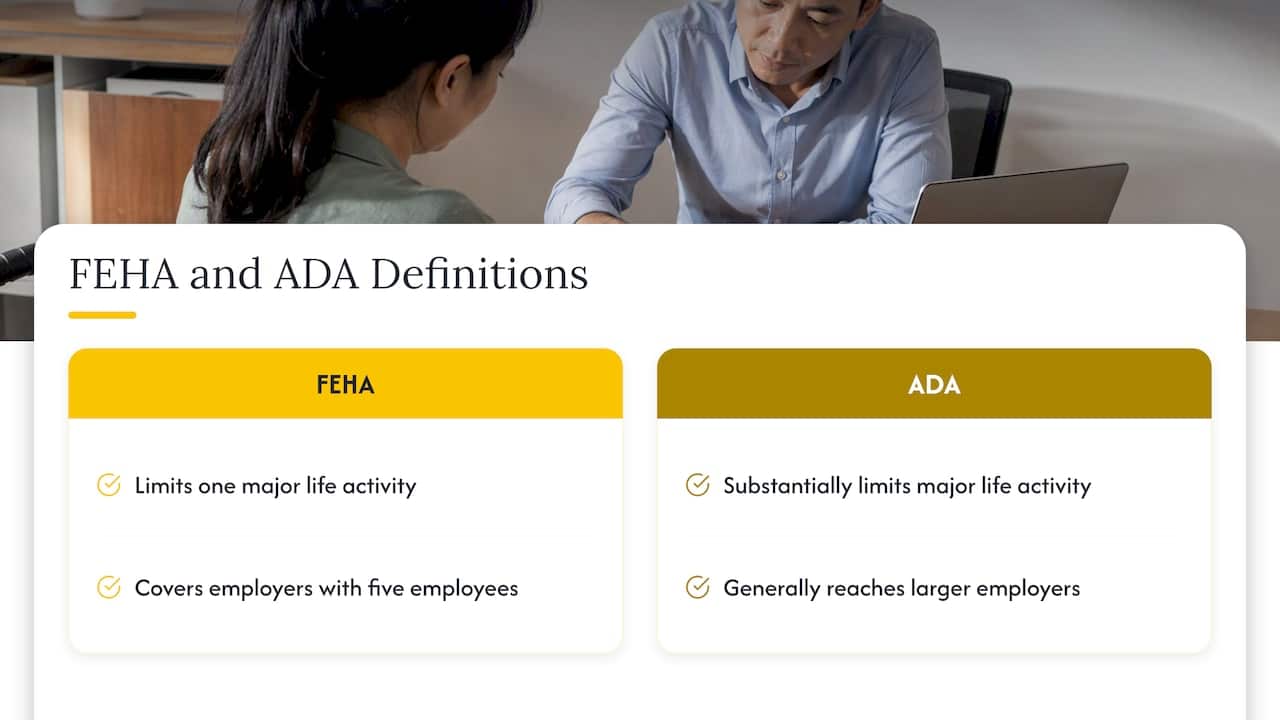
The Fair Employment and Housing Act is the main California law against workplace discrimination, and the CRD enforces it. According to the CRD’s guidance on employment discrimination based on disability, FEHA prohibits discrimination and harassment based on a person’s disability or perceived disability. It applies to employers with five or more employees, public and private.
That threshold matters in a city like Westminster, where many people work for small businesses: restaurants, shops, clinics, salons, and family-run offices. The federal Americans with Disabilities Act (ADA) generally reaches only larger employers. Under FEHA, a five-person company is covered.
FEHA also defines disability more broadly than the ADA. Under federal law, a condition must substantially limit a major life activity. Under California law, it is enough that the condition limits one. That difference can decide whether a back injury, anxiety disorder, diabetes, cancer treatment, or a chronic condition counts as a disability at all.
Protection also extends to people who are regarded as disabled. If a manager assumes you cannot handle the job because of a condition you have or are believed to have, and acts on that assumption, that can be unlawful even if you are fully capable.
Most people picture a termination. In reality, disability discrimination is often quieter. Common patterns include:
Imagine a warehouse employee in the Westminster area who develops a lumbar condition. A doctor’s note says no lifting over 20 pounds for three months. The employee gives the note to a supervisor, who says nothing, keeps assigning heavy lifting, and two weeks later writes the employee up for “productivity.” This is a composite scenario, not a client story. It illustrates three potential claims at once: failure to accommodate, failure to engage in the interactive process, and retaliation.
The CRD explains that FEHA requires employers of five or more employees to provide reasonable accommodation so that people with a physical or mental disability can apply for jobs and perform their work. Accommodations can include:
The law also requires a timely, good faith conversation between you and your employer about what will work. The CRD’s employment page treats an employer’s failure to take part in that conversation as its own violation of California law. That means you may have a claim even if you were not fired.
A common misunderstanding runs in both directions. Employees sometimes believe the employer must grant exactly what they asked for. Under EEOC guidance on the ADA and California guidance, the employer must provide an effective accommodation that lets you perform the essential functions of the job, not necessarily your preferred one. But the reverse risk exists too. If you proposed an effective option and your employer ignored it in favor of one that does not work, the employer can still be liable.
The interactive process is a two-way street. If your employer offers a workable alternative and you refuse to engage, it can weaken your position later. Respond promptly, explain what you can and cannot do, and keep the conversation going.
In hiring, an employer may ask whether you can perform the essential functions of the job with or without reasonable accommodation. Asking about the nature of your disability, or about your medical history, in an interview is not allowed in California, as the CRD’s accommodation guidance lays out. If an interviewer in Westminster asks what condition you have, that question alone can be evidence.
Time limits are where many valid claims die. Here is how the two systems compare:
| California (CRD, under FEHA) | Federal (EEOC, under the ADA) | |
|---|---|---|
| Who enforces it | California Civil Rights Department | U.S. Equal Employment Opportunity Commission |
| Employer size covered | 5 or more employees | Generally 15 or more employees |
| Definition of disability | Condition that limits a major life activity | Condition that substantially limits a major life activity |
| Filing deadline | Generally 3 years from the last discriminatory act | 180 days, extended to 300 days where a state or local agency enforces a similar law |
| Punitive damages | No statutory cap under FEHA | Capped, with compensatory damages combined, at $300,000 for the largest employers |
The CRD states that you generally have three years to file a complaint with it. The EEOC says you generally must file within 180 calendar days, extended to 300 where a state or local agency enforces a law against the same discrimination. Because California has such an agency, the longer federal window typically applies to charges filed there. Still, 300 days is far shorter than three years, and it is easy to miss if you are dealing with illness or job loss.
We do not recommend waiting. Evidence fades, coworkers move on, and emails get deleted under routine retention policies. Even if you have years on paper, a prompt consultation preserves your options. Our neighboring-city guides, such as Costa Mesa disability discrimination rights and the three-year deadline and Anaheim disability discrimination rights, cover the same deadline rules for workers in those cities.
In California, a disability discrimination claim against a private employer usually begins with the CRD. Once you file, the CRD evaluates the facts and decides whether to accept the case for investigation. Filing with the CRD is the required step before a civil lawsuit.
There is a strategic choice here. When you file, you can request an immediate Right-to-Sue notice. That lets you skip the administrative investigation and go straight to court. The investigation route and the lawsuit route carry different advantages and risks, including how evidence is gathered and how quickly settlement talks can begin. This is a decision to make with an employment attorney before you file, not after.
A typical path looks like this:
According to the CRD, remedies in a successful disability discrimination case can include back pay, front pay, reinstatement or hiring, emotional distress damages, and punitive damages. Prevailing employees are also entitled to attorney’s fees and costs.
Some points to understand:
Be realistic about outcomes. Large jury verdicts get headlines, but every case turns on its facts. Proving malice or reckless indifference is a demanding standard that depends on documentation of what the employer knew and how it responded. For a sense of how seriously federal enforcement can treat these cases, the EEOC reported that a court ordered a trucking company to pay a deaf driver $335,682 after a jury verdict. That was a federal case in another state, and federal caps apply there. It is not a prediction for your claim. No lawyer can honestly promise a particular result.
The best disability cases are built from ordinary paperwork. If you are in this situation in Westminster, start with these steps:
Avoid forwarding company files to a personal account without advice. Your notes, your own messages, and documents you legitimately received are usually the safest material to keep.
In our experience of how these disputes unfold, disability issues rarely stand alone. Related claims often include:
A thorough review looks at all of them, because each can add leverage and recovery. Our disability discrimination practice page outlines the types of cases we handle, and our discrimination blog category collects further guides. If you live near Westminster, you may also find our guides for Santa Ana and Rancho Santa Margarita useful for comparison.
We represent employees only, never employers. That focus shapes how we evaluate your case and how we talk to you about it: we want to understand what happened to your job and to you. Our Westminster employee rights page explains how we help workers in the area, and our services page lists every type of case we take, from disability and other discrimination to retaliation, wage and hour claims, and contract and severance review.
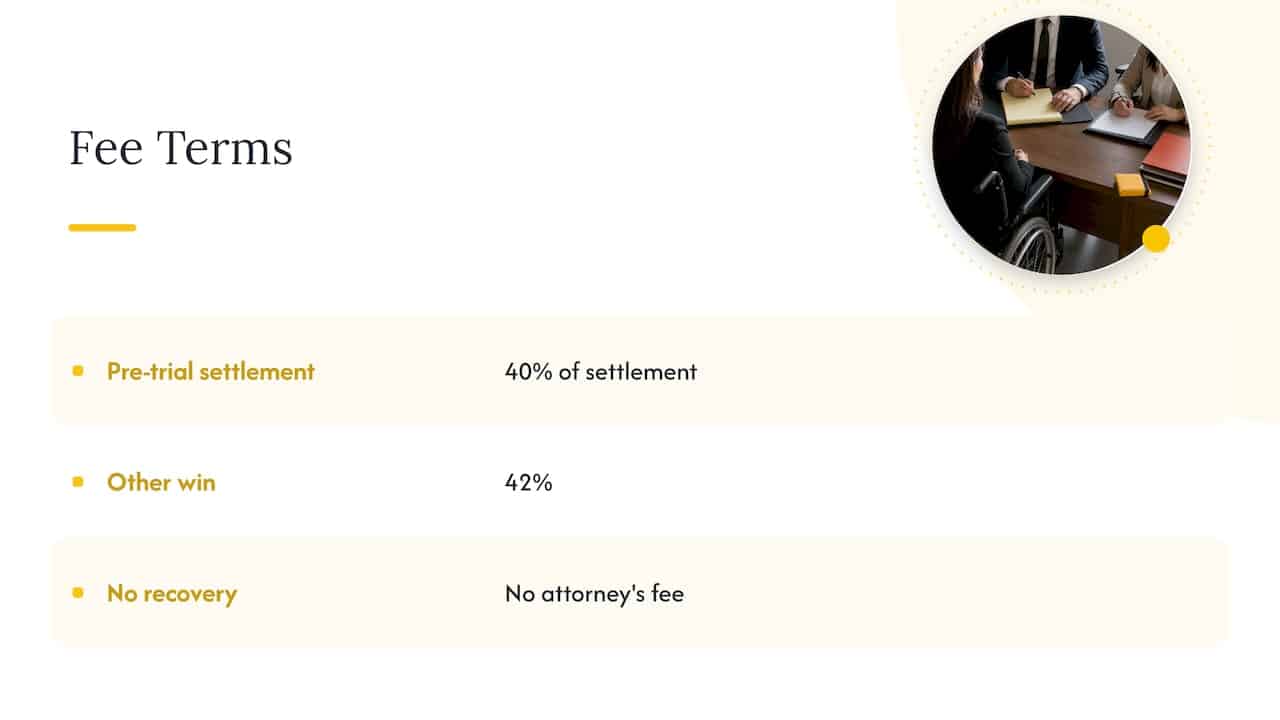
Our fees are on a contingency basis, meaning you pay nothing upfront. As published on our fee page, we take 40% of a pre-trial settlement and 42% for any other win. If there is no recovery, you owe no attorney’s fee. Ready to talk through what happened? Contact us to discuss your situation.
It is any adverse treatment because of a physical or mental disability, or because your employer believes you have one. That includes firing, demotion, refusal to hire, harassment, and refusing a reasonable accommodation. Failing to engage in the interactive process is also a violation under California law.
There is no fixed number. California law allows back pay, front pay, emotional distress damages, punitive damages, and attorney’s fees, and FEHA does not cap punitive damages. The amount depends on your lost income, the harm you suffered, and how your employer behaved. An attorney can only estimate a range after reviewing your facts.
Write down what happened with dates, and put any accommodation request in writing. Keep medical notes and past performance reviews, then speak with an employment lawyer before resigning or signing anything. You can also file with the California Civil Rights Department, generally within three years.
Not necessarily. The employer must provide an effective accommodation that lets you perform the essential functions of your job, which may differ from your first choice. If your employer ignores a workable suggestion and offers something ineffective, it may still face liability.
Yes, if the employer has five or more employees. That is a lower threshold than the federal ADA, so many small Westminster businesses are covered by California law even when federal law would not reach them.

© 2026 Optimum Employment Lawyers, PC
Legal Disclaimer | Privacy Policy
 Share
