
(949) 954-8181 Free Case Review No recovery, no fee.
(949) 954-8181 Free Case Review No recovery, no fee.


If you work in Rancho Santa Margarita and your employer treated you worse because of a physical or mental health condition, you likely have protections under California law. Your first move is to request an accommodation in writing and document every related contact. From there, you can bring a complaint to the California Civil Rights Department or the EEOC, or talk with a California employment lawyer about your options before any deadlines pass.
TL;DR:
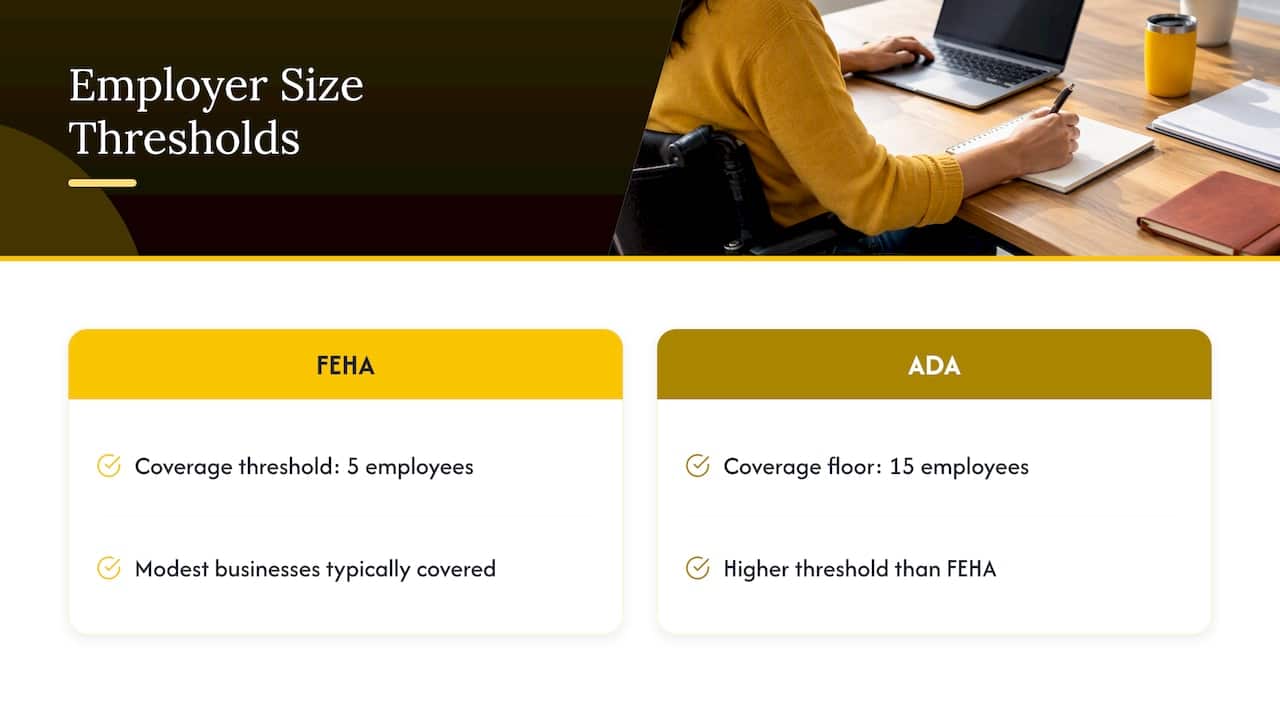
- FEHA generally covers employers with five employees, while the ADA generally starts at 15; FEHA also reaches perceived and potentially disabling conditions.
- Request a workplace change in writing, describe the work limitation rather than volunteering a diagnosis, and keep dated records of every response and follow up.
- An EEOC charge generally has a deadline of 180 days, extended to 300 days when state or local law also covers the conduct.
- Requesting a CRD Right to Sue notice ends the agency’s investigation, so consult an attorney first and preserve evidence while checking the applicable lawsuit deadline.
- Employers may deny accommodation for undue hardship judged against their resources and operations; reassignment is a last resort after other options fail.
Two laws shape your rights at work: California’s Fair Employment and Housing Act (FEHA) and the federal Americans with Disabilities Act (ADA). FEHA and the ADA have different coverage rules for employers. Check the laws that apply to your situation or consult an employment lawyer. FEHA’s definition of disability is also broader: conditions that are only potentially disabling, or that an employer merely perceives as disabling, can still qualify for protection.
Under the ADA, a disability is a physical or mental impairment that substantially limits a major life activity, a record of such an impairment, or being regarded as having one. The EEOC’s guidance on employee rights explains that both applicants and current employees are protected, and that a qualified individual is someone who can perform the essential functions of the job, with or without a reasonable accommodation.
Both laws reach far beyond the hiring decision. Unlawful treatment can show up in:
One in four American adults lives with some type of disability, according to the EEOC, which gives a sense of how often these protections come into play across California workplaces, including in Rancho Santa Margarita.
A reasonable accommodation is any change to the work environment, or to how a job is usually done, that lets you perform your duties despite a disability. The EEOC’s enforcement guidance on reasonable accommodation describes accommodations as a flexible category shaped by the specific job and the specific limitation, not a fixed checklist.
Common examples include:
Reassignment is treated as a last resort, used only after other options have been considered and ruled out. Employers can deny a request only by showing undue hardship, meaning significant difficulty or expense judged against the size, resources, and operations of that specific employer, not a general industry standard. A denial without that kind of case-specific justification is a weak one, and often a sign the interactive process broke down.
Pro Tip: Ask for accommodations in terms of what you need to do the job, not just your diagnosis; it keeps the conversation focused on function rather than medical history.
Your employer’s duty to accommodate starts the moment you say, in plain language, that you need a change at work because of a medical condition. You do not need to use legal terms or cite a statute. From there, a few habits protect you if the situation turns into a dispute later.
This back-and-forth is what the EEOC refers to as the interactive process, and it’s meant to be an ongoing dialogue rather than a single request and a single answer.
Pro Tip: Send accommodation requests by e-mail whenever possible. A written trail with a timestamp is far easier to rely on later than a conversation nobody wrote down.
Acting fast matters because these claims run on strict clocks, and missing one can end a valid claim before it starts. If you are considering filing a complaint with the California Civil Rights Department, check the official filing deadline for your situation. Before requesting a Right-to-Sue notice from the CRD, check how it may affect an agency investigation and the deadline for filing a private lawsuit.
Federal deadlines run differently. The EEOC’s guidance on time limits states that a charge generally must be filed within 180 calendar days of the discriminatory act, extended to 300 days when a state or local law, like FEHA, also covers the same conduct.
Before requesting an immediate Right-to-Sue, talk with an attorney. Here’s why that sequence matters:
Preserving evidence now, before you decide which procedural path to take, keeps your options open longer.
Once you’ve asked for an accommodation or raised a concern about discrimination, your employer has a legal duty to engage with that request in good faith and to leave your job status alone while doing it. Retaliation for exercising these rights is itself illegal, separate from whatever the original accommodation or discrimination issue was.
Retaliation doesn’t always look like an obvious firing. It often shows up as a pattern of smaller actions that only make sense once you connect them:
A single negative review rarely proves retaliation on its own. A documented pattern, with dates lining up against your accommodation request or complaint, is what turns a vague suspicion into a case an agency or attorney can actually work with.
If you work in Rancho Santa Margarita and believe you’re facing disability discrimination, the following steps help preserve your rights while you decide how far to take the matter.
Pro Tip: Keep a simple timeline document, even a basic spreadsheet, that lists each event by date. It turns scattered memories into something an attorney or investigator can use immediately.
Employees in Rancho Santa Margarita are covered by the same FEHA and ADA protections that apply across Orange County and the rest of California, with no local carve-outs that weaken those rights. What changes locally is where you go for practical help and how quickly a situation can escalate without it.
Workers here often deal with employers ranging from small retail and service businesses along Antonio Parkway to larger offices tied to the broader Orange County job market. FEHA’s five-employee threshold means even a modest-sized local business is typically covered, unlike the ADA’s 15-employee floor.
For employees pursuing a formal complaint, the CRD accepts filings from anywhere in California, including Rancho Santa Margarita, without requiring an in-person visit to a specific regional office. The EEOC similarly accepts charges filed online or by mail, so distance from a federal office isn’t a barrier to filing on time.
Local support can also come through community legal aid organizations serving Orange County residents, though eligibility and services vary by group. For a direct, employee-focused option, our Rancho Santa Margarita employee rights page outlines how we work with employees in this area specifically.
Disability discrimination claims share a legal foundation with other FEHA-protected categories, like race, sex, age, or religion, but they carry a distinct obligation that those other categories don’t: the duty to accommodate. An employer can’t simply avoid treating you differently because of a disability; it also has to actively engage in a dialogue about whether a job change would let you keep working.
That interactive process requirement has no real equivalent in a race or religious discrimination claim, where the core question is usually whether you were treated worse because of a protected trait, not whether the employer tried to modify your job. Disability cases also often turn on medical evidence and the ADA and FEHA definitions of what counts as substantially limiting, a record of impairment, or being regarded as impaired, which adds a layer of medical documentation that other discrimination categories don’t typically require.
The remedies available look similar across categories. The EEOC notes that remedies for ADA violations can include hiring, promotion, reinstatement, back pay, and attorneys’ fees, outcomes that parallel what’s available under FEHA for race or sex discrimination. Understanding which category your situation fits matters mainly for figuring out what evidence to gather and whether an interactive process failure, not just unequal treatment, is part of your claim.

We represent California employees exclusively, never employers, in disability discrimination, retaliation, and wrongful termination cases, including claims that start with a denied or mishandled accommodation request. Our contingency fee model means there’s no upfront cost. We collect 40% from a pre-trial settlement or 42% from another type of win, so our fee comes only once there’s a recovery.
A consultation typically covers:
If you’re dealing with a denied accommodation, discipline after a complaint, or termination while seeking medical leave, reach out through our contact page for a consultation, or review our disability discrimination services for more detail on how we handle these cases.
This article is general information, not a substitute for advice from a qualified lawyer. Consult a qualified legal professional about your own circumstances before acting on anything here.
Proving disability discrimination usually comes down to documentation: written accommodation requests, dates, and any change in treatment that followed. Cases built on a clear timeline and saved records tend to be far stronger than those relying on memory alone, which is why documenting requests and responses as they happen matters so much.
Firing an employee specifically because they took or requested disability leave can constitute both disability discrimination and unlawful retaliation under FEHA. Check the official filing deadline for a complaint with the California Civil Rights Department. A federal EEOC charge generally must be filed within 180 days, extended to 300 days where state law also applies.
Disability discrimination happens when an employer treats a qualified employee or applicant unfavorably because of a physical or mental impairment, a record of one, or being regarded as having one. It also includes failing to provide a reasonable accommodation or to engage in the interactive process when a request is made, as described in EEOC guidance on reasonable accommodation.
Common examples include denying a reasonable accommodation without a genuine undue hardship justification, disciplining or firing an employee shortly after they disclose a medical condition, and excluding an employee from promotions or assignments based on assumptions about their condition rather than their actual abilities. Each of these can form the basis of a claim when documented with dates and specifics.

© 2026 Optimum Employment Lawyers, PC
Legal Disclaimer | Privacy Policy
 Share
Share
