
(949) 954-8181 Free Case Review No recovery, no fee.
(949) 954-8181 Free Case Review No recovery, no fee.
If your employer in Santa Ana is treating you differently because of a disability, act now: document every incident, submit a written accommodation request, and contact the California Civil Rights Department (CRD) or Optimum Employment Lawyers. California’s Fair Employment and Housing Act (FEHA), enforced by the CRD, gives you stronger protections than federal law, and the clock starts the day discrimination occurs.
Your first steps this week:
Santa Ana employees facing disability discrimination must document incidents, submit a written accommodation request, and contact the CRD or an employment attorney before the CRD’s intake deadline.
| Point | Details |
|---|---|
| FEHA beats the ADA | California law requires only a “limitation,” not a “substantial limitation,” and covers employers with five or more employees. |
| Three-year CRD deadline | Submit your intake form to the CRD within three years of the last act of discrimination. |
| Written requests matter | Put every accommodation request and internal complaint in writing; it triggers the employer’s legal duty to respond. |
| Retaliation is a separate violation | Document any negative action after you complain or request accommodation; it strengthens your overall claim. |
| Optimum Employment Lawyers | Contingency-fee representation for Santa Ana employees; no upfront cost, with local Orange County experience in disability discrimination cases. |
Start with two things simultaneously: request your accommodation in writing and begin a detailed incident log. Every day you wait, evidence gets harder to recover.
Documenting incidents means more than jotting a note. Record the date, time, exact location, what was said word-for-word, who was present, and how you responded. For electronic evidence, forward relevant emails to a personal account and screenshot any text messages before they disappear. If a coworker witnessed something, ask them to write a brief statement and sign it.

Requesting a reasonable accommodation under FEHA requires only that you notify your employer of your need, not that you use any magic words. Put it in writing regardless. State your condition generally, describe how it affects your work, and propose one or more accommodations. Your employer, if they have five or more employees, must then engage in a timely, good-faith interactive process.
The interactive process is a back-and-forth conversation. Your employer may ask for medical documentation from your doctor. Provide what is reasonable, but you are not required to hand over your entire medical history. If your employer refuses to engage at all or drags the process out without explanation, document those delays in writing too.
Internal complaints can protect you, but choose your words carefully. Stick to facts: what happened, when, and who was involved. Avoid characterizing intent. Keep a copy of everything you submit to HR. If retaliation follows a complaint, such as a sudden negative performance review or a schedule change, document it immediately and treat it as a separate violation. California law protects employees from retaliation for reporting discrimination or requesting accommodations.
Public vs. private sector note: Santa Ana employees working for the City of Santa Ana or Orange County government agencies have additional protections under civil service rules and may have shorter internal grievance deadlines. Check your employee handbook before filing internally.
| Document type | Why it matters | Example |
|---|---|---|
| Written accommodation request | Proves you notified the employer and triggered the interactive-process duty | Email to HR dated and saved |
| Incident log | Establishes a pattern and timeline | Dated notes with witness names |
| Employer response (or silence) | Shows whether the interactive process was engaged in good faith | Denial letter or lack of reply |
| Medical documentation | Supports the existence and nature of your disability | Doctor’s letter describing functional limits |
| Performance records | Counters pretextual discipline claims | Prior positive reviews vs. post-request write-ups |
Pro Tip: If your employer claims your accommodation is an “undue hardship,” ask them to provide that determination in writing. Employers rarely do, and the absence of a written response strengthens your claim that the interactive process was not conducted in good faith.
FEHA covers more employees and more conditions than the Americans with Disabilities Act. Under California Government Code §12926.1, the Legislature explicitly stated that FEHA provides protections independent of the ADA and requires only that a condition limit a major life activity, not substantially limit it as the ADA demands. That single word difference opens the door for many conditions the ADA would exclude.
FEHA also applies to employers with five or more employees, compared to the ADA’s threshold of fifteen. And critically, FEHA evaluates disability without regard to mitigating measures: if your condition would limit you without your medication or prosthetic, you are protected even if those measures control your symptoms day-to-day. The California Attorney General’s guidance recommends consulting an attorney early precisely because these distinctions can determine whether a claim succeeds.
The CRD’s employment-disability guidance covers physical and mental conditions broadly: cancer, diabetes, HIV/AIDS, anxiety disorders, depression, PTSD, back injuries, chronic pain, and episodic conditions like epilepsy or multiple sclerosis all qualify. So does a perceived disability. If your employer treats you as though you have a limiting condition, even if you do not, FEHA protects you. “Working” itself counts as a major life activity under California law, meaning a condition that limits your ability to perform your job functions is covered.
Once you submit an intake form to the CRD, investigators review your documents and request a response from your employer. The CRD may attempt mediation before a full investigation concludes. If investigators find reasonable cause, the case can proceed to a formal complaint, negotiated settlement, or referral for legal action. If the CRD closes the case without finding cause, you can request a Right-to-Sue notice and pursue a private lawsuit.
Possible remedies include reinstatement to your position, back pay, compensatory damages for emotional distress, punitive damages in egregious cases, and attorney’s fees. Accommodation orders are also available, requiring your employer to implement the changes they refused.
Yes, and many cases resolve this way. The CRD offers mediation during the complaint process, and parties can reach a private settlement at any stage. Mediation is typically faster than a full investigation and gives both sides more control over the outcome. An employment attorney can negotiate directly with your employer’s counsel even before a CRD complaint is filed, which sometimes produces faster results. Settlement does not require admitting wrongdoing, and confidentiality terms are common.
Go in with documentation and a specific ask. Bring your written accommodation request, any medical letters your doctor provided, and a list of the specific job functions your condition affects. Propose two or three concrete accommodations rather than leaving it open-ended: modified schedule, remote work on certain days, ergonomic equipment, or reassignment of a marginal duty. Take notes during the meeting or send a follow-up email summarizing what was discussed and agreed upon. That email becomes evidence if the employer later denies the meeting happened or misrepresents what was said. If your employer brings HR or legal counsel, you have the right to bring a support person or request time to consult an attorney before agreeing to anything.
Facing disability discrimination alone is hard. Optimum Employment Lawyers focuses exclusively on employee-side California employment law, with direct experience handling disability discrimination claims across Orange County, including Santa Ana. The firm can investigate your situation, file administrative complaints with the CRD or EEOC, negotiate accommodations and settlements with your employer, and prepare a lawsuit when that is the right move.
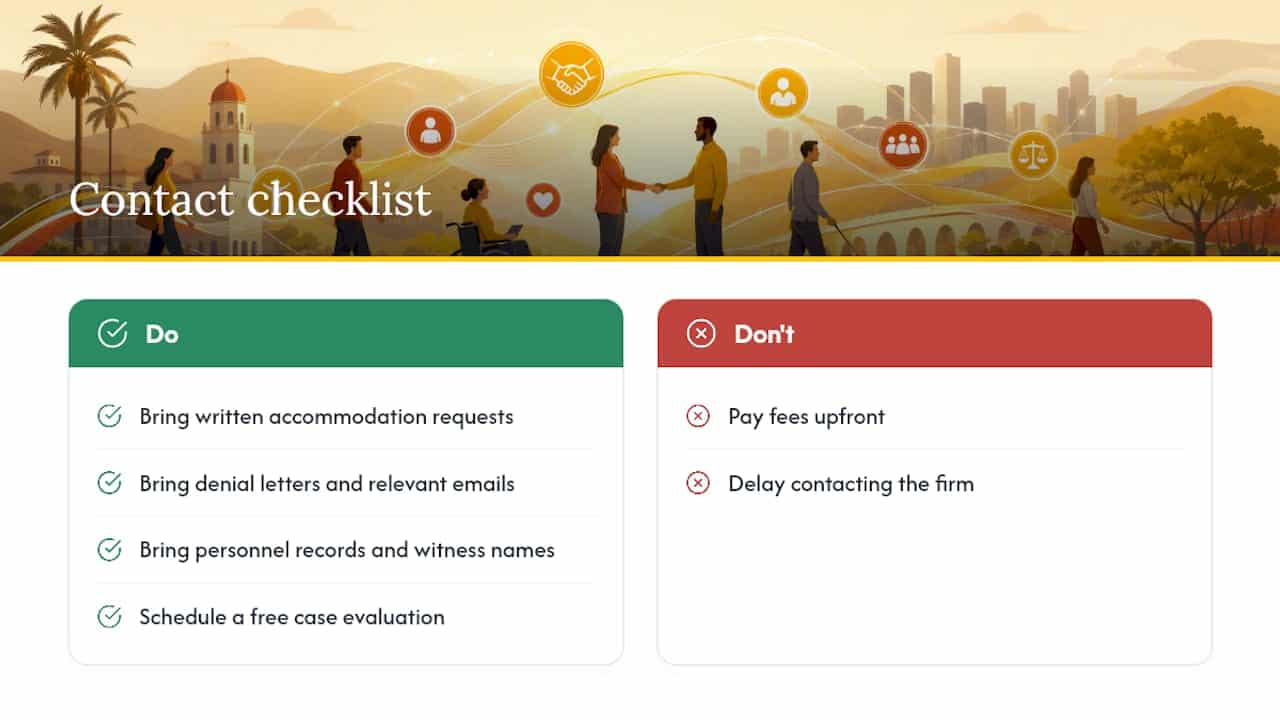
When you contact the firm, bring your written accommodation requests, any denial letters, relevant emails, personnel records, and the names of witnesses. The firm works on a contingency-fee basis: you pay nothing upfront, and the firm collects a percentage of any settlement or court award only if you win. No recovery means no fee.
Schedule a free case evaluation and get a clear picture of your options. The firm has recovered significant results for California employees, including a $2.2 million class settlement, and brings that same focus to individual disability discrimination cases in Santa Ana.
Use these government sources to file, check deadlines, and understand your rights under California and federal law.
For workplace disability discrimination in Santa Ana, file with the CRD first. If your employer has fifteen or more employees, you may also file a parallel charge with the U.S. Equal Employment Opportunity Commission (EEOC); the two agencies coordinate, and filing with one typically preserves your rights with the other.
This article provides general legal information, not legal advice. Consult a qualified California employment attorney or contact the CRD directly to confirm deadlines and procedures that apply to your specific situation.
This article is general information, not a substitute for advice from a qualified lawyer. Consult a qualified legal professional about your own circumstances before acting on anything here.

© 2026 Optimum Employment Lawyers, PC
Legal Disclaimer | Privacy Policy
 Share
Share
