
(949) 954-8181 Free Case Review No recovery, no fee.
(949) 954-8181 Free Case Review No recovery, no fee.


Disability discrimination in employment means treating a worker or job applicant unfairly because of a physical or mental disability, and it is explicitly prohibited in Tustin workplaces under both federal and California law. The Americans with Disabilities Act (ADA) and California’s Fair Employment and Housing Act (FEHA) make this form of workplace discrimination illegal across every stage of employment, from hiring through termination. Tustin employees benefit from some of the strongest worker protections in the country, because California’s FEHA sets a higher standard than federal law in several key areas. The California Civil Rights Department (formerly DFEH) and the Equal Employment Opportunity Commission (EEOC) both enforce these rights, giving workers two parallel enforcement channels.
Disability discrimination covers a broad range of employment actions, including hiring, firing, pay, job assignments, promotions, and benefits. That scope matters because many Tustin employees only recognize discrimination when they are fired. The reality is that being passed over for a promotion, receiving a pay cut, or being reassigned to a less desirable role after disclosing a disability all qualify as adverse employment actions under the ADA and FEHA.
Common scenarios Tustin workers report include:
Two categories trip up many Tustin employees: Long COVID and invisible disabilities. Long COVID qualifies as a disability under FEHA when it substantially limits a major life activity such as breathing, concentration, or mobility. Invisible disabilities, including anxiety disorders, PTSD, and chronic pain conditions, receive the same legal protection as visible physical impairments. Employers who dismiss these conditions as non-serious face significant legal exposure.
Pro Tip: If your employer’s behavior changed noticeably after you disclosed a health condition or requested leave, document every shift in treatment with dates, names, and specific incidents. That paper trail is the foundation of a strong discrimination claim.

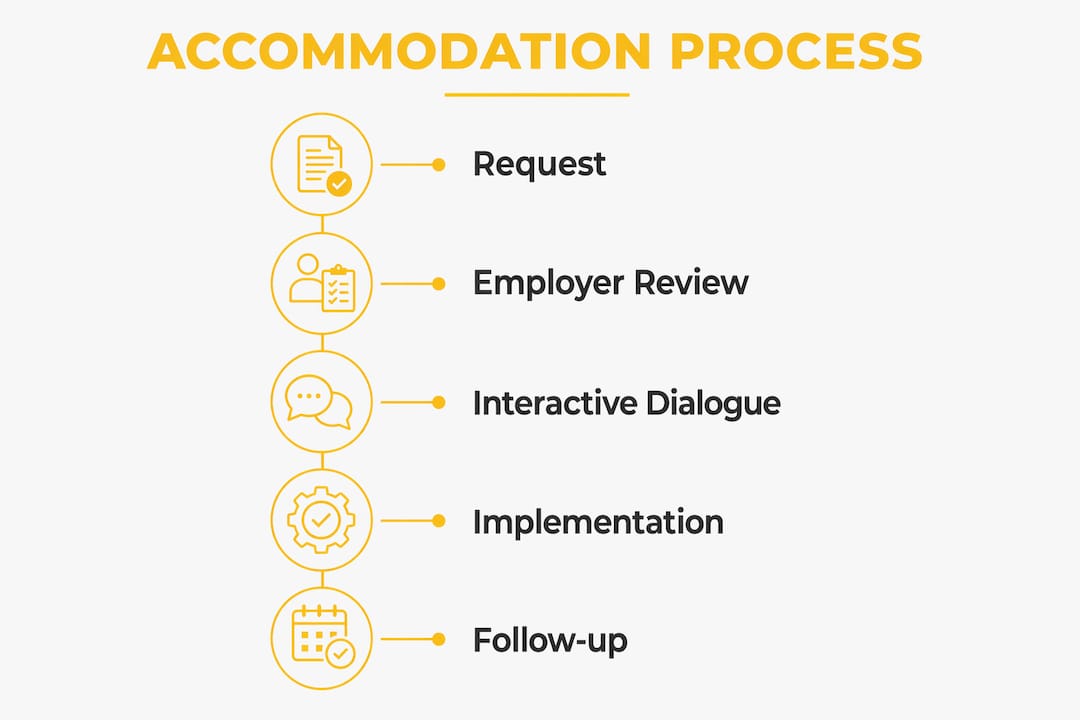
The interactive process is the legally required back-and-forth between an employee and employer to identify a workable accommodation. Under both the ADA and FEHA, this process is triggered when the employer knows or should know an employee needs an accommodation, even if the employee never mentions the ADA by name. A Tustin worker who simply tells a manager, “I need to move my desk because of my back,” has legally initiated the process.
Here is how the process typically unfolds for a Tustin employee:
| Step | Employee action | Employer obligation |
|---|---|---|
| Request | Submit written, dated request | Acknowledge and begin interactive process |
| Documentation | Provide job-related medical info only | Keep records in a separate, confidential ADA file |
| Dialogue | Participate in good faith | Explore all feasible alternatives |
| Decision | Review written response | Issue written approval or compliant denial letter |
| Dispute | Document all delays and gaps | Demonstrate good faith engagement |
Undue hardship is the only legal basis for denying an accommodation. It requires proof that the accommodation would cause significant difficulty or expense given the employer’s size and resources. A large Tustin employer claiming undue hardship for a $200 ergonomic chair will not survive legal scrutiny.
Pro Tip: Always follow up verbal conversations about accommodations with a brief email summary. Write something like: “Per our conversation today, I am requesting X accommodation due to my medical condition.” This single habit closes the most common documentation gap in FEHA disputes.
Filing deadlines in disability discrimination cases are strict and missing them permanently bars your claim. California is a deferral state, which means the EEOC filing deadline extends to 300 days from the discriminatory act rather than the standard 180 days. That extension exists because California has its own parallel enforcement agency, the California Civil Rights Department, and employees can file with either or both.
Key steps for Tustin employees:
The 300-day window sounds generous, but accommodation disputes often turn on who caused delays and whether the employer promptly engaged the interactive process. Waiting months to consult an attorney means critical evidence, including HR communications and manager emails, may be deleted or harder to obtain. Acting within the first 60 to 90 days of a discriminatory act gives your legal team the best position.
Tustin employees who prove disability discrimination under the ADA or FEHA can recover a meaningful range of remedies. These include:
Anti-retaliation protections are equally important. Both the ADA and FEHA prohibit employers from punishing employees for requesting accommodations, filing complaints, or participating in discrimination investigations. Retaliation can take the form of sudden negative performance reviews, schedule changes, isolation, or termination. Courts treat retaliation claims seriously, and a retaliation act that occurs after a discrimination complaint can become a separate, independent legal claim.
Organizations like the Disability Rights California and the California Civil Rights Department provide free resources and advocacy support for Tustin employees who need guidance before retaining private counsel. The reasonable accommodation rights established under California law give employees a strong foundation for both administrative and civil claims.
Documentation is the difference between a strong claim and a dismissed one. Written records establish a clear timeline that is critical in legal proceedings, and gaps in that timeline almost always benefit the employer.
The most effective documentation strategy for Tustin employees compares what you should keep versus what to avoid:
| Keep | Avoid |
|---|---|
| Dated emails and texts about accommodations | Verbal-only conversations with no follow-up |
| HR responses and timelines in writing | Assuming HR will document on your behalf |
| Medical notes limited to job-related limitations | Sharing full medical history with your employer |
| Witness names and contact information | Waiting to record incidents until after filing |
| Performance reviews before and after disability disclosure | Discarding documents that seem minor |
Three practical steps make the biggest difference. First, send a written summary after every accommodation conversation, even if the meeting was informal. Second, keep a personal log with dates, times, locations, and exact words used in any discriminatory incident. Third, store copies of all relevant documents outside your work email, because employer IT systems are accessible to HR and legal teams the moment a complaint is filed.
Pro Tip: If your employer denies your accommodation request verbally, send an email the same day asking for the denial in writing and the specific reasons. Employers who refuse to put denials in writing are often aware their position is legally indefensible, and that refusal itself becomes evidence.
Even when medical documentation arrives late, courts and the California Civil Rights Department evaluate who caused the delay and whether the employer acted in good faith. Proactive, documented communication by the employee consistently produces better outcomes in FEHA and ADA disputes.
Disability discrimination in Tustin jobs is illegal under both the ADA and FEHA, and employees who act quickly with thorough documentation hold the strongest position for recovery.
| Point | Details |
|---|---|
| Two laws protect you | Both the ADA and California’s FEHA prohibit disability discrimination in all employment decisions. |
| Interactive process is mandatory | Employers must engage in a good-faith accommodation dialogue once they know a need exists. |
| 300-day filing deadline | California employees have 300 days from the discriminatory act to file an EEOC charge. |
| Documentation drives outcomes | Written, dated records of requests and responses are the most critical evidence in any claim. |
| Retaliation is a separate violation | Any adverse action after a complaint or accommodation request can be its own legal claim. |
Optimum Employment Lawyers represents employees across Orange County, including Tustin, who face disability discrimination, denied accommodations, and retaliation. The firm works exclusively on the employee side, which means every strategy is built around protecting your rights and maximizing your recovery. Their attorneys understand the specific requirements of FEHA and the ADA, and they have secured significant results for California workers, including a $2.2 million class action settlement. If you believe your employer has violated your disability rights in California, a consultation with Optimum Employment Lawyers gives you a clear picture of your options before any deadlines pass. Time is the one resource you cannot recover in a discrimination case, so acting now protects your claim.
A disability under FEHA includes any physical or mental condition that limits a major life activity, and California’s definition is broader than the federal ADA standard. Conditions such as anxiety, chronic pain, Long COVID, and PTSD all qualify when they affect work-related functions.
No. Employers may only request information about your specific impairment, its job-related limitations, and why the accommodation is needed. They cannot require complete medical records or information unrelated to your job functions.
Tustin employees have 300 days from the discriminatory act to file a charge with the EEOC, because California is a deferral state with a parallel state agency. Missing this deadline typically bars your federal claim permanently.
Document every change in treatment immediately, including performance reviews, schedule changes, and any negative comments, with dates and names. Retaliation after an accommodation request is an independent violation of both the ADA and FEHA and can be filed as a separate complaint.
You can file directly with the EEOC or California Civil Rights Department without an attorney, but legal representation significantly improves outcomes in complex cases involving denied accommodations, termination, or retaliation. Employees-lawyer’s Optimum Employment Lawyers offer consultations to help Tustin workers assess their claims before any deadlines expire.

© 2026 Optimum Employment Lawyers, PC
Legal Disclaimer | Privacy Policy
 Share
Share
