
(949) 954-8181 Free Case Review No recovery, no fee.
(949) 954-8181 Free Case Review No recovery, no fee.


Yes, employees in Newport Beach are protected from workplace disability discrimination under both state and federal law. If your employer has ignored, denied, or punished you for asking for a disability accommodation, you have legal options right now. The first move: put your accommodation request in writing and save every email, text, and doctor’s note tied to it.
California’s Fair Employment and Housing Act (FEHA) and the federal Americans with Disabilities Act both bar disability discrimination, but FEHA’s protections reach further than the ADA’s in several respects.
Quick fact: California employers with just five or more employees must engage in a timely, good faith interactive process once an accommodation is requested, a far lower threshold than the federal 15-employee cutoff.
Newport Beach employees are protected from disability discrimination under both FEHA and the ADA, and a documented accommodation request is the single most important first step in preserving those rights.
| Point | Details |
|---|---|
| Two overlapping laws apply | FEHA’s “limits” standard is broader than the ADA’s “substantial limitation” test, so more conditions qualify under state law |
| Document every request in writing | Include the date, your limitation, and the specific accommodation you’re asking for |
| Employers must engage, not stall | A good faith interactive process is legally required once you request an accommodation |
| CRD intake usually comes before a lawsuit | Filing with the CRD or EEOC, and often getting a right-to-sue notice, generally precedes private litigation |
| Optimum Employment Lawyers handles these cases on contingency | The firm represents Newport Beach employees exclusively and has secured settlements including $2.2 million in a class action case |
This article is general information, not a substitute for advice from a qualified lawyer. Consult a qualified legal professional about your own circumstances before acting on anything here.
Two legal systems overlap here, and the gap between them matters more than most employees realize. FEHA only requires that your condition “limits” a major life activity. The ADA demands a “substantial limitation,” a tougher bar to clear. That difference means some conditions California law protects would get tossed out under a purely federal reading.
When in doubt about which rule applies to your situation, the CRD’s accommodation guidance and the EEOC both publish plain-language explanations you can check against your own case before you talk to anyone at work.
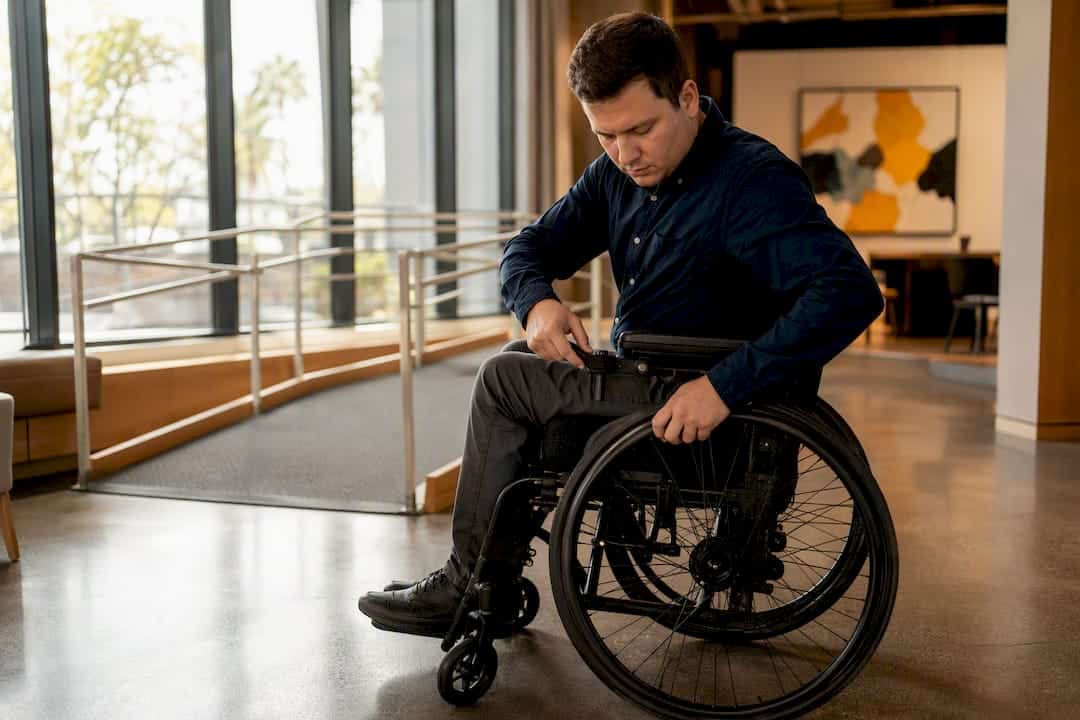
California law doesn’t let employers sit on an accommodation request. Once you ask, your employer has an affirmative duty to start or join a timely, good faith conversation about what might work, according to state regulations governing the interactive process. Failing to engage in that back and forth can itself be a separate violation, even if no accommodation was ever formally denied.
Here’s roughly how that process should unfold, especially if you wonder whether your condition qualifies as a disability under the law, as explained in Is Congestive Heart Failure Considered a Disability?:
You don’t have to name the exact fix. You just need to describe the limitation and what you think might help; the employer can pick among options that actually work, based on CRD guidance. Employers can request medical documentation, but confidentiality rules apply, and if your paperwork is incomplete, they must tell you what’s missing rather than deny the request outright.
Pro Tip: Never assume silence means denial. If two weeks pass with no response to your written request, follow up in writing and reference your original message by date. That paper trail becomes critical if the case escalates.
An employer can reject an accommodation only for undue hardship, a high bar that requires real proof, not a vague claim that it’s inconvenient.
Some of this is obvious. Some of it hides behind ordinary-sounding management decisions. Here’s what crosses the line:
The pattern that matters most: timing. If a manager suddenly finds performance problems right after learning about your diagnosis or accommodation request, that timing itself becomes evidence.
Getting this right on paper protects you later, even if the situation resolves informally. Follow this sequence:
California generally requires CRD intake, and often a right-to-sue notice, before you can file a private lawsuit over workplace discrimination.
| Step | What You Need to Know |
|---|---|
| Written request | Include date, limitation, requested accommodation, and ability to perform job duties |
| Documentation | Keep copies of all correspondence and medical notes tied to the request |
| CRD intake | Required in most cases before an employment lawsuit can proceed |
| EEOC filing | Available for federal ADA claims; strict time limits apply |
| Legal consult | Best done early to avoid missing statutory deadlines |
Outcomes vary case by case, but California and federal law both allow for real financial consequences when discrimination is proven. Potential remedies include reinstatement, back pay, front pay, compensatory and sometimes punitive damages, injunctive relief, and attorney fees.
The CRD’s complaint process involves an intake review and possible investigation, and missing a statutory deadline can close off your options permanently.
Quick fact: Employers cannot force an employee onto indefinite leave when a less restrictive accommodation, like a schedule adjustment or reassignment, would let them keep performing essential job functions.
Timeline depends heavily on how cooperative your employer is, how complex the medical proof gets, and whether either side wants to settle before litigation.
If your employer denied an accommodation, fired you after a disability disclosure, retaliated for a complaint, or simply stopped talking during the interactive process, that’s the moment to call counsel rather than wait it out. Optimum Employment Lawyers represents employees exclusively across Newport Beach and the surrounding area, handling disability discrimination cases with the kind of personalized attention that gets lost at firms juggling both sides of employment disputes. The firm’s track record includes a $2.2 million settlement in a class action wage case, evidence of the aggressive strategy it brings to employee-side representation. Because the firm works on contingency, you pay nothing upfront; fees come only from a settlement or court award.

Before your consult, gather your written accommodation request, any employer responses, medical documentation, and a rough timeline of events. A lawyer’s early involvement often makes the difference between a clean CRD filing and a claim that stalls on a missed technicality. Learn more about the firm’s Newport Beach practice or reach out directly through the firm’s contact page to schedule a consult and find out where you stand.

© 2026 Optimum Employment Lawyers, PC
Legal Disclaimer | Privacy Policy
 Share
Share
