
(949) 954-8181 Free Case Review No recovery, no fee.
(949) 954-8181 Free Case Review No recovery, no fee.


If you are a qualified employee with a disability, the law protects you from discrimination and entitles you to reasonable accommodations. Act promptly and document everything. That means putting accommodation requests in writing, saving emails and dates, and preparing to file a charge with the EEOC or California’s Civil Rights Department if your employer refuses to engage or retaliates against you.
TL;DR:
- Disability discrimination can be subtle, such as being excluded from meetings or scrutinized more harshly after requesting accommodations.
- The ADA and FEHA laws provide protections, requiring employers to engage in a flexible interactive process and avoid undue hardship in providing accommodations.
- A documented, written request for accommodation and timely reporting are essential, with most charges needing to be filed within 180 or 300 days.
- Common accommodations include flexible scheduling, telework, ergonomic equipment, and reassignment, but they must not significantly disrupt operations.
- Filing a discrimination charge early and gathering evidence like medical notes, witness names, and performance reviews improve the chances of a successful claim.
Disability discrimination shows up in obvious and subtle ways, and both are illegal for employees in Anaheim and across California. The obvious forms include refusing to hire a qualified applicant because of a disability, demoting someone after they disclose a diagnosis, firing an employee who asks for an accommodation, or quietly excluding a disabled worker from training sessions and promotion tracks.
The subtler patterns are harder to name but just as damaging. A manager who suddenly scrutinizes your work after you request a modified schedule, a coworker who is excused from the same errors you get written up for, or a team that stops inviting you to meetings after you mention a chronic condition: these are the kinds of shifts that often precede or accompany a formal discrimination claim.
Watch for conduct like this:
Mental health conditions and episodic conditions, such as depression, anxiety, epilepsy, or multiple sclerosis, are protected the same way as visible physical disabilities when they substantially limit a major life activity, even if symptoms come and go. Retaliation after you complain or request an accommodation is its own separate violation, independent of whether the underlying discrimination claim succeeds.
Two legal frameworks apply to most Anaheim employees: the federal Americans with Disabilities Act (ADA) and California’s Fair Employment and Housing Act (FEHA). The ADA makes it unlawful to discriminate against a qualified individual with a disability in hiring, firing, pay, promotions, and other terms of employment, and it defines reasonable accommodation broadly while allowing employers to claim undue hardship as a defense.
To be protected under the ADA, you generally need to show three things: you have a disability (a physical or mental impairment that substantially limits a major life activity), you are a “qualified individual” (you meet the job’s skill and experience requirements), and you can perform the essential functions of the job with or without a reasonable accommodation. FEHA uses a similar framework but defines disability more broadly than the ADA in several respects, which is one reason California employees often have stronger protections than the federal floor alone provides.
Federal employees have an additional layer of protection under the Rehabilitation Act of 1973, which mirrors ADA standards but applies specifically to federal agencies and federal contractors. For nearly everyone else working in Anaheim, FEHA and the ADA run in parallel, and you can often bring a claim under both.
Employers also face strict limits on medical inquiries. They generally cannot ask disability-related questions or require medical exams before extending a conditional job offer, and any medical information they do collect must be kept confidential and separate from your general personnel file. The EEOC’s ADA guidance addresses exactly when employers can and cannot ask about your health.
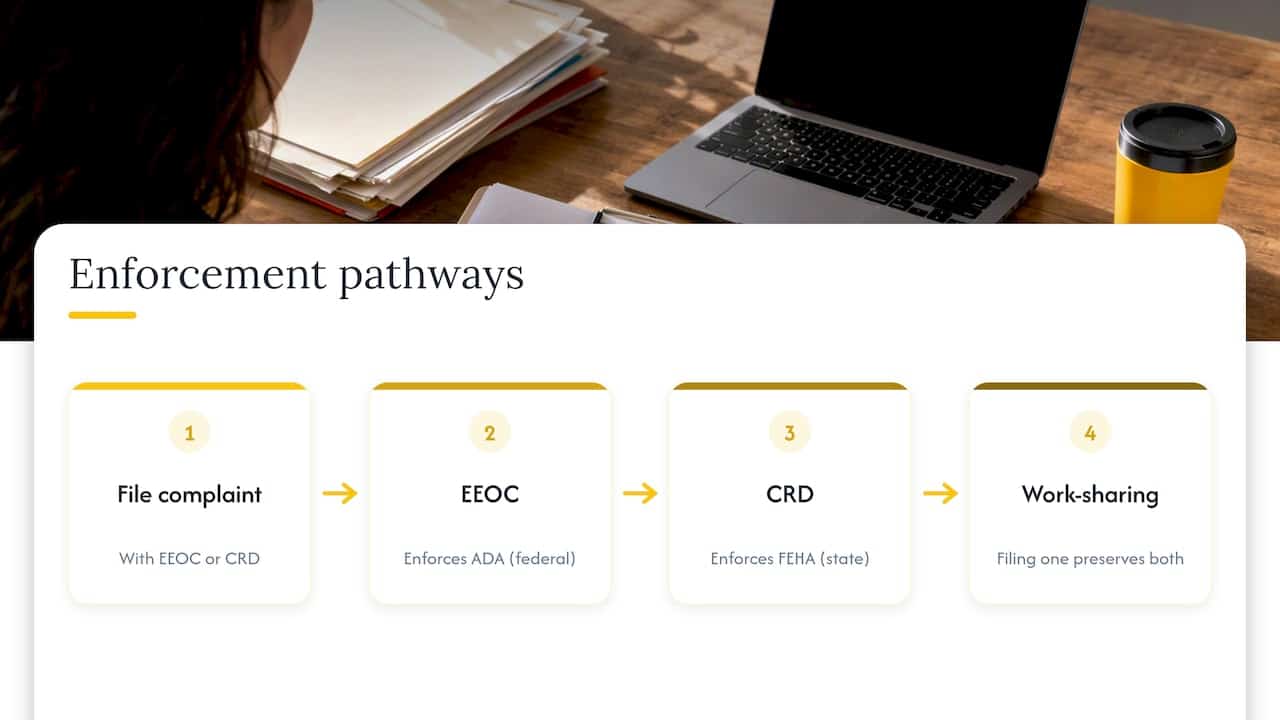
Enforcement splits along similar lines. The EEOC enforces the ADA at the federal level, while California’s Civil Rights Department enforces FEHA at the state level. Because the two agencies have a work-sharing agreement, filing with one generally preserves your rights under both laws, which matters a great deal when you are deciding where to start.
A reasonable accommodation is any change to the work environment or how a job is done that allows a qualified employee with a disability to perform the job’s essential functions. It is not a tool for lowering performance standards. The EEOC has been clear that employees with disabilities are still expected to meet the same production and conduct standards as everyone else; accommodations exist to remove barriers, not to excuse performance.
Common accommodations include:
Once you request an accommodation, your employer is required to engage in what the law calls the “interactive process”: a back-and-forth conversation to figure out what will actually work. The EEOC’s guidance on medical inquiries and telework stresses that this process has to be flexible, and that telework can qualify as a reasonable accommodation even when an employer has no formal remote work program, as long as the essential job functions can be performed remotely.
Employers can deny an accommodation only if it would cause “undue hardship,” meaning significant difficulty or expense given factors like the size of the business, its financial resources, and how the change would affect operations. A small Anaheim retail shop and a large distribution center down the 91 freeway may reasonably reach different conclusions about the same accommodation request, and that is by design.
Pro Tip: Put your accommodation request in writing, even if you already raised it verbally. A dated email or letter is the single strongest piece of evidence if your employer later denies the request or claims it was never made.
If informal conversations with your employer are not resolving the problem, the sequence below protects your rights while building a paper trail.
You can file an EEOC charge through its Public Portal, by phone, or in person at a field office; your charge should include your name and contact information, your employer’s name and location, a description of the discriminatory act, and the approximate dates involved. Timing matters enormously here. The EEOC generally requires charges to be filed within 180 days of the discriminatory act, extended to 300 days when a state or local agency, like California’s Civil Rights Department, enforces a similar law. Because California has its own enforcement agency, Anaheim employees typically get the full 300-day window, but counting from the date of the incident rather than when you first noticed its effects, so do not wait to confirm your deadline.
Dual-filing means a charge filed with one agency is often automatically cross-filed with the other, but it is worth confirming this directly rather than assuming it happened.
Successful disability discrimination claims can lead to several kinds of relief: reinstatement to your position, back pay for wages lost since the discrimination occurred, front pay if reinstatement is not practical, compensatory damages for emotional distress, punitive damages in cases involving malice or reckless indifference, injunctions requiring policy changes, and attorneys’ fees. Which of these apply depends heavily on the facts of your case and which law you proceed under.
Investigations typically take months, not weeks, and mediation (when both sides agree to it) can sometimes resolve a charge faster than a full investigation. Timelines stretch out when the employer disputes key facts, when the agency has a backlog, or when additional witnesses need to be interviewed. Missing a filing deadline can eliminate your right to pursue certain remedies entirely, which is why the 180 and 300-day windows discussed above are not just bureaucratic details.
If you believe you are losing income because of discrimination or retaliation, start collecting pay stubs, work schedules, and medical bills now. These documents become the backbone of a back-pay or damages calculation later, and they are much easier to gather in real time than to reconstruct months afterward. If your disability stems from a workplace injury rather than a non-work-related condition, a workers’ compensation benefits calculator can help you understand what wage-replacement benefits might be available alongside a discrimination claim.
Some situations call for legal help sooner rather than later: being fired while on medical leave, facing retaliation that compounds a disability discrimination claim, watching a filing deadline approach, or dealing with lost wages and damages large enough that a settlement conversation needs real leverage behind it. We built our practice around representing employees exclusively, never employers, because that focus lets us understand both the legal and personal weight of a workplace discrimination claim.
We handle disability discrimination cases on a contingency basis, which means you pay nothing upfront. Our fee comes out of a settlement or court-awarded damages: 40% for a pre-trial settlement, and 42% for other wins, so you only pay when we recover something for you.
Before a consult, it helps to bring:
We also handle related claims that often surface alongside disability discrimination, including wrongful termination, retaliation, and wage disputes, covered in our full list of employment law services. If you are ready to talk through your situation, contact our team for a consultation.
This article is general information, not a substitute for advice from a qualified lawyer. Consult a qualified legal professional about your own circumstances before acting on anything here.
Proof usually combines a documented disability, evidence you were qualified for your job, and a clear timeline showing adverse treatment followed a disability disclosure or accommodation request. Written accommodation requests, denial emails, and records showing different treatment of non-disabled coworkers all strengthen a disability discrimination claim.
Firing someone specifically because they took protected medical leave or requested disability accommodations is generally unlawful retaliation under both the ADA and California’s FEHA. If this happens, document the termination date and reason given, then move quickly toward filing a charge given the strict time limits involved.
Harassment can include mocking comments about a visible or invisible disability, deliberately excluding someone from meetings after they disclose a condition, or repeatedly questioning the legitimacy of accommodation requests. These behaviors become unlawful harassment when they are severe or frequent enough to create a hostile work environment.
There is no fixed amount since damages depend on lost wages, emotional distress, and the specific facts of your case; successful claims can include back pay, front pay, compensatory and sometimes punitive damages, plus attorneys’ fees. An employment attorney can review your documentation and estimate a realistic range based on your actual losses.
Charges generally must be filed within 180 days of the discriminatory act, but that extends to 300 days when a state or local agency, like California’s Civil Rights Department, also enforces a similar law. Because Anaheim employees fall under California’s enforcement scheme, most get the longer 300-day window, but the clock starts at the incident date.
For original definitions and filing steps, see the EEOC’s disability rights guidance, ADA accommodation guidance, and filing deadlines. Related guides cover Santa Ana and Costa Mesa disability discrimination rights.

© 2026 Optimum Employment Lawyers, PC
Legal Disclaimer | Privacy Policy
 Share
Share
