
(949) 954-8181 Free Case Review No recovery, no fee.
(949) 954-8181 Free Case Review No recovery, no fee.
If you work in Garden Grove and your employer has not paid you overtime you earned, California law is on your side. Garden Grove has no overtime rules of its own, so the statewide Labor Code decides what you are owed: time and a half after 8 hours in a day or 40 in a week, and double time in some cases. You can recover the missing wages, and often interest and penalties, but only if you act before the deadlines run out.
This guide explains what the law says, how to tell whether you are really exempt, what evidence matters, and how a claim works from first step to settlement.
Employees in Garden Grove work in theme park and hotel jobs near the resort area, in restaurants and retail along Harbor Boulevard and Brookhurst Street, in warehouses, clinics, call centers and small manufacturers. Whatever the industry, the same state rule applies.
Under Labor Code § 510, eight hours of labor constitutes a day’s work. The statute sets the following pay rules for non-exempt employees:
| Situation | Pay owed |
|---|---|
| First 8 hours in a workday | Regular rate |
| Hours 9 through 12 in a workday | 1.5 times your regular rate |
| Hours over 12 in a workday | 2 times your regular rate |
| Hours over 40 in a workweek | 1.5 times your regular rate |
| First 8 hours on the seventh consecutive day of work in a workweek | 1.5 times your regular rate |
| Hours over 8 on the seventh consecutive day | 2 times your regular rate |
This is stricter than federal law, which generally looks only at weekly hours. Many Garden Grove workers who stay a few hours late on a Tuesday but have a short Friday still earn daily overtime in California, even if their week totals 40 or fewer hours. For a deeper walkthrough, see our page on California overtime law.
Overtime is calculated from your regular rate, and that rate cannot fall below the state minimum. California’s minimum wage rose to $16.90 per hour on January 1, 2026, and Garden Grove has no higher local rate. If you are paid less than that, you may have a minimum wage claim on top of an overtime claim.
The regular rate is not always your hourly base pay. If you earn shift differentials, production bonuses or similar pay, those amounts generally need to be factored into the rate used to calculate overtime. Employers who ignore this underpay overtime even when they do pay something. Compare your paystub to your schedule rather than assuming the overtime line is correct.
The most common defense to an overtime claim is that you were “exempt.” Employers sometimes call workers managers, assistants or “salaried” to avoid paying overtime. Being paid a salary alone does not remove overtime rights.
To qualify for the administrative, professional or executive exemptions, an employee must meet both a salary test and a duties test. On the salary side, the pay must be at least twice the state minimum wage for a 40-hour week, which works out to $1,352 per week in 2026. If your salary falls below that, you are not exempt under those categories, whatever your title says.
The duties test is where many misclassifications fall apart. A “manager” who spends most of the shift running a register, stocking shelves or doing the same work as the team is often performing non-exempt work. Ask yourself:
The employer carries the burden of proving an exemption applies. If you answered “no” to the first two, or “no” to the third, it is worth having your situation reviewed.
Some Garden Grove delivery drivers, installers and office workers are paid on a 1099 form and told they are not entitled to overtime. Calling someone a contractor does not make them one. If the company controls your schedule, tools and methods and your work is part of its regular business, you may have been misclassified. We handle independent contractor misclassification cases as part of our wage and hour practice.
Employers sometimes ask workers to sign agreements saying they will work “flexible” hours, accept comp time, or waive overtime in exchange for a higher hourly rate. As a general principle, California does not allow employees to waive overtime compensation they are owed. If you signed something like this, do not assume you are stuck with it. Bring the document to a lawyer, along with any severance or contract paperwork, so the language can be checked against the statute.
Unpaid overtime rarely looks like an employer openly refusing. It usually hides in routine practices:
These practices often overlap with meal and rest break violations. A workday that runs past a missed meal period can generate both overtime and premium pay. In one of our cases, a class action over missed meal breaks resulted in a $2.2 million settlement, which shows how quickly small daily shortfalls add up across a workforce.
Overtime is not the only wage that gets skipped. If you are told to come to work and are sent home early, you may be owed reporting time pay. According to the Division of Labor Standards Enforcement, when you report for work and are put to work for less than half your scheduled shift, you are generally owed pay for at least two hours and up to four hours at your regular rate, unless the reason is outside the employer’s control, such as a utility failure. The DLSE also notes that reporting time pay counts as wages, so leaving it unpaid at termination can support waiting time penalties.
That last point matters if you have been fired or you quit.
When a Garden Grove employer fires you, final wages, including overtime, are due immediately. Labor Code § 203 allows continuing penalties when an employer willfully fails to pay wages owed to an employee who is discharged or quits. The penalty is calculated as your daily wage for each day the pay is late, up to a statutory cap of 30 days.
Two details trip people up. First, for overtime to count in the daily rate used for this penalty, it generally has to be regularly scheduled, not occasional. Second, according to the same document, filing a wage claim with the Labor Commissioner does not stop the penalty clock from running, while starting a civil court action does. The timing of your first step can therefore change the size of your recovery.
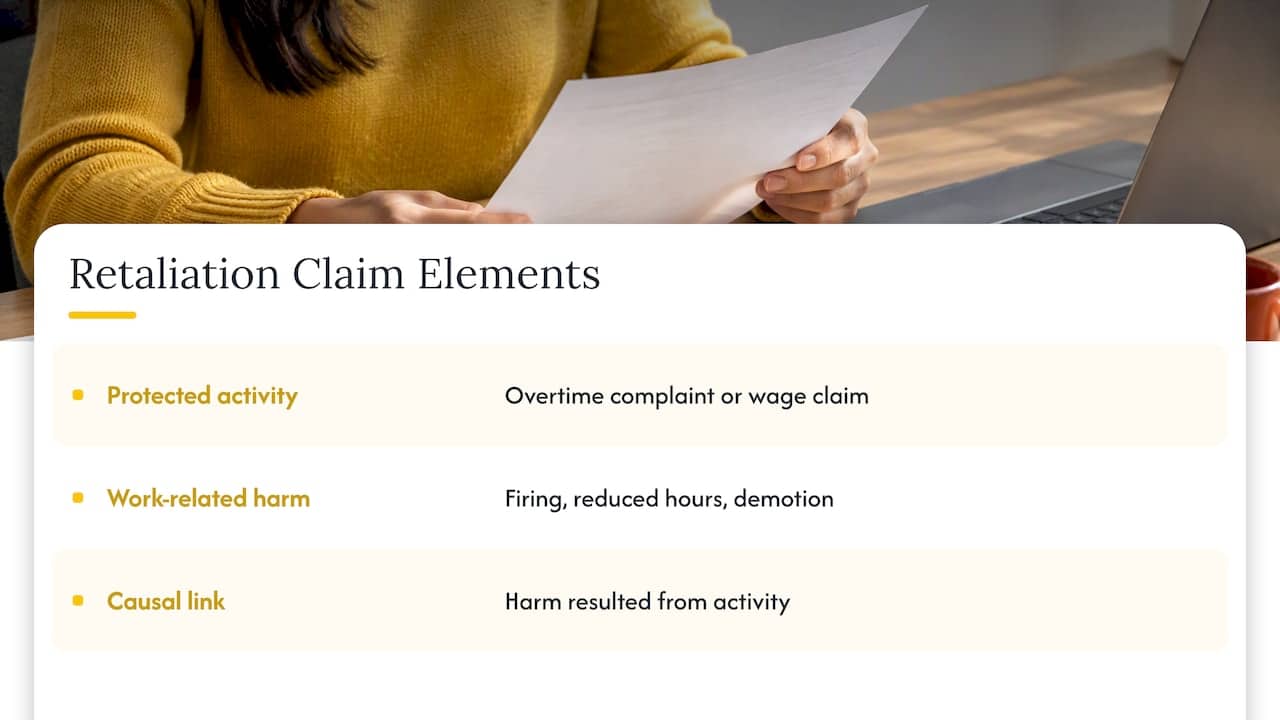
Many workers stay quiet because they fear being fired, scheduled out of hours or branded a troublemaker. California law protects you. The California Civil Rights Department explains that retaliation means punishing an employee for protected activity, and it lists demotion, firing, reduced hours and unwarranted negative evaluations as examples. To prove it, you generally show three things: you engaged in protected activity, you suffered a work-related harm, and the harm resulted from that activity.
In practice, that means asking about your overtime in writing, complaining to a supervisor, or filing a wage claim should not cost you your job. If it does, you may have a separate claim for wrongful termination on top of the wage claim. Our page on wrongful termination after reporting wage violations in Orange shows how those cases typically unfold in Orange County.
The employer is required to keep time records, but do not count on them being complete. Start your own file now:
Do not take company property or confidential documents you are not entitled to have. Copy only your own records and paperwork, and ask a lawyer if you are unsure.
If the employer did not keep proper records, you are not left without a case. Your credible, detailed estimate of hours can carry weight, which is why a consistent daily log helps so much.
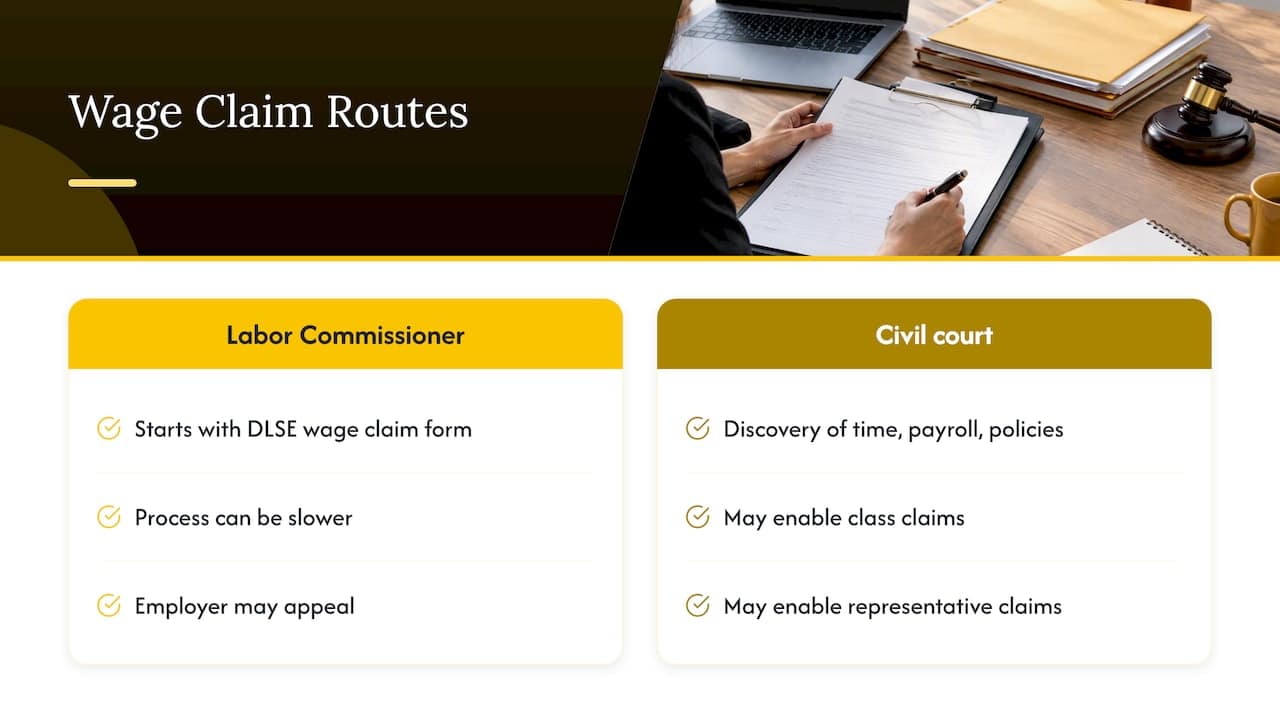
An employee in California has two main paths. According to a National Law Review summary of California’s wage enforcement system, you may file a civil action, or you may seek administrative relief through the Labor Commissioner. A wage claim with the Labor Commissioner starts with the DLSE wage claim form, where you list the amounts and types of wages, compensation and penalties you say you are owed. Garden Grove workers typically deal with the Labor Commissioner’s Santa Ana office.
The administrative route can be slower than people expect, and the employer may appeal. Court gives you access to discovery, meaning you can demand time records, payroll data and policies. It can also open the way to claims that go beyond your own paycheck, including class and representative actions if the practice affected many coworkers.
Wage claims have time limits, and different claims have different ones. A 3-year deadline applies to many unpaid overtime claims in California, and some related claims run shorter or longer. Our unpaid wages guide explains how those windows can range from two to four years. The practical rule is simple: every month you wait, older pay periods can fall out of reach. Do not try to calculate it alone if you changed jobs, were fired or had a mix of overtime and break violations.
Depending on the facts, a successful claim can include:
The exact mix depends on your records, your pay structure and how long the problem lasted. No honest lawyer can promise a number before reviewing your paystubs, and we will not.
Optimum Employment Lawyers represents employees only, never employers. We take unpaid overtime and other wage and hour cases for workers across Orange County, including Garden Grove, and we also handle related claims such as meal and rest break violations, retaliation and wrongful termination. If many coworkers were shorted the same way, we can evaluate whether a class action is the right vehicle.
We work on contingency, so you pay nothing upfront. Our published fee is 40% for a pre-trial settlement and 42% for any other win, as explained on our employment lawyer cost page. If we do not recover money for you, we do not take a fee. A short call is usually enough for us to tell you whether your hours, pay and job duties point to a claim, and you can contact our team to start the conversation.
You may also want to browse our overtime articles for examples from other Orange County cities, such as unpaid overtime in Laguna Beach or Lake Forest overtime deadlines.
No, not automatically. A salary is only one part of the exemption test. You must also meet a duties test, and for common exemptions your pay must reach at least twice the state minimum wage for a 40-hour week, which is $1,352 per week in 2026. If you spend most of your time on routine, non-managerial tasks, you may still be owed overtime.
No. The city has no separate overtime or minimum wage ordinance, so California’s Labor Code applies. That means daily overtime after 8 hours and double time after 12 hours, not just weekly overtime after 40 hours.
It is illegal for an employer to retaliate against you for raising wage concerns or filing a claim. Retaliation can include firing, cutting your hours, demoting you or giving unfair evaluations. If it happens, document it right away and speak with an employment lawyer, because you may have an additional claim.
You can still have a claim. Employers are responsible for keeping time records, and your own detailed notes, texts, schedules and paystubs can help show the hours you worked. Start a daily log now, even if you are recalling past weeks from memory.
At our firm, you pay nothing upfront. We are paid a percentage only if there is a recovery: 40% for a pre-trial settlement and 42% for other wins.

© 2026 Optimum Employment Lawyers, PC
Legal Disclaimer | Privacy Policy
 Share
