
(949) 954-8181 Free Case Review No recovery, no fee.
(949) 954-8181 Free Case Review No recovery, no fee.
If your employer in Laguna Niguel has not paid what you earned, whether that is hourly pay, overtime, final wages, commissions, or meal and rest premiums, California law gives you a clear path to recover it through the Labor Commissioner. Start by preserving your paystubs and time records, identifying your employer’s legal name, and preparing to file a DLSE wage claim. Deadlines range from two to four years depending on the violation, so acting soon protects your right to collect.
TL;DR:
- California allows three years for minimum wage, overtime, and break claims, two years for oral agreements, and four years for written contracts.
- File DLSE Form 1 with specific pay periods, add Form 55 for irregular hours or Form 155 for commissions, and submit copies, not originals.
- Keep dated personal logs of hours, breaks, tasks, and pay; the Labor Commissioner may rely on them when employer records are missing.
- Attend the required settlement conference, bring complete evidence copies again to any hearing, and note that either side has 10 days to appeal an award.
Unpaid wages cover more ground than most employees expect, and recognizing which category fits your situation shapes how you build your claim. The Labor Commissioner’s Office handles disputes over minimum wage, overtime, meal and rest break premiums, and several other violations that show up constantly in Laguna Niguel’s retail, hospitality, and gig economy jobs.
The core violations include:
A restaurant server in Laguna Niguel who works through scheduled breaks without receiving the extra hour of pay has a meal-break claim. A retail associate asked to “clock out” before finishing closing duties has a minimum wage and overtime claim. A rideshare or delivery driver misclassified as an independent contractor may have a separate misclassification issue layered on top of unpaid wages. The Labor Commissioner’s Office accepts claims across all of these categories, and identifying your specific violation early helps you gather the right evidence from the start.
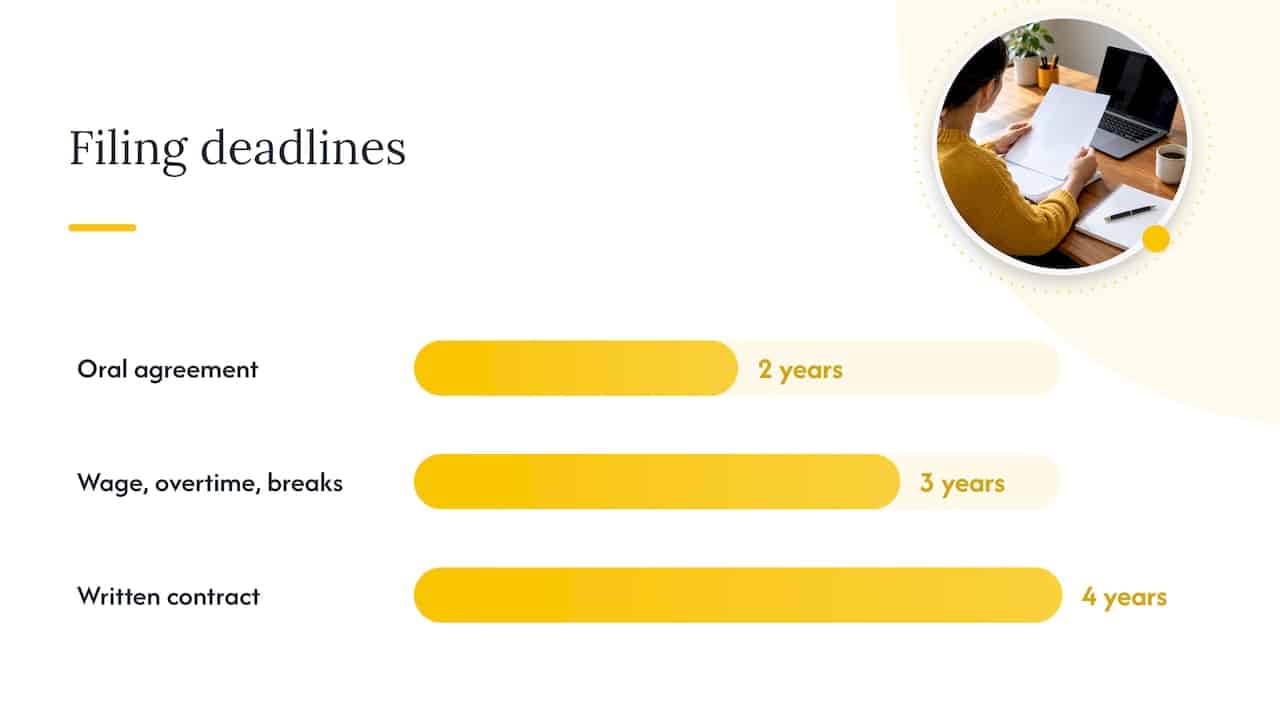
California sets different filing windows depending on the type of claim, and missing one means losing the right to recover that money entirely. The Labor Commissioner’s Office applies a three-year deadline to minimum wage, overtime, and meal or rest break violations. Claims based on an oral agreement carry a two-year window, while claims tied to a written contract extend to four years.
The deadline clock usually starts on the date of the last underpayment, not the date you discovered the problem, according to the Labor Commissioner’s Office. For final wages, the clock typically starts on your last day of work. If you were shorted overtime for a year and a half before your employer corrected the practice, your three-year window runs from the final underpaid paycheck, not from when the pay practice started.
Say you worked in Laguna Niguel from 2022 through early 2026 and your employer never paid meal-break premiums during that stretch. Your three-year window covers violations going back to roughly 2023, meaning earlier violations outside that window are no longer recoverable through this process. This is why employees who suspect a problem benefit from filing sooner rather than waiting to see if the situation improves.
Filing a claim starts with the DLSE’s Initial Report or Claim, known as Form 1, and the process is more approachable than it looks once you know the sequence.
Pro Tip: Before submitting, make a complete copy of your entire claim packet for your own records, since the hearing officer will later require you to resubmit evidence rather than relying on what you filed initially.
For employees working irregular shifts, Form 55 matters because it lets you document hours that do not fit a standard weekly schedule, which is common in hospitality and gig-adjacent roles around Laguna Niguel. Commission disputes almost always benefit from Form 155, since commission structures vary by employer and the form forces clarity on how your commission was supposed to be calculated.
Strong evidence turns a wage claim from a he-said-she-said dispute into a documented case the Labor Commissioner can act on quickly.
When employer records are incomplete or missing, your own contemporaneous log becomes critical evidence. The DLSE’s hearing guidance treats a dated, detailed hours-and-tasks journal, including start and end times, work locations, supervisor names, and what you were actually paid each period, as legitimate proof when employer documentation falls short.
Pro Tip: Start a simple daily log today, even a notes app entry, listing your hours and tasks. Six months of consistent entries carries far more weight at a hearing than a reconstructed memory.
If your employer never gave you paystubs or kept sloppy records, that gap does not disqualify your claim. It shifts weight toward your own documentation and witness statements, which is exactly why building that record early matters.
After you file, the Labor Commissioner’s process moves through a predictable sequence, and knowing what happens at each stage keeps you from being caught off guard.
If you reach a settlement at the conference stage, insist on a signed written agreement with specific payment dates, according to DLSE guidance. If your employer later violates that agreement, you can notify the deputy and move directly toward enforcement or a hearing rather than starting over. Total timelines vary by district office workload, but claimants should expect the process to unfold over several months from filing to final resolution.
Winning your claim is only half the process. California law adds penalties on top of unpaid wages specifically to discourage employers from dragging out payment.
If your employer does not voluntarily pay after an ODA, the award can be entered as a court judgment, and the DLSE brochure on recovering unpaid wages outlines collection tools including bank levies, Sheriff’s levies, and assignment to the Labor Commissioner’s Judgment Enforcement Unit. Identifying your employer’s bank, major clients, and business assets while you are still employed can materially speed up collection if you eventually need to enforce a judgment. Collection is sometimes difficult when an employer has closed, shifted assets, or operates under multiple entities, which is why naming every related business on your original claim matters.
California law prohibits employers from punishing employees for asserting wage rights, and retaliation claims carry their own protections and deadlines. Common retaliation includes termination, demotion, schedule cuts, or threats shortly after you raise a pay issue or file a claim. The Labor Commissioner’s Office handles retaliation complaints through its dedicated unit, and many retaliation claims carry a shorter filing window than standard wage claims, so prompt action matters.
California law also protects workers regardless of immigration status, and the Labor Commissioner will not ask about immigration status when you file a wage claim, so that concern should never stop someone from pursuing wages they earned.
Filing a DLSE claim on your own is possible, but having representation changes how quickly and completely you recover what you are owed. We represent employees exclusively, never employers, which means every strategy we build is aimed at getting you paid, not protecting a business’s bottom line. We work on contingency fees, so you pay nothing upfront, and we only collect a percentage once we win your case.
We bring focused attention to individual wage claims for workers across Laguna Niguel. We handle the DLSE filing, prepare you for the settlement conference, represent you at hearing, and pursue collection if your employer refuses to pay voluntarily.
What a consultation with us looks like:
If you are dealing with unpaid wages, missed overtime, or meal and rest break violations, reach out through our services page or contact us directly to start a free case review.
This article is general information, not a substitute for advice from a qualified lawyer. Consult a qualified legal professional about your own circumstances before acting on anything here.
Generally no. California law restricts deductions from wages to specific legal categories, and an employer cannot simply dock pay for suspected theft without following strict legal procedures and proving the loss through proper channels.
Yes. Paying below the legal minimum wage violates California labor law, and as of January 1, 2026, the statewide minimum wage is $16.90 per hour for all employers, though some local ordinances set higher rates.
Document your hours and pay stubs, then file a wage claim with the Labor Commissioner’s Office, which investigates minimum wage violations and can order back pay plus penalties. You can also consult an employment lawyer to evaluate your specific situation before or during the filing process.
Effective January 1, 2026, California’s statewide minimum wage is $16.90 per hour for all employers regardless of size. Some cities and counties set higher local minimum wages, so employees should check whether their specific location requires a higher rate.
We represent employees on a contingency fee basis, meaning there is no upfront cost, and we take a percentage only when we win your case. We manage the entire DLSE process, from filing through hearing and collection, so you are not navigating it alone.
These official sources cover filing procedures, deadlines, and wage figures referenced throughout this article, including the DLSE wage claim process and minimum wage rules.

© 2026 Optimum Employment Lawyers, PC
Legal Disclaimer | Privacy Policy
 Share
Share
