
(949) 954-8181 Free Case Review No recovery, no fee.
(949) 954-8181 Free Case Review No recovery, no fee.
If you clock extra hours in Laguna Niguel and don’t see time-and-a-half on your paycheck, you’re probably owed money. Most non-exempt employees are entitled to overtime under Labor Code § 510, and the fix starts now: track your hours, save your paystubs and texts, then file a wage claim or call an employment lawyer like Optimum Employment Lawyers before evidence disappears.
TL;DR:
- Employees working more than 8 hours a day in Laguna Niguel are likely entitled to 1.5 times their regular rate for overtime, even if paid a salary.
- Many workers are misclassified or asked to work off the clock, which results in unpaid overtime and requires proper documentation like paystubs.
- Unpaid overtime claims can include back wages, penalties, interest, and potentially severe penalties with PAGA, especially if violations affect multiple employees.
- Filing a claim with the DLSE is free and straightforward, but deadlines typically limit claims to three years, emphasizing the need to act quickly.
- Employers often undercalculate overtime due to omitted bonuses, shift differentials, or misapplied legal exemptions, making forensic payroll review crucial.
California doesn’t just count your weekly total. Under Labor Code § 510, a non-exempt employee earns 1.5 times their regular rate for any hours worked past 8 in a single day, not just past 40 in a week. That daily trigger catches a lot of employers who only think in weekly totals, and it’s often the first thing an attorney checks when reviewing a Laguna Niguel pay dispute.
The full breakdown looks like this:
Some employers use a legally adopted alternative workweek schedule, which can shift when daily overtime kicks in, but that arrangement requires a formal employee vote and specific IWC wage order compliance. It’s not something a manager can just declare.
Here’s what trips up a lot of workers: a salary doesn’t automatically mean you’re exempt. The employer carries the burden of proving an exemption applies, based on your actual job duties and a minimum salary threshold, not your job title. If your employer can’t prove it, you’re non-exempt, and the overtime rules above apply in full.
Misclassification is the biggest offender. Calling someone a “manager” or paying a flat salary doesn’t exempt them from overtime unless their actual day-to-day duties meet a legal test, usually involving genuine decision-making authority and limited manual labor.
Off-the-clock work is the second most common issue, and it shows up differently across industries:
Wage statements can hide the problem too. Some employers bury unpaid hours by rounding time down, misapplying meal-break deductions, or leaving bonuses and shift differentials out of the overtime rate entirely.
Pro Tip: Take a photo of your paystub every payday. If your employer “corrects” past records later, you’ll have your own timestamped copy to compare.
Once you know you’re owed overtime, the amount you can recover often includes more than just the missing hours. Depending on your situation, that can mean:
A DLSE administrative claim costs nothing to file and moves through a relatively informal hearing process. A civil lawsuit can move faster in some respects and opens the door to broader remedies, but it carries higher stakes and more procedural complexity. PAGA claims work best when the violation clearly affected other employees too, since penalties get split between you and the state.
If more than one coworker faced the same pay practice, if your pay involves commissions or bonuses that complicate the math, or if your employer retaliated after you raised the issue, that’s the point to stop guessing and get an employment lawyer involved.
Filing with the Labor Commissioner’s Office doesn’t require a lawyer, though having one review your numbers first rarely hurts. Here’s the general path:
The DLSE’s filing guidance notes that overtime claims generally must be filed within three years of the violation. When the underlying facts are complicated, such as commission-based pay or multiple job sites, some employees skip the DLSE entirely and file directly in civil court instead.
Your “regular rate” isn’t just your hourly wage. It has to include non-discretionary bonuses, commissions, and shift differentials, then get recalculated to reflect the extra pay spread across all hours worked that period, according to DLSE guidance.
Say you earn $20 an hour and also get a $100 non-discretionary weekly bonus for hitting a production target. That bonus has to be folded into your regular rate before your overtime is calculated, which pushes your true overtime rate above $30 an hour. Employers frequently skip this step and just pay 1.5 times the base hourly wage, quietly shorting every overtime hour you worked that week.
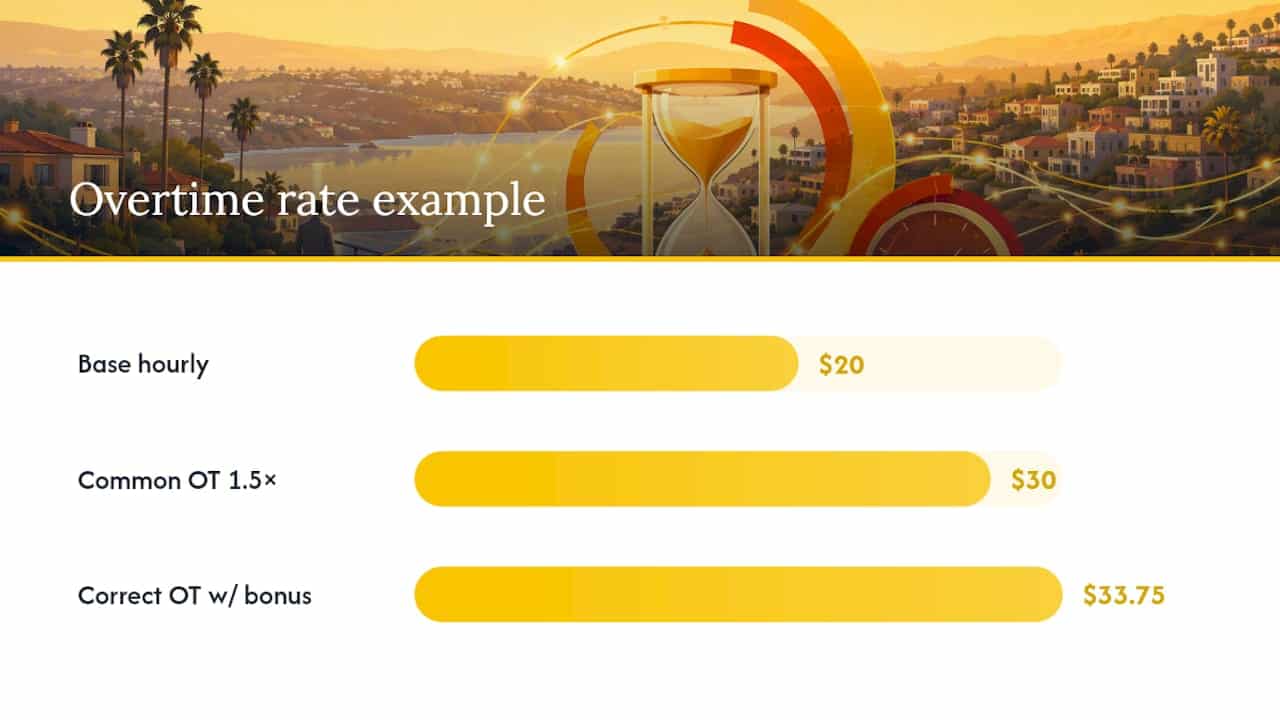
This is exactly where a forensic payroll review earns its keep, since attorneys often reconstruct the correct regular rate across months or years of pay periods to find money employers didn’t know they owed.
Pro Tip: Keep a running note of every bonus, spiff, or shift differential you received. If it wasn’t purely discretionary, it probably should have bumped your overtime rate.
Filing a wage claim is a protected activity. Under Labor Code § 98.6, your employer can’t fire, demote, or cut your hours because you complained about unpaid overtime, and if retaliation happens within 90 days of your complaint, the law shifts the burden onto the employer to prove it wasn’t retaliatory.
Deadlines matter just as much as the violation itself:
Document every complaint in writing, keep emails and texts, and don’t wait to see if things improve on their own.
Attorney Dean Ho and the team at Optimum Employment Lawyers built their practice around one focus: representing employees, never employers, in wage and hour disputes across California. That single-side focus shapes how unpaid overtime cases get handled from the first phone call.
The firm’s track record includes significant settlements in employee wage cases, the kind of result that comes from digging into payroll records most employees never think to request.
Here’s what working with the firm typically involves:
You don’t pay anything out of pocket to find out if you have a claim. Optimum Employment Lawyers reviews unpaid overtime cases on a contingency basis, which means the firm only gets paid if you recover money, so there’s no financial risk in picking up the phone.
Before you reach out, gather what you can: recent paystubs, your work schedule, any texts or emails about your hours, and rough notes on when you worked past 8 hours a day or 40 in a week. Even incomplete records are useful. Missing time logs don’t sink a claim, since a reasonable estimate often carries real weight.
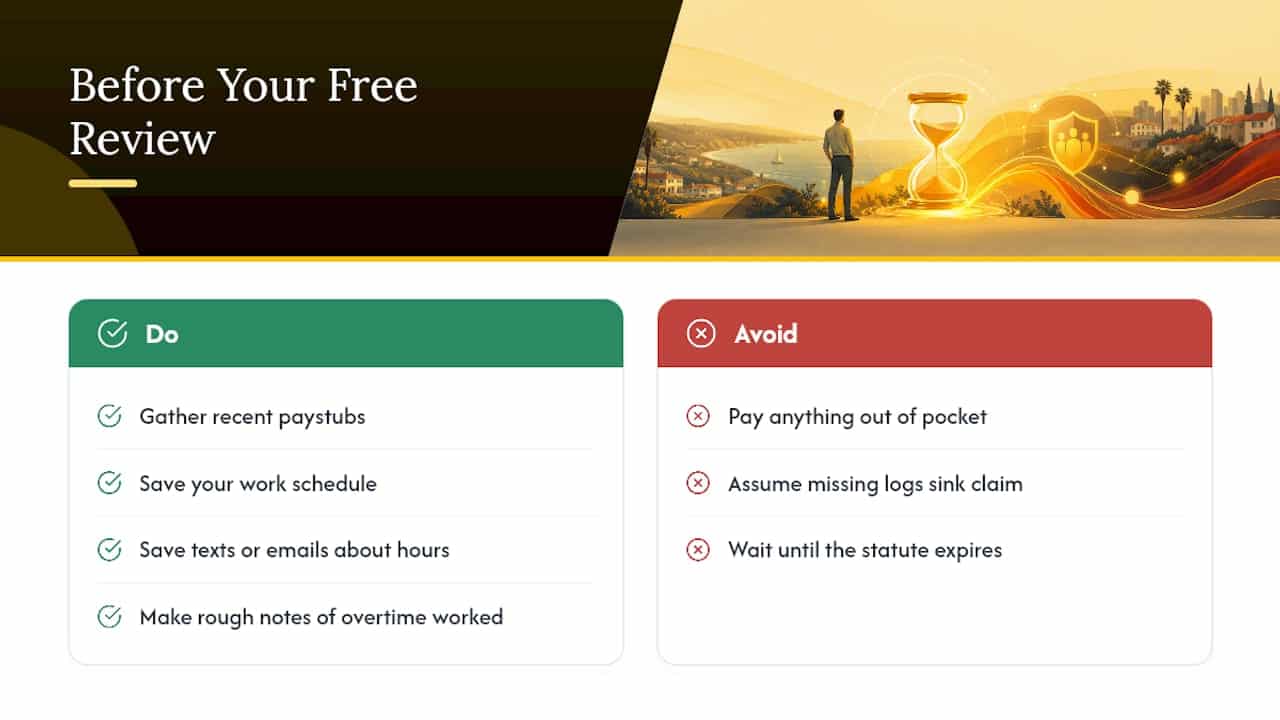
Contact Optimum Employment Lawyers for a free consultation and find out exactly what your unpaid overtime is worth before the statute of limitations closes the door.

© 2026 Optimum Employment Lawyers, PC
Legal Disclaimer | Privacy Policy
 Share
Share
