
(949) 954-8181 Free Case Review No recovery, no fee.
(949) 954-8181 Free Case Review No recovery, no fee.
Unpaid overtime is defined as compensation owed to employees who work beyond 8 hours in a day or 40 hours in a week without receiving the premium pay required by California Labor Code §510. Brea employees face this violation more often than most realize, and California law provides protections that go well beyond federal minimums. The California Division of Labor Standards Enforcement (DLSE) and the California Labor Commissioner’s Office both enforce these rules, and California overtime law gives you the right to recover every dollar you are owed. Identifying unpaid overtime in Brea starts with knowing exactly what the law requires and what your employer may be getting wrong.
Wage theft takes many forms, and most employees do not recognize it until they know what to look for. California employers violate overtime laws in predictable patterns, and understanding those patterns is the first step toward protecting yourself.
Misclassification as exempt or independent contractor. Employers sometimes label workers as salaried exempt or independent contractors to avoid paying overtime. Exempt status requires meeting strict salary and duties tests under California law. If your job duties are routine or your salary falls below the legal threshold, you may be misclassified and owed back pay.

Off-the-clock work. Pre-shift setup, post-shift cleanup, mandatory security screenings, and time spent booting up work systems all count as compensable work time. Employer timecards often exclude these tasks, which pushes actual hours worked above what payroll records show.
Incorrect regular rate calculations. California requires overtime to be calculated on your “regular rate,” which must include all non-discretionary earnings. Bonuses, commissions, and shift differentials must be factored in. Employers who exclude these amounts systematically underpay overtime premiums.
Withheld final paychecks. Failure to pay final wages promptly upon termination can trigger waiting time penalties equal to one day’s wages for up to 30 days under Labor Code §203. This is one of the most costly mistakes an employer can make.
Timekeeping manipulation. Some employers round time entries, delete clock-out records, or pressure workers to underreport hours. These practices are illegal and create the paper trail that an employment attorney can use against the employer.
Pro Tip: Keep a personal log of your start and end times every day, including any tasks you perform before clocking in or after clocking out. This record becomes critical evidence if your employer’s timekeeping is inaccurate.
Identifying a wage violation requires comparing what you were paid against what California law says you should have been paid. The process is methodical, and you can start it on your own.
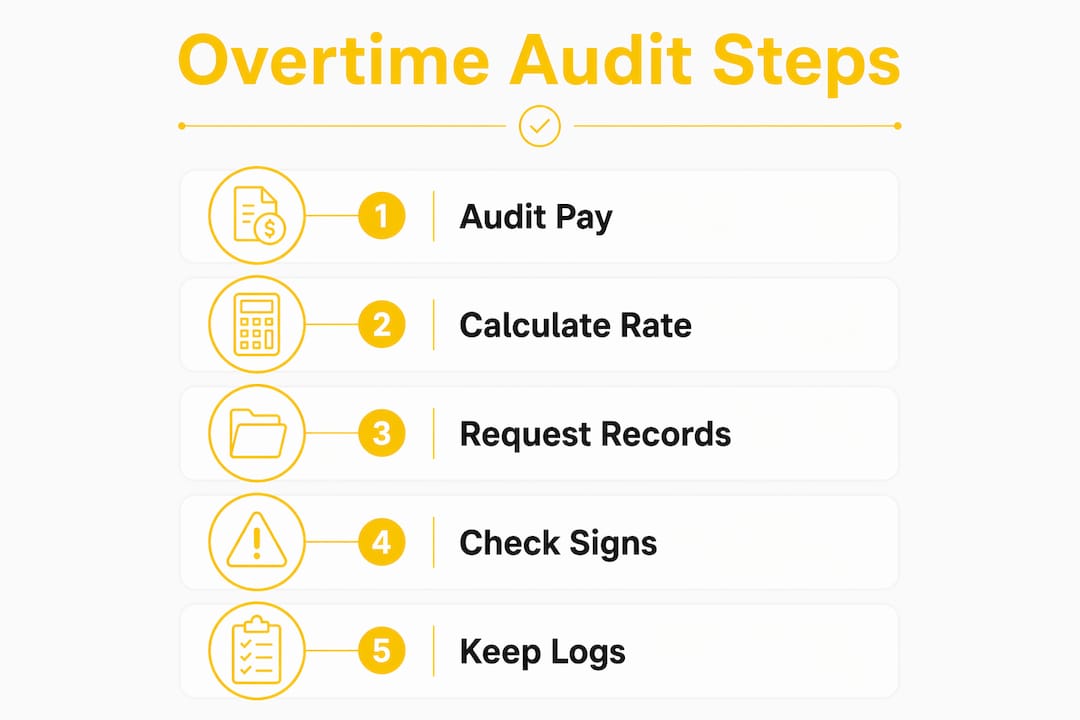
California law requires employers to provide itemized wage statements showing total hours worked, gross wages, and the applicable pay rates. Pull your pay stubs for the past three years and compare the hours listed against your own records. Look for weeks where you worked more than 40 hours or days where you worked more than 8 hours. If the pay stub does not reflect overtime premiums for those periods, you likely have a claim. Pay stub requirements under California law are specific, and any missing information is itself a violation.
Your regular rate is not simply your hourly wage. Add up all non-discretionary pay you received in a workweek, including bonuses tied to performance or production, and divide by total hours worked. That number is your regular rate. Your overtime premium should be 1.5 times that rate for hours 9–12 in a day or hours 41–plus in a week, and 2 times that rate for hours beyond 12 in a day or beyond 8 on the seventh consecutive day worked.
You have the legal right to inspect and obtain your payroll records within 21 days of submitting a written request. Accurate records showing hours worked versus pay received are the foundation of any unpaid overtime claim. If your employer refuses or delays, that refusal is itself evidence of a violation.
Courts accept employee reasonable estimates of unpaid hours when employer records are absent or incomplete, shifting the burden to the employer to disprove your estimate. Signs of incomplete records include missing punch data, rounded time entries that always favor the employer, and pay stubs that show identical hours week after week regardless of actual schedules.
The table below summarizes the California overtime pay structure you should use when auditing your wages.
| Hours worked | Overtime rate |
|---|---|
| Over 8 hours in a day (up to 12) | 1.5 times regular rate |
| Over 12 hours in a day | 2 times regular rate |
| Over 40 hours in a week | 1.5 times regular rate |
| First 8 hours on 7th consecutive day | 1.5 times regular rate |
| Over 8 hours on 7th consecutive day | 2 times regular rate |
Pro Tip: Screenshot or print your online work schedule every week before it can be edited. Employers sometimes alter digital records after a complaint is filed.
California law is more protective than federal law, and employees should not assume that company policy overrides state protections. The remedies available to Brea workers are significant.
Anti-retaliation protections. California strictly prohibits employers from retaliating against employees who report unpaid wage violations. Penalties reach up to $10,000 per employee per violation. A rebuttable presumption of retaliation applies if your employer takes adverse action within 90 days of your complaint. That presumption means the employer must prove the action was not retaliatory, which is a difficult burden to meet.
Filing a wage claim. You can file a wage claim directly with the California Labor Commissioner’s Office at no cost. The DLSE investigates claims and can order employers to pay back wages, interest, and penalties. For Brea residents, the nearest Labor Commissioner office is in Santa Ana, which handles Orange County cases.
Statutes of limitations. The time limits for wage claims in California are:
2026 employer notice requirements. California’s 2026 employment laws now mandate that employers provide annual written workplace rights notices to all employees. Employers who fail to comply face increased penalties. If you never received this notice, your employer may already be in violation.
Employer liability for known work. Employers are liable for overtime whenever they have actual or constructive knowledge that you worked extra hours, even without explicit approval. A supervisor who sees you working late cannot later claim the company did not know about those hours.
California law places the burden on employers to maintain accurate records. When those records are missing or manipulated, courts side with the employee’s reasonable estimate of hours worked.
Acting quickly and methodically protects your claim and your job. Follow these steps in order.
Gather your evidence first. Collect pay stubs, personal time logs, text messages about work hours, emails scheduling tasks outside your shift, and any written communications about pay. Do this before filing any complaint, because employers sometimes destroy records after a claim is filed.
Submit a written payroll records request. Send a written request to your employer’s HR department asking for your complete payroll records. Keep a copy of the request and note the date you sent it. The employer has 21 days to comply.
File a wage claim with the California Labor Commissioner. You can file online through the DLSE’s website or in person at the Santa Ana office. The claim is free to file, and the Labor Commissioner can recover unpaid wages, interest, and penalties on your behalf.
Consult a California employment attorney. A wage claim through the Labor Commissioner is one option, but a civil lawsuit often recovers more. An attorney can pursue attorney’s fees under California Labor Code §1194, which means your legal costs may be covered if you win. Employees-lawyer has recovered significant settlements for California workers, including $2.2 million in a class action involving missed meal breaks.
Protect yourself from retaliation. Document any change in your treatment after you file a complaint. Write down dates, times, and what was said or done. If your employer cuts your hours, demotes you, or terminates you within 90 days of your complaint, whistleblower protections under California law apply immediately.
Know your rights under 2026 pay transparency rules. Employers who fail to comply with new pay transparency laws face increased penalties. If your employer has not provided the required annual notice of your workplace rights, document that failure as part of your claim.
California employees in Brea who work beyond 8 hours in a day or 40 hours in a week are entitled to overtime premiums under Labor Code §510, and any employer who fails to pay those premiums is committing wage theft that California law actively penalizes.
| Point | Details |
|---|---|
| Daily and weekly overtime rules | California requires 1.5x pay after 8 daily hours and 2x pay after 12 daily hours. |
| Regular rate includes all earnings | Bonuses and commissions must be included when calculating your overtime rate. |
| Payroll records access | You can legally request your payroll records and must receive them within 21 days. |
| Anti-retaliation protection | Adverse action within 90 days of a complaint creates a presumption of illegal retaliation. |
| Time limits matter | Most California wage claims must be filed within three to four years of the violation. |
Employees-lawyer, operating as Optimum Employment Lawyers, focuses exclusively on employee-side cases throughout California, including workers in Brea and across Orange County. The firm has a documented record of results, including a $2.2 million class action settlement for missed meal breaks. If you believe your employer has shorted your overtime pay, misclassified your role, or manipulated your time records, the attorneys at Employees-lawyer can review your situation and explain your options. Getting a professional assessment of your unpaid wages claim early gives you the clearest picture of what you are owed. Contact an employment lawyer in California to schedule a free case review and find out what your claim may be worth.
California requires 1.5 times your regular rate for hours worked beyond 8 in a single day, and 2 times your regular rate for hours beyond 12 in a day, under Labor Code §510.
No. California law prohibits retaliation and imposes penalties up to $10,000 per employee per violation, with a rebuttable presumption of retaliation if adverse action occurs within 90 days of your complaint.
California employees generally have three years to file a wage claim under the Labor Code and up to four years under the Unfair Competition Law, so past violations may still be recoverable.
Yes. Non-discretionary bonuses, commissions, and shift differentials must be included in your regular rate calculation, which then determines the correct overtime premium your employer owes you.
Courts accept your reasonable estimate of hours worked when employer records are incomplete or missing, and the burden shifts to the employer to disprove your account.

© 2026 Optimum Employment Lawyers, PC
Legal Disclaimer | Privacy Policy
 Share
Share
