
(949) 954-8181 Free Case Review No recovery, no fee.
(949) 954-8181 Free Case Review No recovery, no fee.
California law is unambiguous: firing an employee for reporting wage violations is illegal. Under California Labor Code Section 98.6, employers cannot retaliate against workers who complain about unpaid wages, file claims with the Labor Commissioner, or even discuss their pay with coworkers. If you work in Orange, Irvine, or Santa Ana and your employer fired you after you raised a wage concern, you likely have a strong legal claim.
Wrongful termination in this context means your employer fired you, or took another serious adverse action against you, because you exercised a protected right related to wages. California Labor Code Section 98.6 is the primary shield here. It covers a broad range of protected activities:
Retaliation does not have to mean termination. Demotion, suspension, a pay cut, a reduction in hours, or even threats all count as adverse employment actions under the law. Employers who violate Section 98.6 face civil penalties of up to $10,000 per violation. Workers in Orange, Irvine, and Santa Ana are covered by these statewide protections, with no local carve-outs that weaken them.

Retaliation rarely arrives as an obvious, immediate firing. More often, it builds gradually. A supervisor starts scheduling you for fewer hours. You get passed over for a promotion you were clearly in line for. Suddenly your performance reviews turn negative, even though nothing about your work changed. These shifts, taken together, can constitute unlawful retaliation under California law.
The California Labor Commissioner’s Office defines “adverse action” broadly. Any significant change in your employment that would discourage a reasonable person from exercising their workplace rights qualifies. That includes:
One of the most powerful tools in California employment law is the rebuttable presumption under Labor Code Section 98.6. If your employer takes an adverse action within 90 days of your protected activity, the law automatically presumes that action was retaliatory. The burden then shifts to your employer to prove otherwise. That is a significant legal advantage for employees.
Pro Tip: Start a private log the moment you report a wage issue. Write down dates, times, who was present, and exactly what was said. Note any changes in your schedule, assignments, or treatment, no matter how minor they seem. A detailed timeline is often the difference between a provable claim and an unprovable one.

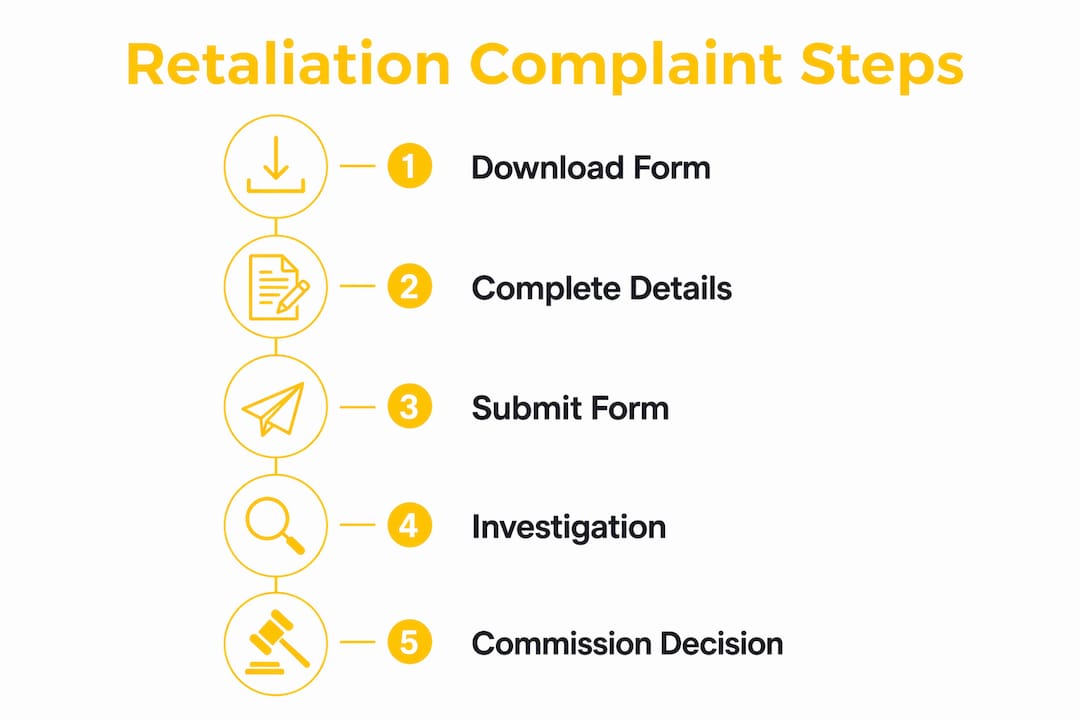
You do not need a lawyer to start this process. The Labor Commissioner’s Retaliation Complaint Investigation Unit (RCI) investigates claims at no cost to the employee. Here is how the process works:
Step 1: Download or request Form RCI-1. The retaliation complaint form is available on the California Department of Industrial Relations website. You can also pick one up at any Labor Commissioner’s Office location.
Step 2: Complete the form clearly and concisely. Describe the adverse action, the protected activity that preceded it, and how your employer knew about your activity. Investigators process claims faster when the core facts are stated plainly. Lengthy legal arguments are not necessary and can actually slow things down.
Step 3: Gather supporting documentation before you file. Useful evidence includes:
Step 4: Submit the form. You can file in person at a local Labor Commissioner’s Office, by mail, or through the online filing portal. After filing, an investigator will contact you, interview relevant parties, and prepare a written report for the Labor Commissioner to review.
The Labor Commissioner will send you a written decision by mail. If the decision goes in your favor, your employer must comply within ten days or face a court action filed by the Labor Commissioner’s own attorneys.
Filing deadlines under California law vary depending on which statute applies to your situation. Missing a deadline can cost you your administrative remedy, so timing matters.
“If an employer engages in any action prohibited by this section within 90 days of the protected activity specified in this section, there shall be a rebuttable presumption in favor of the employee’s claim.” — California Labor Code Section 98.6
The 2023 California Supreme Court decision in People ex rel. Garcia-Brower v. Kolla’s, Inc. (Case No. S269456) expanded these protections significantly. In that case, a bartender at a nightclub in Orange County complained to her employer about three shifts of unpaid wages. Her employer fired her and threatened to report her to immigration authorities. The Supreme Court held that internal complaints to an employer are protected disclosures under Labor Code Section 1102.5(b), even when the employer already knew about the violation. That ruling closed a loophole that had left many workers unprotected.
If you miss the administrative deadline, you may still have the option to file a private lawsuit. Consulting an employment attorney promptly is the best way to preserve all available options.
Available remedies, when retaliation is proven, include:
Employees in Orange, Irvine, and Santa Ana operate under the same California state protections as workers anywhere in the state. There are no local ordinances in these cities that weaken whistleblower protection laws, and local attorneys who handle wage and hour retaliation cases bring familiarity with regional employers and local court practices.
If you believe you were wrongfully terminated after reporting wage violations, take these steps immediately:
The Kolla’s case is a useful illustration of what can happen when an employee acts. A.C.R., the bartender in that Orange County case, filed her complaint with the DLSE in June 2014 after being fired and threatened. The Labor Commissioner pursued remedies including reinstatement, lost wages, and civil penalties. The California Supreme Court ultimately ruled in her favor in 2023, nearly a decade later. Starting the process early, with solid documentation, is what makes that kind of outcome possible.
Pro Tip: When you receive a termination notice or any written adverse action, respond in writing within a few days. Keep your response factual and brief. Simply note that you believe the action is connected to your recent wage complaint. That written record can be critical evidence later.
California employees are legally protected from retaliation after reporting wage violations, and the rebuttable presumption under Labor Code Section 98.6 makes these claims among the strongest in employment law.
| Point | Details |
|---|---|
| Core legal protection | California Labor Code Section 98.6 prohibits retaliation for reporting wage violations, covering termination and all adverse actions. |
| Rebuttable presumption | Adverse action within 90 days of your protected activity shifts the burden of proof to your employer. |
| Filing deadline | Most retaliation complaints must be filed within one year of the adverse action with the Labor Commissioner’s Office. |
| Available remedies | Proven retaliation can result in reinstatement, back pay, personnel file corrections, and civil penalties. |
| Local legal support | Optimum Employment Lawyers represents employees in Orange, Irvine, and Santa Ana on wrongful termination and wage retaliation claims. |
If you were fired or demoted after reporting a wage issue, you do not need to navigate California employment law alone. Optimum Employment Lawyers represents employees exclusively, never employers, and focuses specifically on cases like yours: wrongful termination, wage theft retaliation, and whistleblower claims across Orange County, including Orange, Irvine, and Santa Ana. The firm has secured results like a $2.2 million class action settlement for missed meal breaks, and brings that same aggressive approach to individual retaliation cases. You get an attorney who understands the rebuttable presumption, knows the local courts, and works solely on your side. Contact Optimum Employment Lawyers today to discuss your situation and find out what your claim may be worth.

© 2026 Optimum Employment Lawyers, PC
Legal Disclaimer | Privacy Policy
 Share
Share
