
(949) 954-8181 Free Case Review No recovery, no fee.
(949) 954-8181 Free Case Review No recovery, no fee.


If you work in Fountain Valley and your employer fired, demoted, cut your hours or froze you out after you reported something illegal, California law probably protects you. Labor Code section 1102.5 bars retaliation against employees who disclose suspected violations of state or federal law. This guide explains what counts as protected whistleblowing, how retaliation shows up, how a claim is proved, which deadlines apply, and what to do this week to protect yourself.
Many people assume a whistleblower is someone who goes to the press or the government. California is broader. Under section 1102.5, an employer may not retaliate against you for disclosing information to a government or law enforcement agency, to a person with authority over you, or to someone with authority to investigate the matter, as long as you have reasonable cause to believe the information reveals a violation of a law or regulation. You do not have to be right. You have to be reasonable.
The statute also bars employers from adopting or enforcing any rule or policy that stops you from making those disclosures. A confidentiality clause that tries to gag you from reporting to a regulator is itself a problem.
In practice, a Fountain Valley employee might be protected after:
If your report was about unpaid wages, the protection overlaps with wage and hour law. The firm’s page for Fountain Valley employees explains how those claims often travel together with retaliation.
Termination is the obvious form. It is rarely the first. Retaliation often builds slowly, which is why it is easy to dismiss as a bad stretch rather than a legal problem.
The Labor Commissioner’s guidance describes protection for employees who are discharged, threatened with discharge, demoted, suspended or otherwise discriminated or retaliated against in the terms and conditions of employment for engaging in protected activity. Federal safety guidance goes further and notes that retaliation includes subtler conduct such as isolation, ostracizing, mocking and false accusations about performance meant to intimidate or silence an employee.
Common patterns include:
None of these is automatically illegal. A schedule change can be a genuine business decision. What turns it into a claim is the link to your protected report, which is where timing, documents and witnesses matter.
This is the question people ask most: how does an employee prove retaliation? California’s whistleblower statute is more employee-friendly than many expect.
Under Labor Code section 1102.6, you first need to show by a preponderance of the evidence, meaning more likely than not, that your protected activity was a contributing factor in the action taken against you. Then the burden moves to your employer, who must prove by clear and convincing evidence that it would have taken the same action for legitimate, independent reasons even if you had never spoken up.
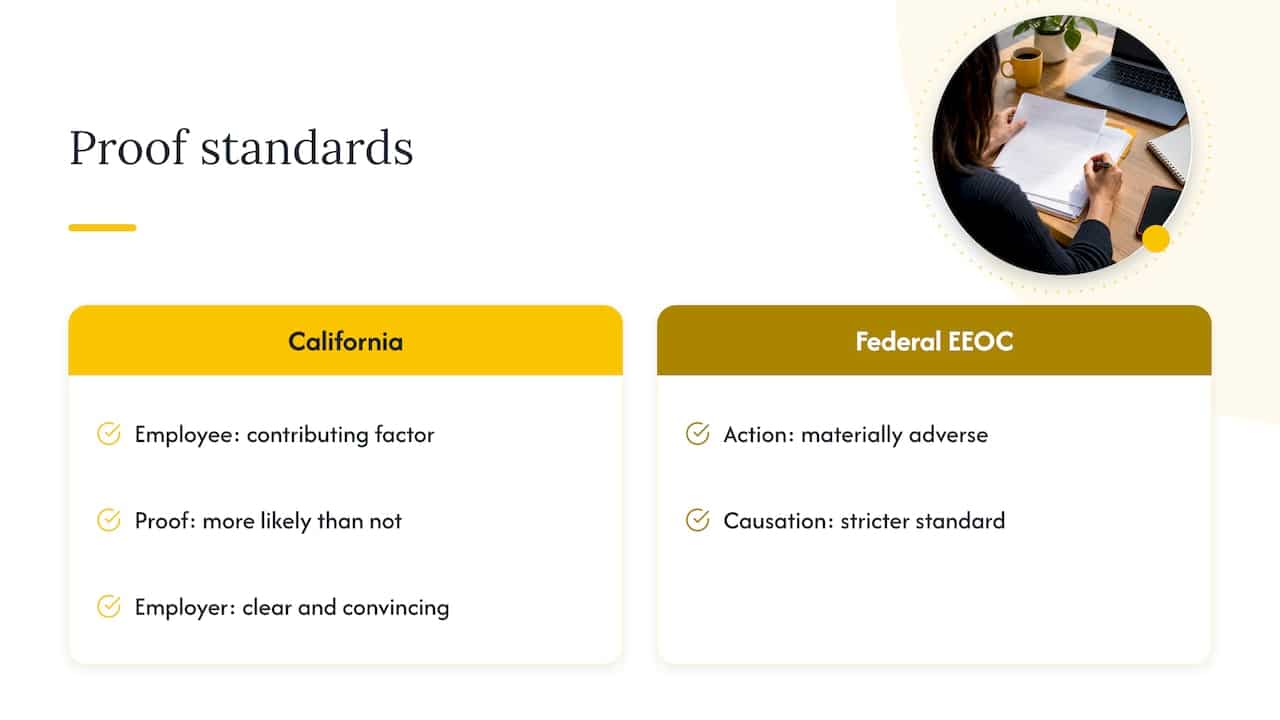
That is a different test from the one used in many federal discrimination and retaliation cases. The EEOC’s guidance explains that under the anti-discrimination laws it enforces, retaliation requires a materially adverse action taken because of protected activity, and that causation standard is stricter. If your complaint was about discrimination or harassment rather than a broader legal violation, a different framework may apply, and our article on discrimination retaliation for California employees walks through it.
| What you need to show | Evidence that helps |
|---|---|
| You made a protected report | Emails, texts, HR tickets, hotline submissions, agency complaint confirmations |
| Your employer knew | Replies, meeting invitations, an investigator’s interview request, witnesses who heard you |
| You suffered an adverse action | Termination letter, schedule history, pay records, demotion notices, comparison with peers |
| The two are connected | Timeline, shifting explanations, sudden criticism after years of good reviews |
Timing is not everything, but a negative action days or weeks after a complaint gets attention. Inconsistent explanations from the employer get even more. If the stated reason for your termination changes between the meeting, the paperwork and the response to an agency, that is worth noting.
Our page on preserving evidence in a Fountain Valley family leave retaliation matter gives a longer checklist that applies to whistleblower situations too.
You generally have more than one path, and they can be combined or sequenced depending on your facts.
The Labor Commissioner’s Office accepts retaliation complaints from employees, former employees and applicants. Its retaliation complaint procedure states that the investigator acts as a neutral fact-finder, not as your attorney, and cannot give you legal advice. The investigator interviews both sides and witnesses, and witness identities are kept confidential unless disclosure is required for a court action. Parties may bring legal counsel to any hearing and may subpoena witnesses and documents.
The same page says that if a violation of section 1102.5 is found, the employer may be ordered to provide reinstatement, back wages and interest, and may face civil penalties of up to $10,000 per violation payable to the employee, with a further $10,000 per violation payable to the State for corporate employers. The agency also publishes instructions on how to file a retaliation complaint.
An agency complaint is not the end of the road. According to the Labor Commissioner’s FAQ, if the agency dismisses a complaint after investigating, you keep the right to sue your employer in civil court. A lawsuit lets a lawyer gather evidence through discovery, depose managers and present the case to a jury, which is often where the leverage in settlement negotiations comes from.
If your report involved workplace safety, federal law gives you a separate route. OSHA explains that employees can file a whistleblower complaint with OSHA if they believe they were retaliated against for raising safety and health concerns. Our page on health and safety retaliation in Brea covers that scenario in detail, and the same principles apply in Fountain Valley.
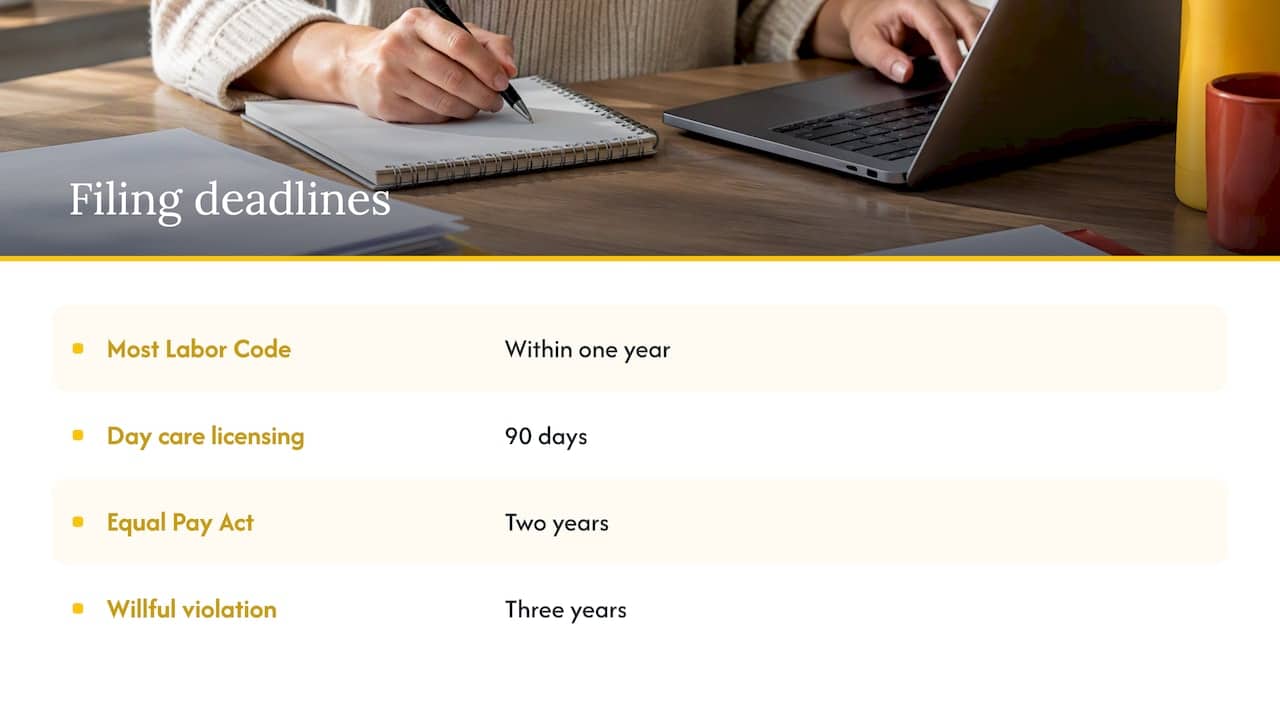
The Labor Commissioner states that most Labor Code retaliation complaints must be filed within one year of the adverse action. There are exceptions: 90 days for child day care licensing retaliation, and a longer period for Equal Pay Act violations (two years, or three if willful). Deadlines for court claims can differ from agency deadlines and depend on which laws your case rests on, so treat the one-year figure as an outer boundary for the agency route, not a comfortable cushion. The earlier a lawyer sees your documents, the more options remain.
Fountain Valley sits in the heart of Orange County, surrounded by Costa Mesa, Huntington Beach, Santa Ana and Garden Grove. Workers here commute across city lines, and employers in healthcare, logistics, retail, restaurants and professional offices all draw from the same labor pool. Retaliation does not depend on the size of the employer: a small shop that cuts the hours of the one person who asked about overtime is covered by the same statute as a large corporation.
Cases with the best footing tend to share a few features:
Cases get harder when the only evidence is a verbal conversation nobody else heard, when the employee has a long record of documented performance problems that pre-date the report, or when the report was made after a termination decision was already communicated. Those are not necessarily dead ends, but a lawyer should assess them early.
A large share of retaliation cases begin with a pay question. An employee asks why overtime was not paid, why meal breaks are skipped or why a paycheck was short. The question itself is protected, and what follows can be a second claim layered on the first. The firm’s own record includes a $2.2 million class action settlement involving missed meal breaks, and we regularly see that the person who raised the issue is the one who gets punished.
If that is your situation, the retaliation claim and the underlying wage claim should be evaluated together. Settling one while ignoring the other can leave money on the table.
Optimum Employment Lawyers represents employees only, never employers. Our services include retaliation and wrongful termination, whistleblower retaliation, wage and hour claims, discrimination, harassment, contract and severance review, and class actions. We take the personal side seriously: losing a job after doing the right thing is a professional and an emotional hit, and we treat it that way.
We work on contingency, so you pay nothing upfront. Our published fee is 40% for a pre-trial settlement and 42% for any other win, and the details are on our page about what an employment lawyer costs. If you are in Fountain Valley and want a confidential read on your situation, contact us. For more background, our whistleblower and retaliation protections guide covers the statewide rules, and our whistleblower and retaliation archives collect related articles.
Yes. Labor Code section 1102.5 prohibits employers from retaliating against employees who disclose, or who are believed to have disclosed, information they reasonably believe shows a violation of law. The protection covers reports made to government agencies, to supervisors and to internal investigators.
Yes, under both state and federal law, depending on the subject of the report. A violation can lead to reinstatement, back pay and civil penalties of up to $10,000 per violation under California’s Labor Commissioner process. Which law applies depends on what you reported.
Build a dated timeline, keep your written reports and any replies, and note changes in your schedule, duties, pay or treatment after you spoke up. Under California’s statute, you need to show your report was a contributing factor, and then your employer must prove it would have acted the same way anyway. A lawyer can tell you quickly whether your facts meet that standard.
Yes. The Labor Commissioner’s FAQ says you keep the right to pursue a private lawsuit in civil court. Dismissal by the agency does not decide your case on the merits in court.
With our firm, nothing upfront. We are paid a percentage of a settlement or award: 40% for a pre-trial settlement and 42% for any other win.

© 2026 Optimum Employment Lawyers, PC
Legal Disclaimer | Privacy Policy
 Share
