
(949) 954-8181 Free Case Review No recovery, no fee.
(949) 954-8181 Free Case Review No recovery, no fee.
If you reported suspected illegal activity at work, or refused to carry out an order you believed broke the law, California’s Labor Code §1102.5 likely protects you. That protection covers Costa Mesa employees the same way it covers workers anywhere else in the state, and it comes with real teeth: SB 497’s 90 day rebuttable presumption shifts the legal burden onto your employer if they punished you within three months of your report, and Section 1102.6’s contributing factor standard means you don’t have to prove retaliation was the only reason you got fired or demoted, just that it played a part.
Here’s what to do in the next 48 hours, regardless of how strong you think your case is:
Costa Mesa employees who report suspected illegal conduct or refuse unlawful orders are protected under Labor Code §1102.5, and documenting the timeline immediately is the single most important step toward a strong claim.
| Point | Details |
|---|---|
| Reasonable belief is enough | You don’t need proof the law was actually broken, just a good faith belief that it was. |
| Timing drives your case | Adverse action within 90 days of your report triggers a rebuttable presumption of retaliation under SB 497. |
| Deadlines vary by employer type | Civil claims allow roughly three years, but public employees may face a six month government claim deadline. |
| Remedies go beyond your job back | Back pay, front pay, emotional distress damages, and penalties up to $10,000 per violation are all available. |
| Get a confidential evaluation early | Optimum Employment Lawyers offers free case reviews and works on contingency, including a past $2.2 million settlement. |
Not every complaint at work counts as protected whistleblowing, but the bar is lower than most people assume. Labor Code §1102.5 protects employees who disclose information to a supervisor, an internal compliance department, a government agency, or a public body conducting an investigation or hearing, as long as you have reasonable cause to believe the information reveals a violation of law. It also protects you if you refuse to participate in an activity that would result in a legal violation, even if your employer never actually broke the law.
You don’t need to file a formal grievance or invoke a specific statute by name. According to the California Civil Rights Department’s retaliation factsheet, a clear, dated statement to someone with authority, saying you believe something unlawful is happening, is enough to trigger protection. A good faith mistake about whether the law was actually violated doesn’t cost you coverage.
Protected activity includes:
One detail catches people off guard: you can be protected even if you’re not the one who reported the violation. Employees mistakenly believed to be whistleblowers, and in some cases family members of an actual whistleblower, have been found to fall under retaliation protections as well.
Statistic to know: the same statute that protects your report also allows courts to impose civil penalties of up to $10,000 per violation against an employer, on top of other damages according to California law.
Proving retaliation comes down to three elements: you engaged in protected activity, your employer took an adverse action against you, and there’s a connection between the two. Adverse actions aren’t limited to firing. Demotions, sudden schedule cuts, exclusion from meetings you used to attend, a poor performance review that appears out of nowhere, or even subtle threats can all qualify.
Here’s the sequence that typically plays out once a claim is filed:
The California Supreme Court’s clarification of §1102.6 confirmed this contributing factor framework governs §1102.5 cases, and it’s a notably easier standard for employees than the older McDonnell Douglas test used in many other discrimination claims.
Timing does a lot of the heavy lifting here. If your employer disciplined you within 90 days of your report, SB 497 creates a rebuttable presumption of retaliation, meaning the burden falls on them to explain it away. Inconsistent discipline (like being written up for something coworkers do routinely) and hostile comments referencing your report both strengthen circumstantial evidence.

Employers commonly argue the adverse action was tied to a pre-existing performance issue or a company-wide layoff. Look closely at whether that explanation lines up with the actual timeline.
Pro Tip: If your performance reviews were positive right up until you made your report, and then suddenly turned negative, save both versions. That contrast is often the single most persuasive piece of evidence in a retaliation case.
The strength of a retaliation claim usually comes down to what you can prove, not just what you remember. Start gathering material the moment you suspect retaliation, before access to company systems disappears.
Build a simple dated chronology as you go. A one-page timeline listing each date, what happened, and who was present holds up far better in a legal review than scattered memories months later.
California is a two-party consent state for recording private conversations, so don’t record coworkers or supervisors without checking with an attorney first. A recording made illegally can hurt your case rather than help it. Keep every written communication professional, even when you’re frustrated, since anything you write can surface later as evidence.
Pro Tip: Once you sense retaliation is underway, stop trying to resolve it entirely on your own. Repeated internal complaints without legal guidance sometimes give an employer more opportunities to build a paper trail against you.
California law gives whistleblowers access to several forms of relief, and the right combination depends on how the retaliation affected your income, your career, and your well-being.
In cases involving particularly egregious employer conduct, punitive damages may also be on the table, and it’s common to pursue several of these remedies at once rather than choosing just one.
Because contingency-fee representation means you pay nothing upfront, the fee comes as a percentage of what you recover, cost usually isn’t the barrier people assume it is. Optimum Employment Lawyers has represented California employees on this exact model, including a $2.2 million settlement in a class action involving missed meal breaks, evidence that aggressive, employee-focused representation can produce real financial outcomes.
You generally have three paths, and they’re not mutually exclusive: an administrative complaint with a state agency, a civil lawsuit, or both pursued at the same time. Civil claims under §1102.5 typically must be filed within roughly three years of the retaliatory act, but some remedies carry shorter windows, and public sector employees in Costa Mesa often face a much tighter deadline, sometimes a much shorter deadline under specific public sector rules, such as six months, under the California Tort Claims Act.
Missing a deadline is one of the most common ways employees lose an otherwise strong case, so don’t wait to find out which clock applies to you.
A practical starting sequence looks like this:
Before you file anything, it helps to have a professional review the specifics of your case.
Optimum Employment Lawyers offers a free confidential case evaluation for Costa Mesa employees weighing whether to move forward, a low-risk way to find out where you stand before any deadline closes in.
Where you work changes the procedural map more than most employees expect. If you work for a private employer in Costa Mesa, retaliation protections under §1102.5 apply directly, and you can generally go straight to an administrative complaint or civil lawsuit within the standard filing windows described above.
Public employees, including those working for the City of Costa Mesa or other government agencies in Orange County, face an added procedural layer. Claims against a public entity typically require filing a government claim under the California Tort Claims Act first, often within six months of the retaliatory act, before you can proceed to civil court. Skip that step, and a court can dismiss an otherwise valid claim regardless of its merits.
Public sector whistleblowers also frequently have overlapping protections through civil service rules, employee handbooks, or specific statutes covering government employees, in addition to §1102.5. That can work in your favor, since it sometimes means multiple avenues for relief exist simultaneously.
Private sector employees, by contrast, may have collective bargaining agreements or arbitration clauses in their employment contracts that route disputes into a different process entirely before litigation is even an option. Reviewing your offer letter or employee handbook early tells you which track applies, and it’s a detail worth raising during any legal consultation rather than discovering after a deadline has already passed.
California’s §1102.5 doesn’t operate in isolation. Depending on your industry and the type of misconduct you reported, federal protections may run alongside state law, sometimes offering longer filing windows or different remedies entirely.
The Sarbanes-Oxley Act protects employees of publicly traded companies who report securities fraud, accounting irregularities, or violations of SEC regulations. If you work for a publicly traded company with operations in Costa Mesa and reported financial misconduct, Sarbanes-Oxley claims typically route through the Department of Labor’s Occupational Safety and Health Administration before you can sue in federal court.
Dodd-Frank goes further for securities-related whistleblowers, offering monetary awards to people who report violations directly to the SEC, along with anti-retaliation protections that in some respects are broader than Sarbanes-Oxley’s.
Other federal statutes cover narrower situations: the False Claims Act protects those who report fraud against the government, and OSHA’s whistleblower provisions cover safety-related reports across more than twenty different federal statutes.
The practical takeaway is that your situation might qualify under both state and federal law at once, and each comes with its own deadlines, agencies, and procedural quirks. An employment attorney can typically spot which federal statutes apply to your reported conduct in a single conversation, which matters because federal deadlines are frequently shorter and less forgiving than California’s three-year window.
Not every employment lawyer handles whistleblower cases the same way, and the questions you ask during an initial consultation tell you a lot about fit before you sign anything.
Look for an attorney who focuses specifically on employee-side representation rather than one who splits time defending employers, since the strategic instincts differ. Ask how many retaliation cases they’ve handled under §1102.5 specifically, not just wrongful termination generally, and ask them to walk through how they’d evaluate the timing and causation evidence in your situation.
Questions worth asking directly:
Contingency arrangements mean the attorney only gets paid if you recover money, so their incentives line up with yours from day one. That structure also means a reputable firm will tell you honestly if your facts don’t support a strong claim, rather than stringing you along.
Optimum Employment Lawyers works exclusively on the employee side across California, including Costa Mesa, and offers case evaluations at no upfront cost specifically so you can get that honest read before committing to anything.
Filing a complaint isn’t risk-free, and it helps to go in with clear eyes about what might follow. Some employers respond to a whistleblower complaint by escalating scrutiny of your work, documenting minor issues that were previously ignored, or making the workplace uncomfortable enough that you consider leaving on your own.
That escalation is itself illegal if it’s connected to your protected activity, but proving the connection takes documentation, which is exactly why building your timeline early matters so much.
There’s also a practical employment reality to weigh: even a legally airtight case can be stressful to live through while it’s ongoing, and some employees find it easier to search for a new position during the process rather than waiting for resolution before moving on. That’s a personal decision, not a legal requirement, and pursuing a claim doesn’t obligate you to stay in a hostile environment.
On the other side of the ledger, employers who retaliate expose themselves to real financial consequences: back pay, statutory penalties, and attorney’s fees add up quickly, which is part of why many retaliation cases settle rather than go to trial. Knowing that dynamic exists doesn’t guarantee a fast resolution, but it does mean your employer has genuine incentive to avoid a prolonged legal fight once a well-documented claim is on the table.
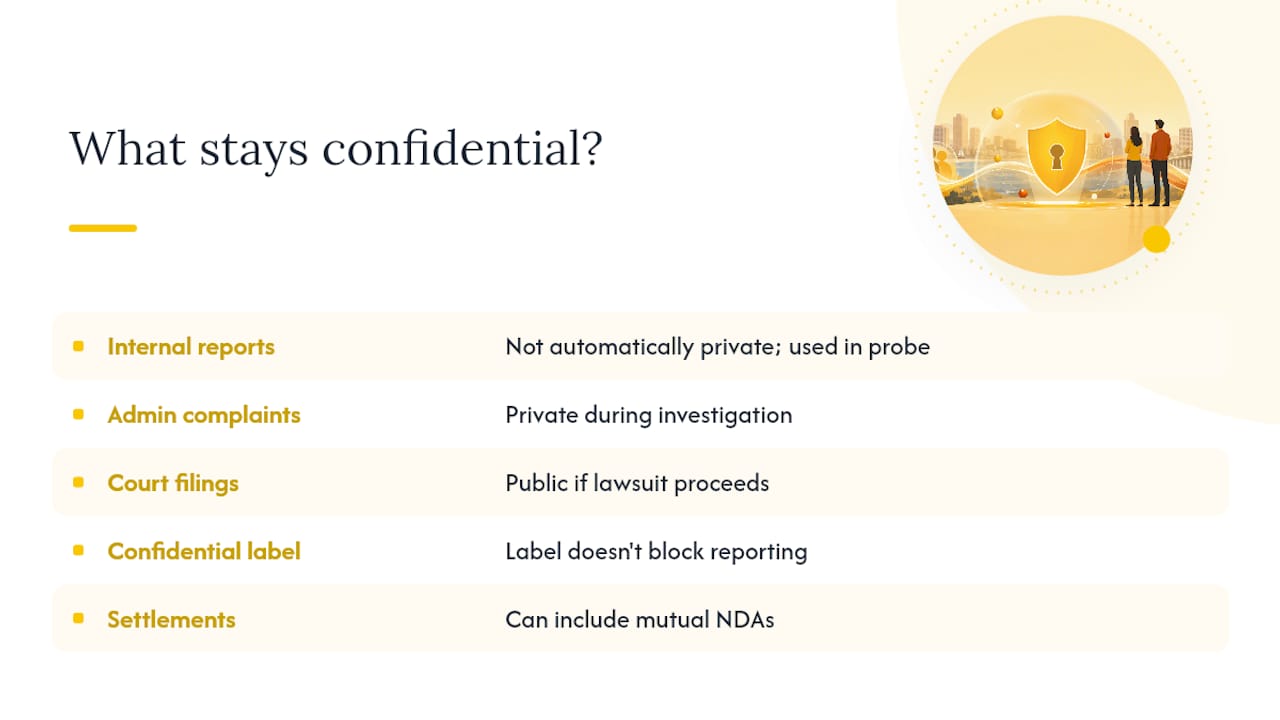
Confidentiality concerns stop a lot of employees from reporting misconduct in the first place, so it’s worth understanding what actually stays private and what doesn’t.
Internal reports to HR or a supervisor aren’t automatically public, but they’re rarely airtight secrets either, since your employer needs some information to investigate and respond. What matters more is that the Civil Rights Department’s factsheet makes clear an employer cannot punish you simply because they learned who reported the issue.
Administrative complaints filed with a state agency generally aren’t part of the public record during the investigation phase. If your case proceeds to a civil lawsuit, though, court filings typically become public documents, which is a factor worth discussing with your attorney if confidentiality is a major concern for you.
One point that surprises people: an employer labeling internal documents “confidential” doesn’t automatically shield unlawful conduct from disclosure. Courts have made clear that a company can’t use a confidentiality stamp to prevent employees from reporting suspected violations to the appropriate authorities. Legal privilege is narrower and more specific than a document header, and a blanket confidentiality policy generally can’t override your right to report.
If confidentiality is a priority, discuss settlement options with your attorney early, since many resolved cases include mutual non-disclosure terms that protect both sides once the matter closes.
For many Costa Mesa employees, the first move isn’t a government agency, it’s HR or a direct supervisor. Reviewing your company’s employee handbook for a whistleblower or ethics reporting policy tells you the official internal channel, and using it creates a documented record that you raised the issue through proper channels.
A written report beats a verbal one every time. Send an email or written memo describing what you observed and why you believe it violates the law, and keep a copy for yourself outside the company system. That single document often becomes the anchor for your entire timeline if retaliation follows.
Internal reporting has real advantages: it gives your employer a chance to fix the problem, and it establishes the date your protected activity began, which is exactly what triggers SB 497’s 90 day presumption if retaliation follows.
That said, internal reporting isn’t mandatory before you can pursue outside remedies, and some situations call for going straight to a government agency, particularly if the misconduct involves your direct supervisor or if you reasonably fear immediate retaliation. If your internal report is met with hostility, sudden scrutiny, or a shift in how you’re treated, that’s the moment to stop navigating it alone and get a confidential legal opinion on your next move.
Plenty of general practice firms will take a whistleblower case and treat it like any other wrongful termination file. Optimum Employment Lawyers works exclusively on the employee side of California employment disputes, which means every strategy decision, from how evidence gets framed under §1102.6 to how a settlement demand gets built, comes from attorneys who don’t also represent employers on the other days of the week.
That focus shows up in outcomes: a $2.2 million settlement for a class of employees denied proper meal breaks reflects the kind of aggressive, detail-driven representation the firm brings to retaliation claims too. Representation runs on contingency, so there’s no upfront cost, and no fee unless you recover compensation.
If you’re a Costa Mesa employee weighing whether your situation fits the protections described above, the next step is a straightforward one: reach out for a free confidential case evaluation and find out where you actually stand before any filing deadline gets closer.
This article is general information, not a substitute for advice from a qualified lawyer. Consult a qualified legal professional about your own circumstances before acting on anything here.

© 2026 Optimum Employment Lawyers, PC
Legal Disclaimer | Privacy Policy
 Share
Share
