
(949) 954-8181 Free Case Review No recovery, no fee.
(949) 954-8181 Free Case Review No recovery, no fee.


California law protects you. If you work in Brea and your employer punished you for reporting unsafe working conditions, Labor Code §6310 makes that retaliation illegal. The statute prohibits employers from discharging or discriminating against any employee who files a complaint about unsafe conditions, and it entitles affected workers to reinstatement and reimbursement for lost wages. You do not need to know the exact Cal/OSHA standard that was violated. Describing the hazard is enough.
Three things you can do right now:
The two main enforcement channels are Cal/OSHA (Division of Occupational Safety and Health, under the Department of Industrial Relations) and the Labor Commissioner’s Office. Both are free to use, and your identity can be kept confidential if you request it.
Labor Code §6310 is the primary protection for Brea employees who report health and safety concerns. It prohibits employers from discharging, threatening, or otherwise discriminating against any worker who makes a complaint about unsafe conditions to their employer, to a government agency, or to Cal/OSHA. Remedies under the statute include reinstatement to your former position and full reimbursement of lost wages and benefits.

Cal/OSHA, the Division of Occupational Safety and Health within the California Department of Industrial Relations (DIR), enforces workplace safety standards and investigates safety-related retaliation complaints. The Labor Commissioner’s Office, also part of the DIR, runs the Retaliation Complaint Investigation Unit (DLSE) and handles retaliation claims filed under the Labor Code. Both agencies operate independently, which means you can pursue both routes simultaneously.
Federal OSHA also provides a parallel complaint process. If your employer is subject to federal jurisdiction (certain industries or federal contractors), you can file with federal OSHA as well. The federal filing window is significantly shorter than California’s, so timing matters. California’s protections are generally broader, but preserving federal rights by filing early is a strategy worth discussing with an attorney.
Labor Code §6311 adds a related protection: workers who refuse to perform work because a violation of a Labor Code section or Title 8 safety order creates a real and apparent hazard to themselves or coworkers are protected from discharge or layoff for that refusal. Any worker laid off in violation of §6311 has a right of action for wages lost during the period without work.
Retaliation does not have to be a pink slip. Under Labor Code §6310, a broad range of adverse actions qualify, including:
Legitimate discipline looks different. A well-documented performance improvement plan issued before your safety complaint, consistent enforcement of the same policy against other employees, and prior written warnings all point toward genuine discipline rather than retaliation. The key question is whether the employer’s action was triggered by your protected activity or by a pre-existing, documented performance issue.
Pro Tip: Watch for timing. If your employer had no documented concerns about your performance for months, then suddenly issued a write-up within days of your safety complaint, that sequence is a red flag investigators and courts take seriously. Sudden changes in duties, shifts, or access to resources right after a complaint are also classic warning signs.
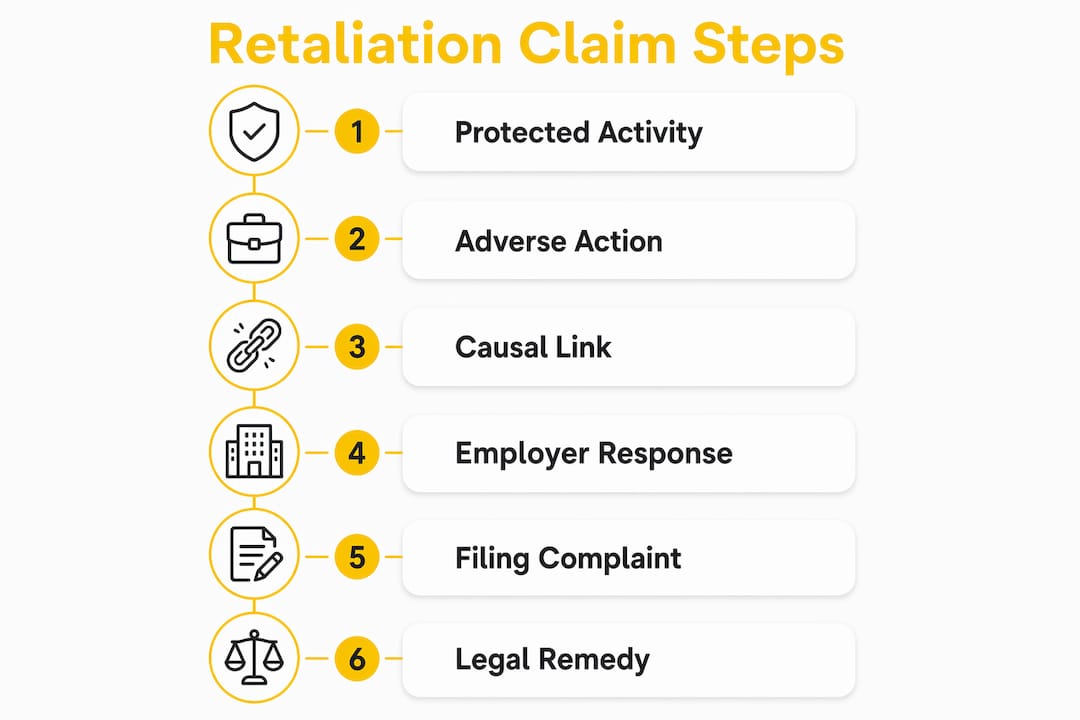
Three elements form the core of a retaliation claim under California law.
Protected activity means you did something the law shields, such as filing a health and safety complaint with Cal/OSHA, reporting an unsafe condition to your supervisor, refusing to perform work that posed an imminent hazard, or contacting the Labor Commissioner. The DLSE Form RCI-1 lists the full range of protected activities, and it includes complaints made to government agencies as well as internal reports to management.
Adverse employment action means your employer did something that materially harmed your employment. Termination is the clearest example, but courts and investigators also recognize demotions, pay cuts, schedule changes, and hostile work environment escalations as adverse actions when they are significant enough to deter a reasonable employee from complaining.
Causal link is where most cases are won or lost. You need evidence connecting the adverse action to your protected activity. A tight timeline, where the adverse action follows the complaint by days or weeks, is strong circumstantial evidence. Emails, text messages, witness statements, and comparative treatment of coworkers who did not complain all help establish causation.
Once you present these three elements, the burden shifts to the employer to offer a legitimate, non-retaliatory reason for the action. If they do, you then need to show that reason is pretextual, meaning it is not the real reason. Pretext often shows up as inconsistent explanations, discipline applied only to complainants, or performance critiques that contradict prior positive reviews.
You have three main filing routes, each with its own timeline and process.
| Forum | Filing Deadline | What They Investigate |
|---|---|---|
| California Labor Commissioner (DLSE) | 6 months from retaliatory act | Retaliation under Labor Code §6310 and related statutes |
| Cal/OSHA | No hard deadline for safety complaints; retaliation complaints follow DLSE timelines | Workplace safety violations and safety-related retaliation |
| Federal OSHA | 30 days from retaliatory act | Federal safety-retaliation claims (certain industries) |
Filing with the Labor Commissioner (DLSE): Submit Form RCI-1 by mail, email, or in person. The DLSE assigns an investigator, sends an investigation letter to the employer, and reviews the employer’s response. The process includes an investigation phase and, if warranted, a determination with potential remedies. Appeals go to the Director of the DIR and can proceed to CASPA (California Apprenticeship Standards and Procedures Act) or federal OSHA for administrative complaints.
Filing with Cal/OSHA: You can file a safety complaint online, by phone, by mail, or in person. Cal/OSHA responds either by sending an inspection letter to the employer (who must respond within 14 days and post the letter in the workplace) or by conducting an onsite inspection for more serious hazards. You do not need to know the exact regulation violated. Describing the hazard is sufficient.
Confidentiality: Cal/OSHA can keep your identity confidential, but this is not automatic. You must explicitly request confidentiality when you file. The nearest DIR district office serving Orange County and Brea handles local Cal/OSHA matters; check the DIR website for current office hours and contact information.
Pro Tip: Filing with both the Labor Commissioner and federal OSHA on the same day is a common strategy to preserve all administrative pathways. The federal 30-day window closes fast, so if federal OSHA jurisdiction applies to your employer, file there first.
If your retaliation claim succeeds, the available remedies under California law include:
The six-month filing deadline with the Labor Commissioner is a hard rule for most retaliation complaints. Missing it does not automatically end your options. A private lawsuit under Labor Code §6310 may still be available, and the statute of limitations for civil claims can be longer depending on the legal theory. That said, waiting always makes a case harder. Evidence fades, witnesses move on, and courts scrutinize delays.
Federal OSHA’s 30-day window is even less forgiving. If your employer is subject to federal jurisdiction, that deadline can pass before you have finished consulting with an attorney. The moment you believe retaliation has occurred, start the clock in your head and act accordingly.
A strong retaliation case is built on a paper trail. Start collecting the following immediately:
Build a timeline. List every protected activity with the exact date, every adverse action with the exact date, and every communication in between. A contemporaneous timeline showing protected activity followed closely by adverse actions is often the single most persuasive document for investigators and attorneys. Keep it in a personal file outside of work systems, such as a personal email account or a secure cloud folder.
Pro Tip: If you want a coworker’s written account of what they saw, ask them to write it in their own words and keep a copy for themselves. Do not pressure anyone or suggest specific language. A voluntary, first-person statement from a witness carries far more weight than one that looks coached.
Working in Brea puts you in Orange County, which has accessible DIR and Cal/OSHA resources. Here is a practical order of operations.
Step 1: Address immediate safety. If the hazard is still present, do not work in conditions that pose an imminent danger. Labor Code §6311 protects you from discharge for refusing work that creates a real and apparent hazard.

Step 2: Report internally, in writing. Send an email to your supervisor or HR describing the unsafe condition. Keep a copy. An internal written complaint creates a clear record of protected activity and a timestamp.
Step 3: File with Cal/OSHA. For ongoing safety hazards, file a complaint at dir.ca.gov/dosh/Complaint.htm. Request confidentiality explicitly when you file. Cal/OSHA serves Orange County from its district offices; check the DIR website for the current Anaheim or Santa Ana district contact.
Step 4: File a retaliation complaint with the DLSE. If retaliation has already occurred, submit Form RCI-1 to the Labor Commissioner’s Retaliation Complaint Investigation Unit within six months of the retaliatory act. You can file by email, mail, or in person.
Step 5: Consider federal OSHA. If your employer is a federal contractor or operates in a federally regulated industry, file with federal OSHA within 30 days.
Step 6: Contact a union or workers’ organization. If you are a union member in Orange County, your union steward can help you document the retaliation, gather witness statements, and file a grievance. Several workers’ rights organizations in the broader Orange County area also provide free or low-cost guidance to non-union workers.
Step 7: Consult an employment attorney. An attorney can assess your claim, identify all available remedies, and handle agency filings on your behalf. Many employment lawyers, including Optimum Employment Lawyers, work on a contingency fee basis, meaning no upfront cost to you.
Optimum Employment Lawyers represents employees only. The firm does not take employer-side cases, which means every strategy, every filing, and every negotiation is built around protecting workers in Brea and across Orange County.
Services available to Brea employees facing health and safety retaliation include:
The firm’s track record includes a $2.2 million settlement in a class action case involving missed meal breaks, which reflects the kind of aggressive, results-focused approach it brings to individual retaliation cases as well. The contingency fee model means you pay nothing unless the firm recovers compensation for you. For a Brea employee who has already lost income due to retaliation, that structure removes the financial barrier to getting real legal help.
To start, bring your timeline, copies of your complaint, any disciplinary notices, and payroll records showing changes after your complaint. The initial consultation is free.
California’s state-level protections under Labor Code §6310 and Cal/OSHA apply uniformly to every employer in Brea. The city of Brea and Orange County do not currently have separate local ordinances that create additional retaliation protections specifically for health and safety complaints beyond what state law provides.
That said, Orange County employers in certain industries, such as healthcare, construction, and food service, face sector-specific Cal/OSHA standards under Title 8 of the California Code of Regulations. Violations of those standards, when reported by an employee, trigger the same §6310 protections. Brea’s proximity to major industrial and commercial corridors in north Orange County means workers in warehousing, manufacturing, and retail distribution are particularly likely to encounter Title 8 hazards.
California also requires every employer to maintain a written Injury and Illness Prevention Program (IIPP) under Labor Code §6401.7. An employer who retaliates against a worker for pointing out IIPP deficiencies is violating both the IIPP requirement and §6310. That dual violation can strengthen a retaliation claim.
Overt termination is easy to identify. The harder cases involve a slow erosion of your position after you file a complaint. Subtle retaliation is still illegal, and it is more common than most workers realize.
Watch for these patterns after making a safety complaint: your schedule shifts to less desirable hours without explanation; you are suddenly excluded from team meetings you previously attended; your supervisor stops communicating with you directly; your workload doubles while your coworkers’ stays the same; or you receive your first negative performance comment after years of clean reviews. None of these acts alone may seem like much. Together, they can constitute a pattern of workplace safety retaliation that courts and investigators recognize.
The practical response is documentation. Every time something changes, write it down with the date and who was involved. Note whether the same change was applied to coworkers who did not complain. Comparative treatment is powerful evidence. If your coworker kept their preferred shift and you lost yours the week after your complaint, that disparity tells a story.
Courts apply an objective standard: would the adverse action deter a reasonable employee from making a safety complaint? A single minor inconvenience probably would not. A sustained campaign of schedule changes, exclusion, and hostile supervision almost certainly would.
California law protects all workers regardless of immigration status. Labor Code §6310 does not contain a citizenship or work authorization requirement. Cal/OSHA’s complaint process is open to any worker, and the agency does not ask about immigration status when you file.
The California Labor Commissioner’s Office has also stated that workers without documentation retain the right to file retaliation complaints and recover lost wages. The California Civil Rights Department (CRD) similarly enforces anti-retaliation protections without regard to immigration status.
Fear of employer retaliation tied to immigration status is a real concern, and some employers exploit it. California law specifically prohibits employers from threatening to report an employee to immigration authorities in retaliation for exercising labor rights. That threat itself can constitute an unlawful retaliatory act under state law.
If you are undocumented and concerned about exposure, requesting confidentiality when filing with Cal/OSHA is especially important. An employment attorney can also advise on how to pursue your claim while minimizing immigration-related risk. The protections are real, and you are entitled to use them.
You have several ways to report unsafe conditions or retaliation without your employer knowing who filed.
Cal/OSHA confidential complaints: When you file a safety complaint online or by phone, you can request that your identity be kept confidential. Cal/OSHA will not disclose your name to the employer during the investigation if you make that request. This is not automatic; you must ask for it explicitly at the time of filing.
Labor Commissioner anonymous tips: The DLSE accepts retaliation complaints with a request for confidentiality. Note that if your case proceeds to a formal hearing, some disclosure may become necessary, but the agency works to protect complainant identity during the investigation phase.
Federal OSHA: Federal OSHA also accepts complaints with a confidentiality request and will not reveal your name to the employer without your consent.
Workers’ rights organizations: Several nonprofit organizations in Orange County provide confidential guidance to workers facing unsafe conditions or retaliation. These groups can help you understand your options, connect you with legal resources, and in some cases assist with filing, all without notifying your employer.
Anonymous hotlines: Cal/OSHA maintains a phone complaint line where you can report hazards without providing your name. The agency will still investigate based on the hazard description alone.
California law gives Brea employees real, enforceable protections against retaliation for reporting unsafe working conditions, but acting quickly and preserving evidence from day one is what determines whether a claim succeeds.
| Point | Details |
|---|---|
| Labor Code §6310 is your foundation | California law prohibits retaliation for reporting unsafe conditions and entitles you to reinstatement and back pay. |
| File before deadlines close | The Labor Commissioner requires filing within six months; federal OSHA closes in just 30 days from the retaliatory act. |
| Document everything immediately | A dated timeline of your complaint and the adverse actions that followed is the strongest evidence you can build. |
| Confidentiality must be requested | Cal/OSHA will not automatically protect your identity; ask for confidentiality explicitly when you file. |
| Optimum Employment Lawyers | The firm represents Brea employees on a contingency fee basis, handling Cal/OSHA complaints, wrongful termination, and retaliation claims. |
If you work in Brea and believe your employer retaliated against you for reporting unsafe job conditions, Optimum Employment Lawyers offers a free consultation with no upfront cost. The firm works exclusively on the employee side, with deep experience in Orange County retaliation and wrongful termination cases. You pay nothing unless the firm recovers compensation for you.
Bring your timeline, your complaint records, and any disciplinary notices to the first meeting. The firm’s attorneys will assess your claim, identify every available remedy, and advise on whether to file with the Labor Commissioner, Cal/OSHA, or both. Schedule a free consultation to get started.
This article provides general legal information, not legal advice. Laws and deadlines change, and your situation may involve facts that affect your rights. Confirm current rules and filing deadlines with the relevant agency or a qualified employment attorney.
Check each agency’s website for current Orange County district office contact information, updated form versions, and any changes to filing procedures that may affect Brea employees.

© 2026 Optimum Employment Lawyers, PC
Legal Disclaimer | Privacy Policy
 Share
Share
