
(949) 954-8181 Free Case Review No recovery, no fee.
(949) 954-8181 Free Case Review No recovery, no fee.
Whistleblower retaliation in Orange is illegal under California Labor Code § 1102.5, one of the strongest employee protection statutes in the country. If your employer demoted you, cut your pay, or fired you after you reported a workplace violation, you have legal rights and a clear path to fight back. California law covers both internal reports to supervisors and external reports to government agencies, which means you do not need to go outside your company to earn protection. The California Division of Labor Standards Enforcement (DLSE) and the courts are available to enforce these rights for workers throughout Orange County.
Protected whistleblower activity under California law is broader than most employees realize. California Labor Code § 1102.5 protects employees who report violations to governmental agencies or to internal supervisors, and it also protects employees who refuse to participate in illegal acts. Protection applies regardless of employer size, which means a small business in Orange has the same legal obligations as a Fortune 500 company.
Specifically, the following actions qualify as protected disclosures:
The distinction between internal and external reporting matters strategically. Internal reports are protected, but external reports to agencies like OSHA or the DLSE create a stronger paper trail and trigger additional enforcement mechanisms. Many employees in Orange start with internal reports and escalate to agency complaints when retaliation follows.
Pro Tip: Document every protected disclosure in writing. Send a follow-up email after any verbal report to a supervisor so you have a timestamped record. That email could be the most important piece of evidence in your case.

SB 497, which took effect in January 2024, created a significant legal advantage for employees pursuing retaliation claims in California. The 90-day window under SB 497 creates a rebuttable presumption that retaliation occurred if an adverse employment action happens within that period after a protected disclosure. This presumption shifts the burden of proof directly onto your employer before you have to prove anything beyond the timing itself.
Here is how the presumption works in practice:
“The 90-day rebuttable presumption shifts the causation burden to the employer, which must overcome it with strong evidence, greatly aiding employees in early case stages.” — Lawson v. PPG Framework Analysis
The SB 497 rebuttable presumption significantly lowers the employee’s burden by assuming retaliation when adverse action occurs within 90 days of protected disclosure. That is a dramatic shift from how most employment cases work, where employees carry the full burden of proving intent. For workers in Orange who face swift retaliation after speaking up, this 90-day window is often outcome-determinative.
The Lawson v. PPG Architectural Finishes, Inc. decision (California Supreme Court, 2022) established the governing framework for § 1102.5 claims. Under that framework, the employee must first show that whistleblowing was a contributing factor in the adverse action. The employer then must prove by clear and convincing evidence that it would have taken the same action anyway. SB 497 strengthens the employee’s position at step one by creating the timing presumption.
Retaliation does not always look like a termination letter. Common retaliation forms include demotions, pay decreases, exclusion from meetings, and termination, and they often require detailed documentation by employees. Employers sometimes use subtle tactics precisely because they know overt retaliation is easier to prove.
Watch for these specific patterns after you make a protected disclosure:
The identity of the decision-maker matters as much as the adverse action itself. If your direct supervisor knew about your report and then initiated a demotion, that knowledge creates a direct link between the disclosure and the punishment. Exact dates of each adverse action and the decision-maker’s identity are critical in whistleblower retaliation litigation, especially under SB 497 where the 90-day window is outcome-determinative.
Pro Tip: Keep a private log outside of work systems, such as a personal email or a notebook at home. Record every adverse event with the date, the person involved, and what was said or done. Never store this log on a company device or company email.
The legal process for whistleblower retaliation claims in Orange County involves two main tracks, and choosing the right one early affects your outcome. The California DLSE is the agency where workers can file retaliation complaints, and it enforces labor laws and protects workers who report labor violations or safety hazards.
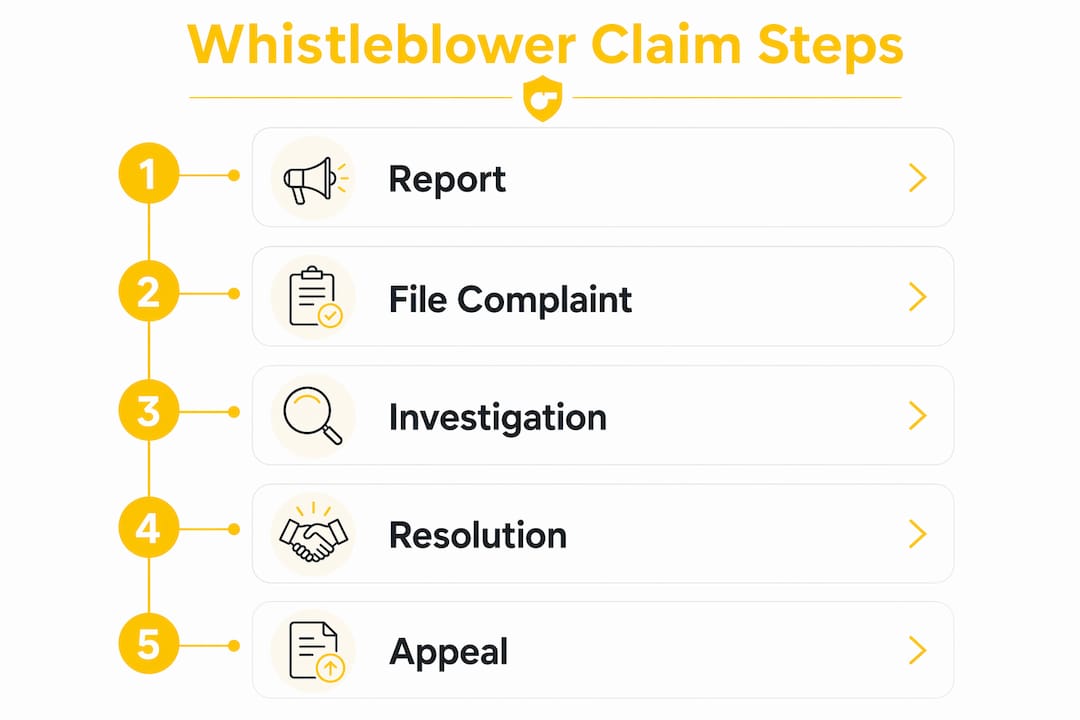
The table below summarizes the key differences between the two primary claim types:
| Claim Type | Filing Requirement | Statute of Limitations | Court |
|---|---|---|---|
| Labor Code § 1102.5 | No administrative exhaustion required | 3 years from adverse action | California Superior Court |
| FEHA Retaliation | Must file with CRD first | 3 years to file with CRD; then 1 year for lawsuit | California Superior Court |
| DLSE Complaint | File directly with DLSE | Varies by violation type | Administrative process |
FEHA retaliation claims require a CRD complaint first, but § 1102.5 whistleblower claims can be filed directly in Superior Court with a three-year statute of limitations. That direct-filing option gives Orange County employees more flexibility and speed. However, whistleblower claims may overlap with FEHA claims, and employees should treat retaliation as a multi-claim issue for the best protection and compliance with legal deadlines.
DLSE retaliation complaints are especially strategic when retaliation relates to labor, wage, or safety reporting, because the agency’s enforcement focus aligns directly with those violations. Filing with the DLSE can also preserve evidence and create an official record before you file in court.
Most whistleblower retaliation cases in California resolve in 2–3 years after filing civil complaints, with discovery and possible trial phases. Early settlements happen but usually at lower values. Understanding this timeline helps you plan financially and emotionally for the process ahead.
For employees in Orange County, considering overlapping claims under Labor Code § 1102.5 and FEHA with awareness of forum and deadlines is the safest legal strategy. An attorney who handles only employee-side cases will know which combination of claims maximizes your recovery.
Taking the right steps immediately after retaliation can determine whether your case succeeds or stalls. Speed and documentation are your two most powerful tools in the early stages.
Orange County employees have access to the California whistleblower protections under state law, the DLSE office, and local employment attorneys who specialize in employee-side cases. You do not have to navigate this alone, and you do not have to accept retaliation as the end of your career.
Pro Tip: If you are still employed after the retaliation began, do not resign without speaking to an attorney first. Quitting can complicate your claim unless the conditions rise to the level of constructive discharge, which is a separate legal theory your attorney can evaluate.
Employees-lawyer, operating as Optimum Employment Lawyers, focuses exclusively on employee-side cases throughout Orange County and the surrounding region. If you experienced retaliation or wrongful termination after reporting a workplace violation, their attorneys understand both the legal framework and the personal toll that retaliation takes. The firm has secured significant results for California employees, including a $2.2 million class action settlement for missed meal breaks. They offer free consultations so you can understand your options without financial risk. Contact the Orange employee rights team at Employees-lawyer to get personalized guidance on your whistleblower retaliation claim today.
Whistleblower retaliation in Orange is illegal under California Labor Code § 1102.5, and SB 497’s 90-day presumption gives employees a powerful early advantage when adverse action follows a protected disclosure quickly.
| Point | Details |
|---|---|
| Protected activity is broad | Reporting violations internally or externally, and refusing illegal orders, all qualify for protection. |
| SB 497 shifts the burden | Adverse action within 90 days of disclosure creates a presumption of retaliation the employer must disprove. |
| Document everything immediately | Record dates, decision-makers, and adverse events in a private log outside company systems. |
| § 1102.5 claims skip CRD filing | You can file directly in Superior Court with a three-year statute of limitations, unlike FEHA claims. |
| Act fast and consult an attorney | The 90-day presumption window and overlapping deadlines make early legal advice outcome-determinative. |
Whistleblower retaliation is any adverse employment action an employer takes against an employee for reporting a legal violation or refusing to participate in illegal conduct. California Labor Code § 1102.5 prohibits this conduct and applies to employers of all sizes.
You have three years from the date of the adverse action to file a § 1102.5 claim directly in California Superior Court. FEHA retaliation claims require a complaint with the California Civil Rights Department first, so deadlines vary depending on which claims you pursue.
Yes. SB 497 took effect in January 2024, so any adverse action taken within 90 days of a protected disclosure after that date triggers the rebuttable presumption. Your employer must then prove by clear and convincing evidence that the action was unrelated to your report.
Adverse actions include termination, demotion, pay cuts, schedule changes, exclusion from meetings, and increased negative scrutiny. Courts look at whether the action would deter a reasonable employee from making a protected disclosure.
Filing with the DLSE is the stronger choice when your retaliation relates to wage or safety complaints, because the agency’s enforcement mission aligns with those violations. For other retaliation claims under § 1102.5, filing directly in Superior Court is an option. An employment attorney can help you decide which path fits your specific facts.

© 2026 Optimum Employment Lawyers, PC
Legal Disclaimer | Privacy Policy
 Share
Share
