
(949) 954-8181 Free Case Review No recovery, no fee.
(949) 954-8181 Free Case Review No recovery, no fee.

Short answer: yes. California law protects you from whistleblower retaliation under Labor Code 1102.5 and 1102.6, whether you reported wrongdoing internally, to a government agency, or refused to carry out an illegal order. If you believe you have been punished for speaking up at work in Huntington Beach, preserve your records now, note dates and witnesses, and talk to an employment lawyer before any filing deadline passes.
TL;DR:
- Retaliation is often subtle, including demotions, schedule changes, or negative reviews, especially if these follow closely after protected activity.
- Employees must gather and preserve detailed evidence such as emails, performance records, and witness accounts to strengthen their case.
- Filing deadlines are strict, with the Labor Commissioner’s Office generally allowing about one year and federal OSHA as little as 30 days to report retaliation.
- Employers should have clear anti-retaliation policies, properly train supervisors, and conduct prompt investigations to prevent liability.
- Confidentiality agreements generally cannot block you from reporting illegal conduct to authorities or cooperating with investigations.
If you work in Huntington Beach and reported wrongdoing, refused an unlawful order, or cooperated with an investigation, California law says your employer cannot punish you for it. That protection covers reporting to a supervisor, human resources, a government agency, or even a public body with authority to investigate the issue.
OSHA investigations that substantiate retaliation can require an employer to restore the worker’s job, earnings, and benefits. That remedy exists specifically because retaliation cases often start with an employee losing income or standing at work, and the law aims to put them back where they would have been.
California Labor Code 1102.5 is the backbone of whistleblower protection in this state. It prohibits an employer from retaliating against an employee for disclosing information to a government or law enforcement agency, to a person with authority over the employee, or to another employee who has authority to investigate the issue, when the employee has reasonable cause to believe the information discloses a violation of law. The statute also protects employees who refuse to participate in an activity that would violate a state or federal law, and it applies even if reporting the activity was part of the employee’s job duties.
Labor Code 1102.6 sets the standard courts use to decide these cases, and it favors employees more than most retaliation statutes. Once an employee shows that protected activity was a contributing factor in an adverse action, the burden shifts to the employer, which must then prove by clear and convincing evidence that it would have taken the same action for legitimate, independent reasons. That is a tougher standard for employers than the “but for” test used in many other retaliation claims, and it is one reason whistleblower cases in California can be strong even when the employer offers an alternative explanation.
Beyond 1102.5 and 1102.6, other California and federal laws may apply depending on the facts. The California Fair Employment and Housing Act (FEHA) prohibits retaliation against employees who oppose discrimination or harassment, file a complaint, or participate in an investigation, and claims under FEHA go through the California Civil Rights Department. Federal whistleblower statutes administered by OSHA cover more than twenty distinct laws, protecting employees who report violations involving workplace safety, securities fraud, environmental hazards, trucking safety, and other regulated areas. A publicly traded company employee who reports suspected fraud, for example, may have an additional layer of protection under the Sarbanes-Oxley Act. Which law applies often depends on who you reported to and what kind of violation you flagged, which is why it helps to lay out the full timeline with a lawyer early.
Protected activity is broader than most employees assume. It is not limited to calling a hotline or filing a formal complaint with a government agency.
A Huntington Beach retail employee who tells a manager that the store is skipping required rest breaks is protected. A hospitality worker who refuses to serve alcohol to a visibly intoxicated guest because state law prohibits it is protected. A construction worker on a local job site who reports a safety violation to Cal/OSHA is protected, and so is a municipal employee who flags suspected misuse of public funds to a city official. The common thread is a reasonable, good-faith belief that something unlawful is happening, not certainty that you are right.
Retaliation does not always look like a termination letter. Some of the most common forms are far more subtle, and employees often miss them until a pattern becomes obvious.
Timing matters. An adverse action that follows closely after a protected report, or a pattern of smaller slights that escalate over weeks, tends to build a stronger case than a single isolated incident. A Huntington Beach hotel worker who reports a safety hazard and is reassigned to the worst shifts within days has a very different case than one reassigned months later for unrelated reasons.
Pro Tip: Write down the date, time, and content of every meeting or conversation connected to your report or the treatment that followed, even if nothing seems significant at the time.
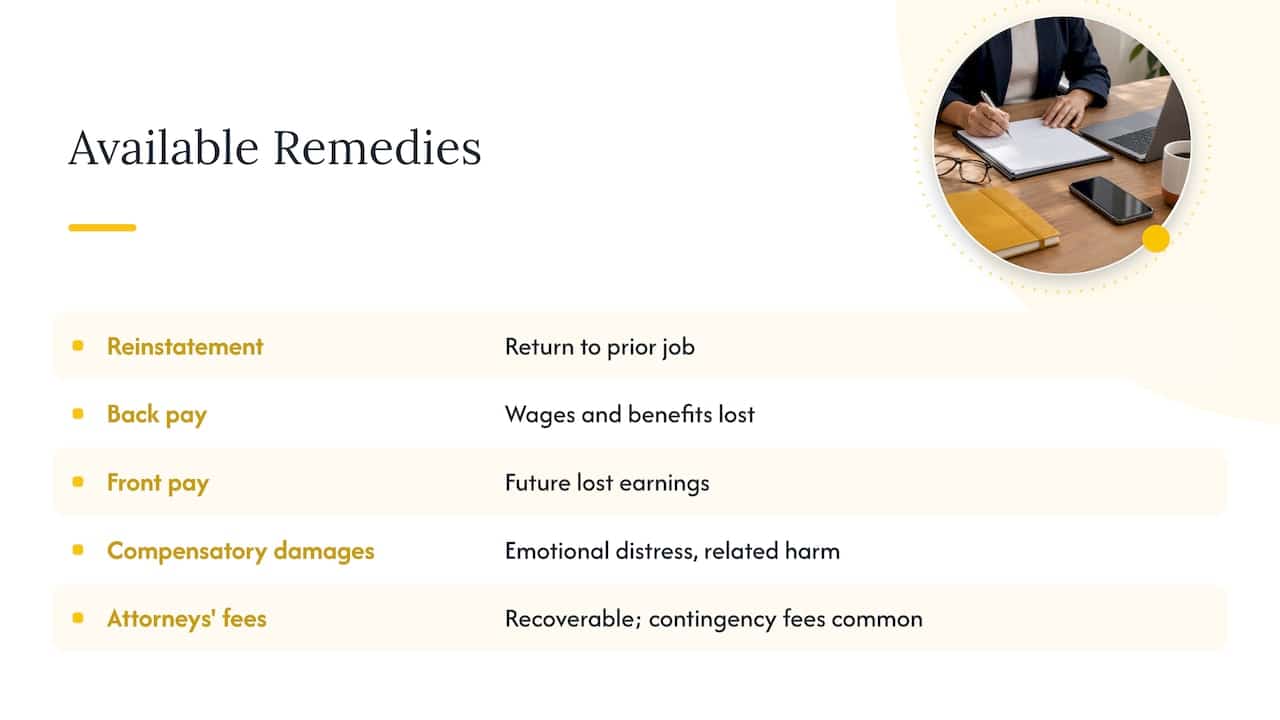
Employees who prove retaliation under California law can recover several forms of relief, and the combination often depends on how long the retaliation lasted and how it affected income and career trajectory.
Reinstatement puts you back in your job, which is sometimes requested even though many employees prefer not to return to a hostile workplace. Back pay covers wages and benefits lost between the retaliatory action and the resolution of the claim, calculated from your actual pay rate and benefits package. Front pay may be awarded when reinstatement is not practical, covering future lost earnings for a reasonable period. Compensatory damages can address emotional distress and related harm, and in some cases, courts can award statutory penalties on top of these amounts. OSHA investigations that substantiate a retaliation claim can similarly require an employer to restore job status, earnings, and benefits.
Attorneys’ fees are often recoverable in successful whistleblower cases, which matters because contingency fee arrangements let employees pursue claims without paying upfront. The strength of the evidence drives the outcome more than anything else. A clear timeline connecting the protected report to the adverse action, backed by emails, witness statements, and documented performance history, tends to produce stronger settlements or verdicts than a claim built on recollection alone. Settlement amounts vary widely based on lost wages, the egregiousness of the conduct, and how well the record supports causation, so there is no fixed number that applies to every case.
Different agencies handle different types of retaliation, and filing with the wrong one, or missing a deadline, can cost you the claim entirely.
A Seal Beach retaliation case illustrates how tight these windows can be, with DLSE complaints generally due within one year and OSHA complaints under certain federal statutes due within 30 days. The same kind of clock applies to Huntington Beach employees, which is why early legal advice matters more than most people expect.
Retaliation cases often turn on documentation more than any single dramatic event. Building a clear record early makes a meaningful difference later.
Pro Tip: Stop discussing the situation over work email or company chat once you suspect retaliation, since those messages can be reviewed later and may undercut your claim if written in frustration.
Witness statements carry weight when they are collected close to the events they describe, because memories fade and coworkers may become reluctant to get involved later. If you already filed an internal complaint, keep a copy of it and any response you received, since that document often becomes the anchor for your entire timeline.
If you suspect retaliation, the next week matters more than you might think.
A contingency fee arrangement means you generally do not pay upfront for representation, since the fee comes from a settlement or award if the case succeeds. Confidentiality during this process matters too: sharing details selectively, and avoiding public statements before speaking with a lawyer, helps protect both your claim and your standing at work.
California law places the responsibility on employers to avoid retaliating against employees who report wrongdoing, and most employers that take this seriously build clear systems around it. A written anti-retaliation policy, distributed and explained during onboarding, sets expectations before a report ever happens. Employers are also expected to train supervisors specifically on what protected activity looks like, since many retaliation cases start with a manager who did not realize a comment or a refusal was legally protected.
Prompt, documented investigation of internal complaints is another core obligation. When an employer drags out an investigation, or fails to separate the person who reported an issue from the person accused of it, the risk of retaliation increases and so does legal exposure. Employers are also expected to track personnel decisions, such as discipline, schedule changes, and performance reviews, with enough detail to show a decision was made for legitimate reasons unrelated to a protected report. That documentation cuts both ways: it protects employers who act properly, and it becomes evidence against employers who do not.
For employees in Huntington Beach working in retail, hospitality, construction, or municipal roles, this means your employer should have a channel for reporting concerns that does not run through the same manager you are reporting about. If that channel does not exist, or if it is ignored, that gap itself can become part of a retaliation claim.

Many employees worry that an NDA or confidentiality agreement they signed blocks them from reporting wrongdoing or pursuing a retaliation claim. In California, a confidentiality agreement generally cannot prevent you from reporting suspected legal violations to a government agency, testifying in a legal proceeding, or cooperating with an investigation. Labor Code 1102.5 protections exist independently of private contract terms, and an employer cannot use an NDA to punish you for protected disclosures.
That said, NDAs still matter in practice. They often restrict how you talk about settlement terms, trade secrets, or internal business information unrelated to the unlawful conduct you reported. If you signed a severance or settlement agreement in the past and are now facing new retaliation, the specific language matters, which is one reason it helps to have a lawyer review any prior agreement alongside your new claim rather than assuming it either blocks you entirely or has no effect at all.
If your employer has asked you to sign a new confidentiality agreement after you raised a concern, or has suggested your report violates an existing one, that request itself can sometimes be evidence of retaliatory intent, especially if the timing lines up closely with your disclosure.
You do not always have to attach your name to a report to trigger legal protection, but anonymous reporting works differently depending on the channel. Many companies offer anonymous hotlines or compliance portals, and some government agencies, including Cal/OSHA, accept complaints without requiring the complainant’s identity to be disclosed to the employer. The tradeoff is that anonymity can make it harder to prove retaliation later, since you need to show your employer knew or suspected you were the source of the report in order to connect it to an adverse action.
In practice, many retaliation cases involve reports that started anonymously but became known to the employer through indirect means, such as the timing of the report matching a narrow group of people with access to the information, or a follow-up investigation that identified the source. If you report anonymously and later face retaliation, document how and when you believe your employer learned or guessed your identity, since that detail becomes central to proving the connection between your report and what happened afterward.
Anonymous reporting is a useful tool for raising concerns safely, but it is not a substitute for documenting your own involvement if you later need to prove a retaliation claim.
One of the most common fears among employees considering a retaliation claim is that pursuing it will follow them into future job searches. California law restricts what a former employer can say in many reference situations, and retaliating further after a claim is filed, including through a deliberately negative reference, can itself be a separate retaliatory act.
In practice, many employers limit references to dates of employment and job title specifically to avoid this kind of exposure, which can actually work in a departing employee’s favor. If a former employer does go further and provides a reference that appears designed to punish you for a prior complaint or claim, that pattern can strengthen your case rather than weaken your prospects, since it demonstrates the same retaliatory motive extending beyond the original workplace.
Employees sometimes delay reporting wrongdoing out of concern about how it will look to future employers. Framing matters here: a documented, good-faith report of unlawful conduct followed by a legal claim for retaliation is a very different story than unexplained job turnover, and a prepared explanation, discussed in advance with a lawyer, can help you navigate that conversation in future interviews without oversharing details of an active or resolved matter.
Beyond legal representation, several resources exist for Huntington Beach employees navigating a retaliation situation. The California Labor Commissioner’s Office (DLSE) accepts complaints and provides guidance on filing without requiring an attorney, which matters for employees who want to understand the process before committing to representation. The California Civil Rights Department similarly offers a complaint process for retaliation tied to discrimination or harassment, along with informational resources on employee rights.
For federal claims, OSHA’s Whistleblower Protection Program provides guidance on filing, including how dual filing with a State Plan and federal OSHA can preserve rights under both systems. Orange County also has legal aid organizations and employee advocacy groups that assist workers who cannot afford private counsel, which can be a starting point for employees who need guidance before deciding whether to pursue a formal claim. Our whistleblower resource page lays out California’s protections in more detail for employees who want to read further before reaching out.
We represent employees exclusively, focusing every strategy decision in a retaliation case on what helps you. Our firm has secured significant results for workers and we bring that same intensity to whistleblower and retaliation claims.
We work on contingency, so you do not pay upfront. Our fee comes from a settlement or award, structured as 40% on a pre-trial settlement or 42% on other wins, with nothing owed if we do not recover for you. If you believe you were retaliated against for reporting wrongdoing in Huntington Beach, we can help you evaluate your timeline, identify the right agency to file with, and build the documented record a strong claim requires.
Reach out through our contact page for a case assessment, or review our full range of employment law services, including wage and hour violations, discrimination, and wrongful termination, to see how we can help.
Yes. California Labor Code 1102.5 prohibits retaliation against employees who report suspected legal violations internally or to a government agency, and Labor Code 1102.6 sets a favorable standard for proving causation once protected activity is shown to be a contributing factor.
It depends on the strength of your evidence and the harm you experienced, since remedies can include reinstatement, back pay, damages, and attorneys’ fees. A documented timeline connecting your report to the adverse action tends to produce stronger outcomes, which is why many employees consult a lawyer before deciding whether to proceed.
There is no fixed amount, since outcomes depend on lost wages, the severity of the retaliation, and how well the evidence supports your claim. Remedies can include back pay, front pay, compensatory damages, and in some cases statutory penalties, with settlements varying widely based on these factors.
Build a clear timeline connecting your protected report or activity to the adverse action that followed, supported by emails, performance records, and witness accounts. Retaliation claims are strongest when the timing is close and the documentation shows a pattern rather than a single ambiguous event.
Official filing guidance and statutory text referenced in this article are listed below for direct access.

© 2026 Optimum Employment Lawyers, PC
Legal Disclaimer | Privacy Policy
 Share
Share
