
(949) 954-8181 Free Case Review No recovery, no fee.
(949) 954-8181 Free Case Review No recovery, no fee.
Yes, Seal Beach employees who report unsafe working conditions are protected against retaliation under California Labor Code sections 6310 and 6311, and often under federal OSHA Section 11© as well. State complaints generally must be filed within the standard time allowed by the Labor Commissioner’s Office, while federal OSHA claims typically require action within a shorter federal deadline. If your employer disciplined, demoted, or fired you after a safety complaint, document everything immediately and file with the Labor Commissioner’s Office or OSHA before your deadline passes.
TL;DR:
- Filing a retaliation claim must happen within one year at the state level, and within 30 days for federal OSHA, to preserve your options.
- Protected activities include informal safety concerns, refusing unsafe work, reporting injuries, and witnesses’ testimony, with retaliation including demotions, pay cuts, and schedule changes.
- Gather detailed documentation immediately after retaliation, including emails, schedules, notices, and witness statements, to strengthen your case.
- Employers must investigate hazards and avoid adverse actions after a safety complaint, with the burden of proof shifting to them if a case proceeds to civil litigation.
- Consulting an experienced employment lawyer promptly improves your chances of effectively navigating deadlines and evidence requirements.
California gives you two separate paths to fight back against a retaliatory employer, and understanding both matters because they have different deadlines, different remedies, and different agencies behind them.
Labor Code section 6310 prohibits your employer from firing, demoting, or otherwise punishing you for reporting unsafe working conditions, participating in a workplace safety committee, or filing a complaint with Cal/OSHA. Section 6311 adds another layer: you cannot be disciplined for refusing to perform work that would violate a safety order and expose you or coworkers to real danger. Both statutes entitle you to reinstatement and reimbursement for lost wages if the Labor Commissioner’s Office finds in your favor.
The Division of Labor Standards Enforcement, commonly called DLSE, is the state agency that actually investigates these claims. Once you file, DLSE reviews your evidence, may interview witnesses and your employer, and issues a determination that can include back pay, reinstatement, and penalty assessments.
Federal OSHA Section 11© runs alongside California’s protections and sometimes fills gaps state law does not cover, particularly for certain federally regulated employers. Here’s how the two systems typically compare:
Protected activity covers more ground than most workers realize, and retaliation covers more than getting fired.
You are protected when you report a hazard directly to your employer, file a complaint with Cal/OSHA, serve on an employer-employee safety committee, refuse to perform work that violates a safety standard and creates real danger, report a workplace injury, or testify in a safety-related proceeding. Even raising a concern informally, in a hallway conversation or an internal email, can count as protected activity if it clearly relates to a safety issue.
Retaliation rarely looks as obvious as a pink slip. Common tactics Seal Beach workers report include:
DLSE’s own guidance confirms retaliation includes any adverse change to your terms and conditions of employment, not just termination. Protection also extends to workers who are targeted because they are associated with someone else’s safety complaint, or because an employer merely suspects they were involved in reporting a hazard, even if they weren’t.
Speed matters more than most people assume, especially if you want to preserve your federal OSHA option alongside your state claim.
The practical difference between the two systems shows up in evidence standards and appeal routes. DLSE tends to move faster on straightforward cases; OSHA’s federal process can carry more weight for employers who operate across state lines.
Retaliation cases live and die on documentation, and the workers who win are almost always the ones who started keeping records the day they made their safety complaint.
Start collecting these items immediately, even if you’re not sure yet whether you’ll file a formal complaint:
Build a simple timeline: the date you reported the hazard, the date anything changed at work, and every date something adverse happened afterward. Save originals wherever possible, and back up digital records with screenshots stored outside your work email or devices, since access can disappear the moment you’re terminated.
Pro Tip: Ask witnesses to write down what they saw while it’s fresh, even a few sentences in a text message to you. A contemporaneous account carries more weight with investigators than a memory reconstructed months later, and it also shows management’s response to your original complaint.
The remedies available through DLSE are designed to put you back where you would have been if the retaliation had never happened, and sometimes to punish the employer on top of that.
If DLSE finds retaliation occurred, typical remedies include:
DLSE can also assess statutory penalties, and certain Labor Code violations carry penalties up to $10,000 per violation, on top of any back pay ordered. Under Labor Code 1102.6, once you show your protected activity was a contributing factor in the adverse action, the burden shifts to your employer. They must then prove by clear and convincing evidence that they would have taken the same action regardless of your complaint, a standard that favors employees far more than ordinary civil cases.
Private lawsuits, filed after or instead of an administrative complaint, can sometimes yield larger damages, including emotional distress and punitive damages, which DLSE’s administrative process does not typically award.
A dismissal is not the end of the road, and too many workers assume it is.
For Labor Code 6310/6311 safety claims, you generally have 15 days from the determination to file a written appeal to the Director of the Department of Industrial Relations, a step frequently missed by claimants who don’t realize the clock is already running. If you’ve exhausted state appeals and believe federal review is warranted, you can pursue a CASPA complaint requesting that federal OSHA step in and review the case independently.
A private civil action may also be available depending on the facts of your case. Because the appeal window is short and the legal standards get more technical at this stage, this is exactly the point where talking to a California employment lawyer before your appeal deadline expires can protect options you’d otherwise lose.
Once retaliation has already happened, the decisions you make in the first few days shape everything that follows.
Optimum Employment Lawyers represents California employees exclusively, never employers, and has secured significant results for workers, including a $2.2 million class action settlement over missed meal breaks. The firm’s attorneys, including Dean Ho, build retaliation cases around the same evidence standards DLSE and federal OSHA investigators use, which means your documentation work directly strengthens your legal position from day one. Every case is handled on contingency, so you owe nothing upfront.
Seal Beach does not currently maintain a separate municipal ordinance specifically governing workplace safety retaliation, so your core protections come from California Labor Code 6310/6311 and federal OSHA Section 11© rather than city code. That matters because it means the same statewide standards apply whether you work at a restaurant along Main Street, a warehouse near the Seal Beach Naval Weapons Station corridor, or a retail shop closer to the pier.
What does shift at the local level is enforcement access. Seal Beach employees fall under the jurisdiction of the Los Angeles or Orange County DLSE district offices depending on where the employer’s records are processed, and the closest Cal/OSHA consultation resources typically run through the Long Beach or Santa Ana regional offices. Knowing which office handles your filing can shave weeks off an already tight one-year deadline.
Seal Beach’s mix of small retail, hospitality, and light industrial employers near the harbor also means many workers are employed by businesses with fewer than 50 employees. Labor Code 6310/6311 protections apply regardless of company size, a detail some smaller employers count on workers not knowing. If you work for a small operation in Old Town Seal Beach or near Rossmoor, your rights are identical to an employee at a large employer across the county line. The absence of a local ordinance is not a gap in protection. It simply means state and federal law carry the full weight here, and knowing that keeps you from being told otherwise by an employer hoping you won’t check.
Every employer operating in Seal Beach, regardless of industry, has a legal duty to maintain conditions that meet Cal/OSHA’s general industry safety standards, and that duty exists independent of whether a worker has ever complained.
Employers must maintain an Injury and Illness Prevention Program, train employees on hazards specific to their job, provide required protective equipment, and correct known hazards within a reasonable timeframe. For Seal Beach’s harbor-adjacent businesses, that can mean anything from proper ventilation in a restaurant kitchen on Main Street to fall protection on a construction site near the marina.
Once an employee reports a hazard, whether directly to a manager, through a safety committee, or to Cal/OSHA, the employer’s obligations expand. They must investigate the complaint, correct verified hazards, and refrain from any adverse action connected to the report. An employer who responds to a safety complaint by quietly cutting a worker’s hours or reassigning them to a worse shift is not meeting that obligation. They’re violating it.
Employers with multiple locations often argue that a scheduling change or disciplinary action was unrelated to the safety complaint. Under Labor Code 1102.6, that argument only succeeds if the employer can prove, with clear and convincing evidence, that the same action would have happened regardless. For a small business near the Seal Beach pier or a larger employer with operations elsewhere in Orange County, that standard does not bend based on company size.
Retaliation rarely announces itself. It shows up disguised as a scheduling change or a sudden performance concern that never existed before the safety complaint.
A common pattern in coastal service industries: a restaurant worker reports a broken walk-in freezer creating an ice hazard in the kitchen. Two weeks later, the same worker who had steady weekend shifts for a year suddenly gets cut to weekday mornings, a schedule that effectively cuts their income in half. No formal write-up, no stated reason, just a quiet shift change that happens to follow the complaint by exactly two weeks.
Another pattern shows up in light industrial and warehouse settings closer to the Seal Beach Boulevard corridor: an employee refuses to operate a forklift with a known hydraulic leak, citing a real safety risk under Labor Code 6311. Management responds not with immediate termination, which would be an obvious red flag, but with a sudden string of write-ups for unrelated minor infractions over the following month, building a paper trail toward a termination that looks performance-based on paper.
A third scenario involves association retaliation: a coworker who witnessed a safety complaint and was interviewed by DLSE investigators later finds their hours cut and their name pulled from an upcoming promotion list, despite having filed nothing themselves. This is exactly the kind of associational retaliation that DLSE’s guidance explicitly protects against.
In each case, the timeline is the evidence. A safety complaint followed within days or weeks by an unexplained adverse action is the pattern investigators and attorneys look for first.
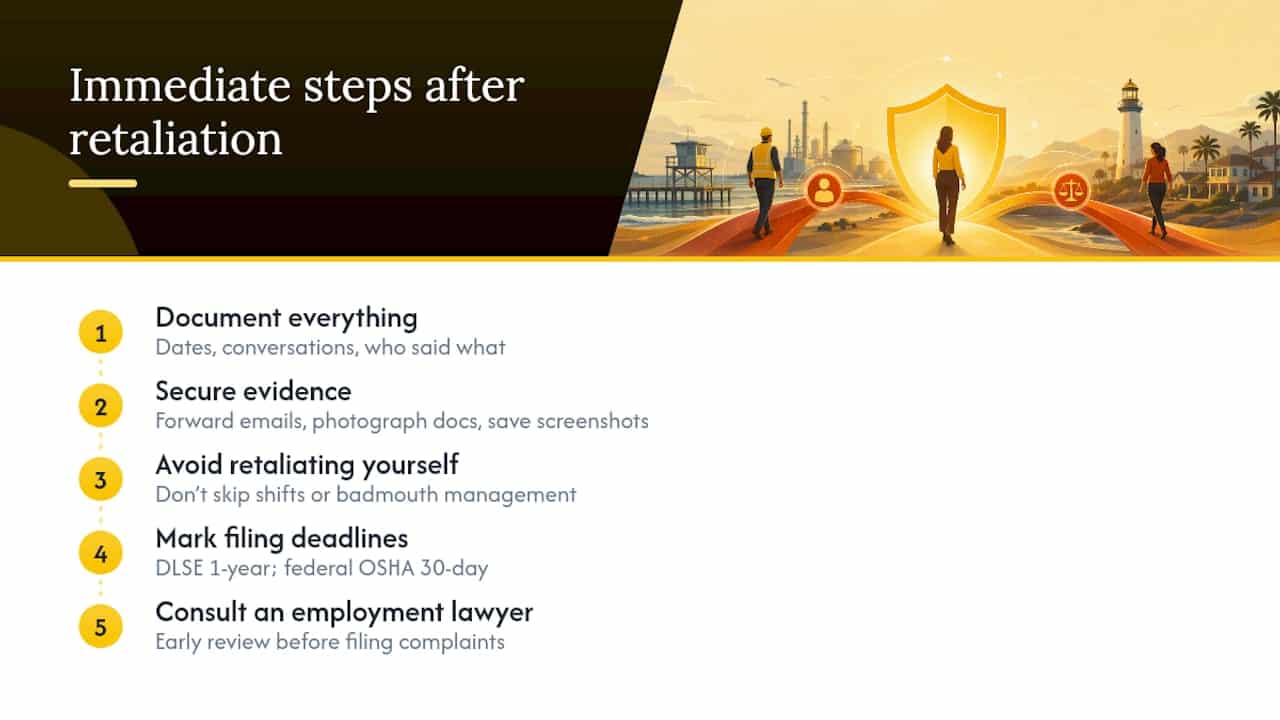
Not every employment issue calls for a lawyer on day one, but health and safety retaliation cases tend to move fast once an employer senses a worker is building a case, which makes early legal advice more valuable than in most other workplace disputes.
Look specifically for attorneys who handle retaliation and wrongful termination claims tied to safety reporting, rather than general practice firms that dabble in employment law alongside other areas. The evidentiary burden-shifting under Labor Code 1102.6 and the tight federal OSHA deadline both reward attorneys who’ve navigated DLSE’s process before and know which regional office handles Seal Beach filings.
Beyond private attorneys, workers can also reach out directly to DLSE’s Retaliation Complaint Investigation Unit for guidance on filing procedures, or to federal OSHA’s regional whistleblower staff for questions about the 30-day filing window. These agencies can explain process, but they represent the state or federal government, not you individually, which is an important distinction if your employer has legal counsel already involved.
For Seal Beach employees specifically, local familiarity matters more than it might seem. An attorney who understands the mix of hospitality, retail, and small-scale industrial employers along the Seal Beach coastline will recognize retaliation patterns faster than someone unfamiliar with the area’s employment landscape. Many firms, including ones handling wrongful termination claims tied to safety reporting, offer free initial consultations specifically so you can evaluate fit before committing to representation.
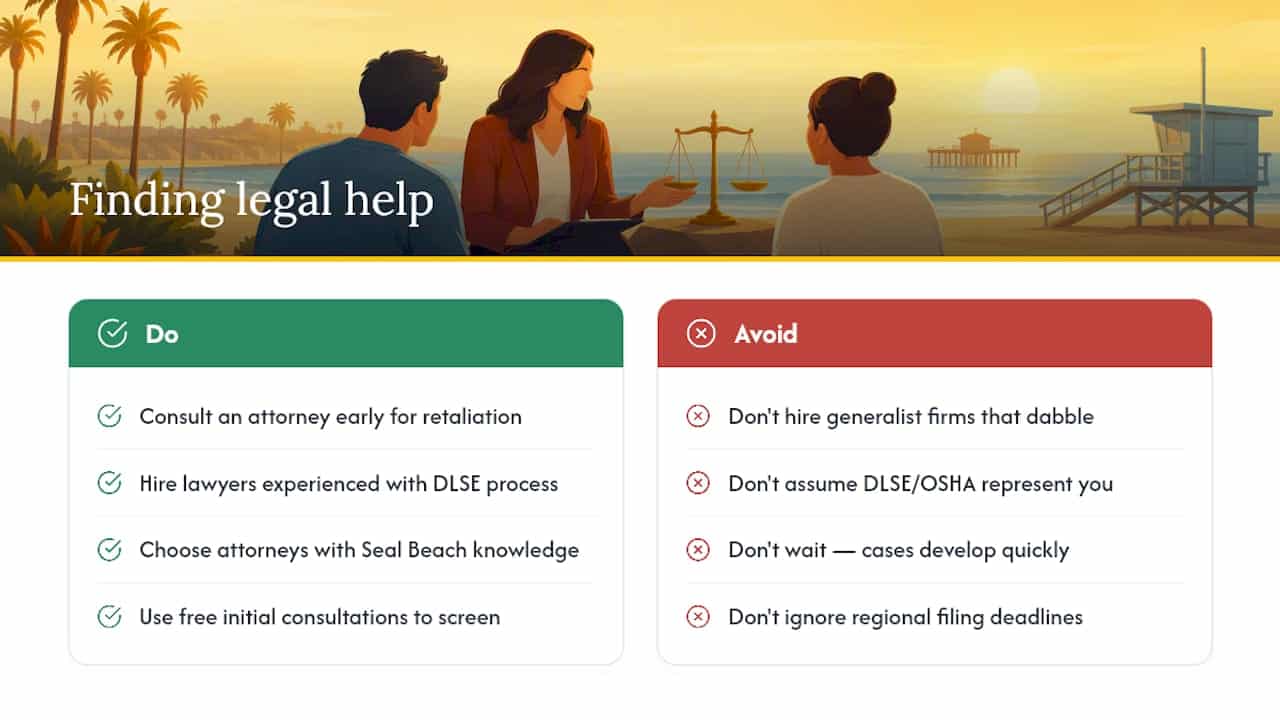
If retaliation has already happened, what you do in the next 48 hours matters more than almost any other point in the process.
First, write down everything while it’s fresh: dates, conversations, who said what, and how your job changed. Memory fades fast, and a detailed account written the same week carries far more weight than one reconstructed months later.
Second, secure your evidence outside of company systems. Forward relevant emails to a personal account, photograph physical documents, and save screenshots of any messages referencing the hazard or the retaliation. Do this before you lose access to a work account or device.
Third, avoid retaliating against the retaliation. Do not skip shifts, badmouth management publicly, or take actions that could give your employer a legitimate, independent reason to discipline you further. Keep your conduct clean so the only issue on the table is the employer’s response to your safety report.
Fourth, calculate your deadlines immediately. Mark the one-year state filing deadline and, if applicable, the 30-day federal OSHA window on a calendar the same day the retaliation occurs, not weeks later when you finally decide to act.
Fifth, reach out to a California employment lawyer before you file anything formally, if possible. An early consultation can flag issues with your evidence or timing that are much harder to fix after a complaint is already on file.
If you’re weighing whether to file with DLSE, federal OSHA, or both, you don’t have to figure out the strategy alone. Optimum Employment Lawyers represents employees exclusively across retaliation, wrongful termination, and wage and hour disputes, which means every case decision is made with your outcome in mind, not an employer’s. The firm’s approach centers on understanding what you’ve actually been through at work, not just the paperwork, and pairing that with aggressive representation once a case is underway.
Representation runs on a contingency-fee basis: 40% of pre-trial settlements and 42% on other wins, with no upfront cost to you. A free case review gives you a clear read on your deadlines, your evidence, and whether filing with DLSE, federal OSHA, or both makes sense for your situation. You can review the full range of practice areas, including wage and hour claims that sometimes overlap with retaliation cases, before deciding how to proceed.
If you’ve reported a safety hazard in Seal Beach and something at work changed for the worse afterward, contact Optimum Employment Lawyers for a free case review before your filing deadline closes.
Proving retaliation requires showing your protected activity, such as a safety complaint, was a contributing factor in the adverse action. Under Labor Code 1102.6, once you clear that bar, your employer bears the harder burden of proving they would have taken the same action anyway.
Amounts vary widely depending on lost wages, penalties, and whether you pursue an administrative complaint or a private lawsuit. Administrative remedies can include back pay and statutory penalties up to $10,000 per violation, while private lawsuits can add emotional distress damages that DLSE’s process does not typically award.
Labor Code 1102.6 established a burden-shifting standard that favors employees: once you show your protected activity contributed to the adverse action, your employer must prove by clear and convincing evidence they would have acted the same way regardless. This standard applies statewide, including for Seal Beach employees filing safety retaliation claims.
Retaliation includes firing, but also demotion, pay cuts, shift changes, threats, and exclusion from opportunities you previously qualified for, all covered under DLSE’s retaliation guidance. It can also extend to coworkers targeted merely for association with a safety complaint, even if they never filed one themselves.
Yes. Optimum Employment Lawyers represents employees exclusively in retaliation and wrongful termination cases tied to health and safety reporting, working on contingency so there’s no upfront cost while your case is evaluated and pursued.

© 2026 Optimum Employment Lawyers, PC
Legal Disclaimer | Privacy Policy
 Share
Share
