
(949) 954-8181 Free Case Review No recovery, no fee.
(949) 954-8181 Free Case Review No recovery, no fee.
Same-sex hostile work conduct at your job can be illegal under California’s Fair Employment and Housing Act, and you don’t have to wait for it to get worse before you act. If you’re facing slurs, exclusion, threats, or unwanted comments tied to your sexual orientation at a Garden Grove workplace, start documenting everything now. Then talk to an employment lawyer who handles these cases before deadlines start working against you.
TL;DR:
- Proper documentation, including dates, quotes, and witnesses, is crucial to prove severity and interference regardless of performance impact.
- Filing promptly with the Civil Rights Department and requesting a right-to-sue notice is essential to preserve legal options before deadlines close.
- Harassment can be illegal even from a single incident if it unreasonably disrupts work, and the law protects perceptions of sexual orientation, not just actual identity.
- An employer’s weak or biased investigations and retaliatory acts after reporting can undermine defenses and strengthen your case.
- Contingency legal representation is available to help employees navigate complex claims without upfront costs, especially in cases involving discrimination or harassment.
FEHA lists sexual orientation as a protected category, and its harassment provisions cover a wide range of conduct, not just the most extreme cases. The law protects you whether the harassment comes from a supervisor, a coworker, a customer, or even a third party your employer allows onto the premises, according to ACLU SoCal’s summary of California LGBTQ employment rights. It also protects you if a coworker merely perceives you as gay, bisexual, or transgender, even if that perception is wrong.
Courts apply a “severe or pervasive” standard, weighing the totality of the circumstances rather than checking off a rigid list. That means a judge or jury looks at frequency, severity, whether the conduct was physically threatening or just offensive, and whether it interfered with your ability to do your job.
Here’s what often surprises people: you don’t have to prove your work performance actually suffered.
Pro Tip: Judges rarely toss these cases out early because the “severe or pervasive” question almost always depends on disputed facts, which is exactly why documentation matters so much before you ever get to court.
Strong documentation turns your memory into evidence a lawyer, an investigator, or a jury can actually use. Vague recollections lose to a timeline with dates, quotes, and names.
Pro Tip: Contemporaneous notes, meaning notes written the same day or within a day or two of the incident, carry far more weight in litigation than a reconstructed memory written months later. Keep a private log outside of work systems.
Once you’ve documented what happened and reported internally, the next formal step is often an administrative complaint with California’s Civil Rights Department. Filing there is a common prerequisite before you can sue in civil court, according to the CRD’s own complaint process page.
There’s a newer wrinkle worth knowing about. A California appellate court in Decloedt v. Radnet held that sexual orientation harassment can qualify as sexual harassment under FEHA, which matters because it can trigger the Ending Forced Arbitration of Sexual Assault and Sexual Harassment Act. That federal law can let you void a mandatory arbitration clause and take your case to open court instead.
Remedies in a successful hostile work environment claim go beyond just getting your job back, though that’s on the table too.
Arbitration clauses complicate things. Many California employment contracts require arbitration instead of a jury trial, but the Decloedt holding means EFAA may override that clause specifically in sexual orientation harassment cases tied to sexual harassment claims. Your realistic odds also hinge on practical factors: how strong your documentation is, whether witnesses are willing to testify, and whether your employer actually took corrective action after you reported. The statutory language behind hostile work environment claims makes clear that these cases are fact heavy, which is exactly why early legal advice pays off.
Not every employer investigation actually protects you, and knowing the difference matters for your case.
Certain moments call for legal advice immediately rather than waiting to see how things play out.
A lawyer experienced in these claims can preserve evidence properly, file your CRD complaint, negotiate a settlement, or litigate if your employer won’t budge. Legal counsel experienced in employee rights cases has represented employees in same-sex hostile work environment matters in nearby Orange County cities, including Mission Viejo and Fullerton, often working on a contingency basis, meaning clients typically pay only if the case results in a settlement or award.
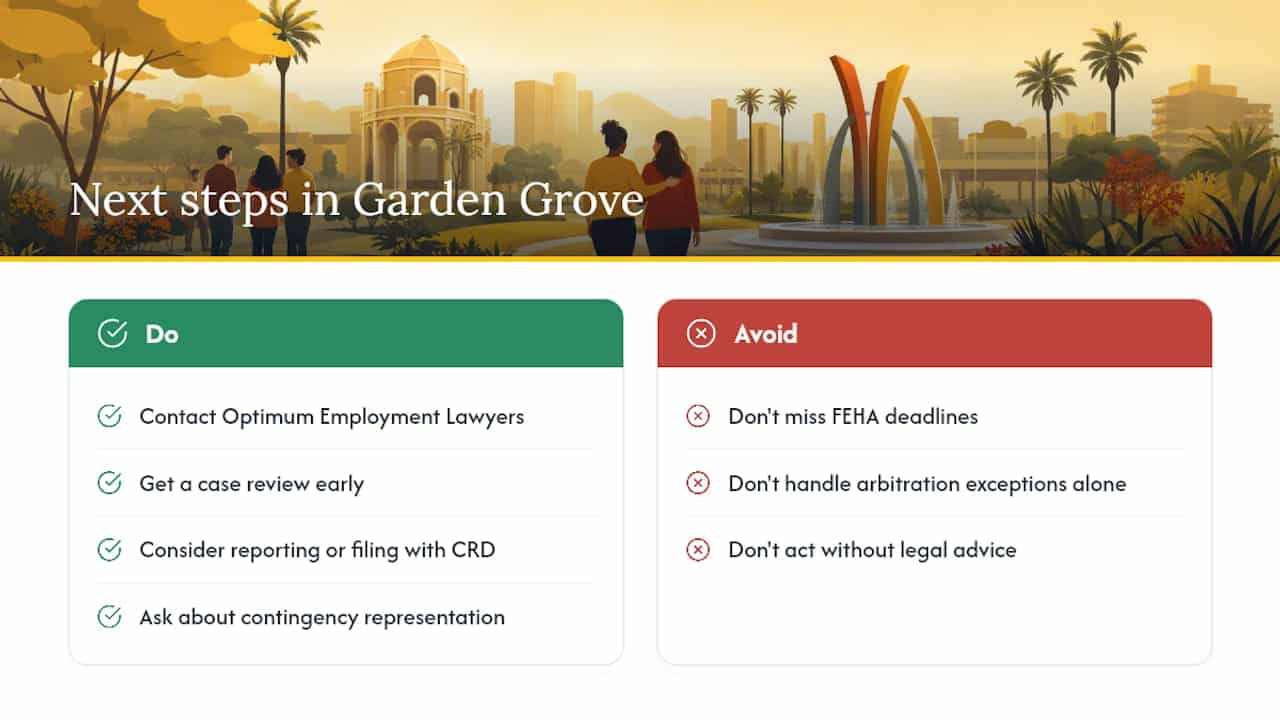
If you’re dealing with same-sex hostile work environment harassment in Garden Grove, you don’t need to figure out FEHA deadlines, CRD paperwork, and arbitration exceptions on your own while also just trying to get through your workday. Some legal firms represent employees exclusively, focusing strategy on achieving compensation and protection rather than preserving a company relationship. Such firms have experience handling same-sex-based hostile work environment claims in Orange County communities near Garden Grove and offer reviews of severance agreements.
Contingency-based representation means clients typically pay no upfront fees and legal fees are paid only if the case results in a settlement or court award. If you’re weighing whether to report, file with CRD, or push back on an arbitration clause, contact Optimum Employment Lawyers for a case review before any deadlines close in on you.
This article is general information, not a substitute for advice from a qualified lawyer. Consult a qualified legal professional about your own circumstances before acting on anything here.
Yes. FEHA protects against harassment based on sexual orientation regardless of the harasser’s own orientation, since the law focuses on the conduct and its effect on the workplace, not the harasser’s identity.
Not necessarily. Under California’s legislative findings, a single incident can be enough if it’s severe enough to unreasonably interfere with your work.
You generally need to file with CRD promptly after the last discriminatory act, so check the CRD complaint process as soon as possible rather than assuming you have unlimited time.
Not always. The Decloedt v. Radnet decision found that sexual orientation harassment can trigger EFAA protections, which can let you avoid a mandatory arbitration clause in cases tied to sexual harassment.
Document the retaliatory actions the same way you documented the original harassment, then contact an employment lawyer promptly, since retaliation can be a separate, independently compensable violation.

© 2026 Optimum Employment Lawyers, PC
Legal Disclaimer | Privacy Policy
 Share
Share
