
(949) 954-8181 Free Case Review No recovery, no fee.
(949) 954-8181 Free Case Review No recovery, no fee.
A same sex-based hostile work environment is defined under California law as a workplace where an employee faces unwelcome, severe, or pervasive conduct tied to their actual or perceived sexual orientation that materially alters their working conditions. California’s Fair Employment and Housing Act (FEHA), codified at Government Code § 12940(j), prohibits this conduct explicitly. The California Civil Rights Department (CRD) enforces these protections for workers across the state, including Fullerton employees. If you work in Fullerton and face this kind of harassment, you have concrete legal rights and a clear path to hold your employer accountable. Understanding those rights is the first step toward doing something about it.
A same sex-based hostile work environment in Fullerton covers far more than physical contact. Harassment includes verbal, visual, physical, and digital forms such as lewd emojis, anti-gay jokes, unwanted touching, and suggestive memes sent through workplace messaging apps. That definition matters because many employees mistakenly believe they need to prove physical assault to have a valid claim.
The conduct must be unwelcome and connected to sexual orientation. Specific examples that qualify include:
FEHA also protects employees against harassment based on perceived sexual orientation. That means if a coworker harasses you because they assume you are gay, even if that assumption is wrong, you still have a valid claim. The law does not require you to be a member of the LGBT community to be protected from this type of harassment.
Pro Tip: Document what your employer calls “banter” or “jokes.” Courts recognize atmospheric evidence, meaning a pattern of humiliating comments, exclusionary behavior, and digital messages, as proof of a hostile environment even without a single physical incident.

Proof of a hostile work environment requires showing that the conduct was severe or pervasive enough to change your employment conditions. California Government Code § 12923 and § 12940(j) set this standard. One single egregious act, such as a physical assault or an extreme public humiliation, can meet the severity threshold on its own. A pattern of repeated lesser acts meets the pervasiveness threshold.
Here is how courts evaluate these claims in practice:
Employers are strictly liable for supervisor harassment. That means you do not need to prove your employer knew about a supervisor’s conduct. For coworker harassment, you must show the employer knew or should have known about it and failed to act. This distinction is critical when you are deciding how to frame your claim.
The continuing violation doctrine allows you to link older harassment incidents to your current claim, even if those incidents fall outside the standard filing window. If the harassment was cumulative and ongoing, earlier acts can support your case. This doctrine is especially useful when a hostile environment built gradually over months or years.
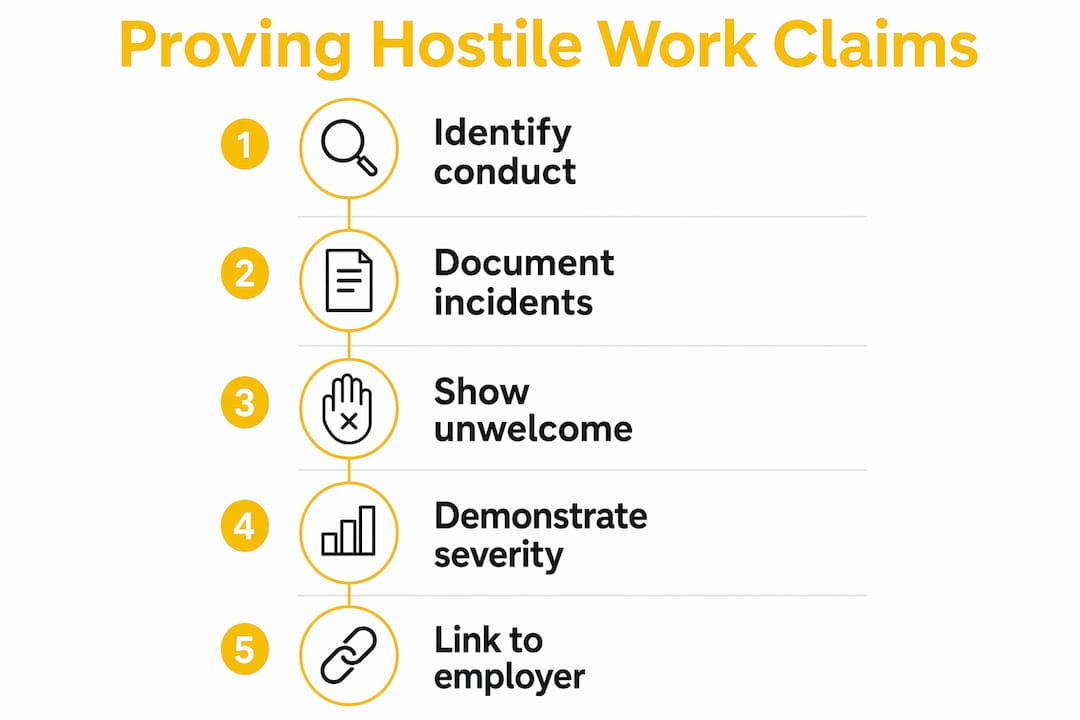
Employers must take reasonable steps to prevent harassment under Government Code § 12940(j). A Fullerton employer who ignores complaints, fails to train supervisors, or retaliates against reporters faces heightened liability. You can learn more about how supervisor liability works under California law and how courts assign responsibility in these cases.
Pro Tip: Start a private log the same day an incident occurs. Record the date, time, location, exact words used, names of witnesses, and your emotional response. Courts treat contemporaneous notes as credible evidence, especially when they predate any formal complaint.
The filing deadline is strict. California employees must file a CRD complaint within 3 years of the last act of harassment to preserve their right to sue under FEHA. Missing that deadline bars your claim entirely. The clock starts on the date of the most recent incident, not the first one.
Before you file anything, consult an employment lawyer. Filing a CRD complaint requires careful drafting because how you word the complaint directly affects the scope of any future lawsuit. An attorney can help you identify every viable legal theory before you commit to a written record.
The practical steps for Fullerton employees are:
Fullerton employees also have access to federal protections. The U.S. Equal Employment Opportunity Commission (EEOC) enforces Title VII of the Civil Rights Act, which the Supreme Court confirmed in Bostock v. Clayton County (2020) covers sexual orientation discrimination. You can file with both the CRD and the EEOC simultaneously to preserve all options. If you were fired for reporting harassment, that retaliation is a separate legal claim under FEHA.
A Fullerton employment lawyer with experience in hostile work environment cases can assess whether your facts support a claim, identify the right defendants, and calculate realistic damages before you spend time on the process.
Same sex-based hostile work environment claims share legal DNA with other discrimination claims but carry distinct features. The table below compares key aspects across claim types.
| Claim type | Protected characteristic | Employer liability standard | Perceived status covered | Key statute |
|---|---|---|---|---|
| Same sex-based hostile work environment | Sexual orientation (actual or perceived) | Strict for supervisors; negligence for coworkers | Yes | FEHA § 12940(j) |
| Sex-based harassment | Sex or gender | Strict for supervisors; negligence for coworkers | Yes | FEHA § 12940(j) |
| Race discrimination | Race or national origin | Negligence for coworkers; strict for supervisors | Limited | FEHA § 12940(a) |
| Gender identity harassment | Gender identity or expression | Strict for supervisors; negligence for coworkers | Yes | FEHA § 12940(j) |
Sexual orientation harassment and sex-based harassment often overlap. A gay employee who faces comments about being “too feminine” may have claims under both categories. Filing under multiple theories strengthens the case and increases potential remedies. Sexual orientation discrimination claims can yield damages for emotional distress, back pay, front pay, and punitive damages in egregious cases.
Race discrimination claims under FEHA follow the same negligence standard for coworker conduct, but courts have awarded substantial verdicts. A $21 million verdict in a racial slur case shows how seriously California courts treat workplace harassment when employers ignore known misconduct. The same principle applies to LGBT workplace discrimination in Fullerton. Employers who look the other way face significant financial exposure.
The perceived status protection is a feature that sets FEHA apart from many other state laws. Protection extends to perceived sexual orientation, meaning a straight employee harassed because coworkers assume they are gay has a fully viable claim. This protection aligns with California’s broader policy of eliminating discrimination based on assumptions, not just confirmed identity. You can review the full scope of illegal workplace harassment under California law to understand where your situation fits.
If your employer terminated you after you reported harassment or filed a complaint, that is wrongful termination under FEHA. Discriminatory termination claims in California follow a separate but related legal path and can be filed alongside a hostile work environment claim for maximum recovery.
A same sex-based hostile work environment in Fullerton is illegal under FEHA, and employees who experience it have three years to file a CRD complaint and multiple legal pathways to recover damages.
| Point | Details |
|---|---|
| FEHA covers perceived orientation | You have a valid claim even if your employer only assumed your sexual orientation incorrectly. |
| Severity or pervasiveness required | One egregious act or a pattern of repeated conduct both satisfy the legal threshold under § 12923. |
| Strict liability for supervisors | You do not need to prove employer knowledge when a supervisor is the harasser. |
| Three-year filing deadline | File with the CRD within three years of the last incident or lose your right to sue. |
| Consult a lawyer before filing | How you draft the CRD complaint shapes the scope of any future lawsuit. |
Employees-lawyer, operating as Optimum Employment Lawyers, focuses exclusively on employee-side cases across California, including Fullerton. The firm handles same sex-based hostile work environment claims, LGBT workplace discrimination cases, wrongful termination, and related matters. Their track record includes a $2.2 million class action settlement, which reflects the firm’s willingness to pursue aggressive legal strategies when employers violate California law. If you are facing harassment at work and need to understand your options, speaking with a California employment lawyer is the most direct way to protect your rights and evaluate your claim before the filing deadline passes.
A same sex-based hostile work environment exists when an employee faces unwelcome conduct tied to actual or perceived sexual orientation that is severe or pervasive enough to alter working conditions under FEHA Government Code § 12940(j).
Yes. FEHA protects employees against harassment based on both actual and perceived sexual orientation, so a claim is valid even if the harasser’s assumption about your orientation was wrong.
California employees must file a CRD complaint within three years of the last act of harassment. Missing this deadline eliminates the right to sue under FEHA.
Yes, but you must prove the employer knew or should have known about the harassment and failed to take reasonable corrective action. For supervisor harassment, strict liability applies and no proof of employer knowledge is needed.
Consult a California employment lawyer first. How you draft an internal complaint or CRD filing directly affects the scope of your legal claim, and early legal advice protects your options before you commit anything to writing.

© 2026 Optimum Employment Lawyers, PC
Legal Disclaimer | Privacy Policy
 Share
Share
