
(949) 954-8181 Free Case Review No recovery, no fee.
(949) 954-8181 Free Case Review No recovery, no fee.
Gender and sexual orientation discrimination is defined as treating an employee unfairly because of their gender identity, gender expression, or sexual orientation, and it is explicitly illegal under California law. Laguna Niguel employees face this type of workplace discrimination in Laguna Niguel more often than many realize, from biased hiring decisions to daily harassment. California’s Fair Employment and Housing Act (FEHA) and federal Title VII both prohibit these practices, and the 2020 U.S. Supreme Court ruling in Bostock v. Clayton County confirmed that Title VII covers sexual orientation and gender identity. Knowing your rights under these laws is the first step toward protecting yourself.
California’s FEHA is the strongest employment discrimination law in the country for LGBTQ+ workers. It covers employers with five or more employees and prohibits discrimination based on sex, gender, gender identity, gender expression, and sexual orientation. FEHA goes further than federal law in several key ways, including broader definitions of protected classes and stronger remedies for employees.
Federal law also provides protection. Title VII of the Civil Rights Act of 1964 applies to employers with 15 or more employees. The Supreme Court’s Bostock v. Clayton County decision in 2020 settled the question at the federal level: firing or discriminating against someone for being gay or transgender violates Title VII. That ruling applies directly to Laguna Niguel employers covered by federal law.
California’s FEHA provides strong protection independent of any federal enforcement changes. This matters because federal enforcement has shifted. The EEOC rescinded its 2024 harassment guidance after a 2025 Texas federal court ruling, creating a gap in federal enforcement that California law fills completely for employees working in Laguna Niguel.
Key protections under FEHA and Title VII include:
Pro Tip: If you work for a Laguna Niguel employer with fewer than 15 employees, federal Title VII may not apply to you, but California’s FEHA still does. Always check both laws when evaluating your situation.
Discrimination in the workplace rarely announces itself. Most employees in Laguna Niguel encounter it through patterns of behavior that are easy to dismiss individually but form a clear picture when documented together.

Hiring bias is one of the most documented and least discussed forms. Research shows that gay-sounding speakers are perceived as 11% less employable than straight-sounding speakers in hiring contexts. That gap exists before a candidate even submits a resume. It reflects unconscious bias that shapes decisions in interviews and reference checks alike.
Common forms of discrimination Laguna Niguel employees report include:
The data on workplace climate tells a stark story. Workers at organizations scaling back diversity efforts report more than double the rate of workplace stigma compared to those at companies maintaining inclusion practices. That finding means the rollback of diversity, equity, and inclusion programs is not a neutral business decision. It directly increases the risk of bias and harassment for LGBTQ+ employees.
| Discrimination Type | Common Example | Legal Status Under FEHA |
|---|---|---|
| Hiring bias | Rejecting candidate based on perceived orientation | Prohibited |
| Misgendering | Repeated wrong pronoun use after correction | Harassment |
| Promotion denial | Skipping LGBTQ+ employee for advancement | Prohibited |
| Pay disparity | Lower wages based on gender expression | Prohibited |
| Outing | Disclosing orientation without consent | Harassment |
Pro Tip: Keep a private log of every incident with dates, times, locations, and witnesses. Courts and agencies rely heavily on documented patterns, not isolated memories.
Acting quickly and methodically after experiencing discrimination gives you the strongest possible legal position. The steps below apply whether you work in a small Laguna Niguel business or a large corporation.
Document everything first. Write down each incident the same day it happens. Include the date, time, location, what was said or done, who was present, and any witnesses. Save emails, texts, or written communications that relate to the discrimination. This record becomes the foundation of any complaint or lawsuit.
Use internal reporting channels. Most employers in Laguna Niguel have a human resources department or a written harassment policy. Report the discrimination in writing, not just verbally. A written complaint creates a paper trail and puts the employer on notice. Keep a copy of everything you submit.
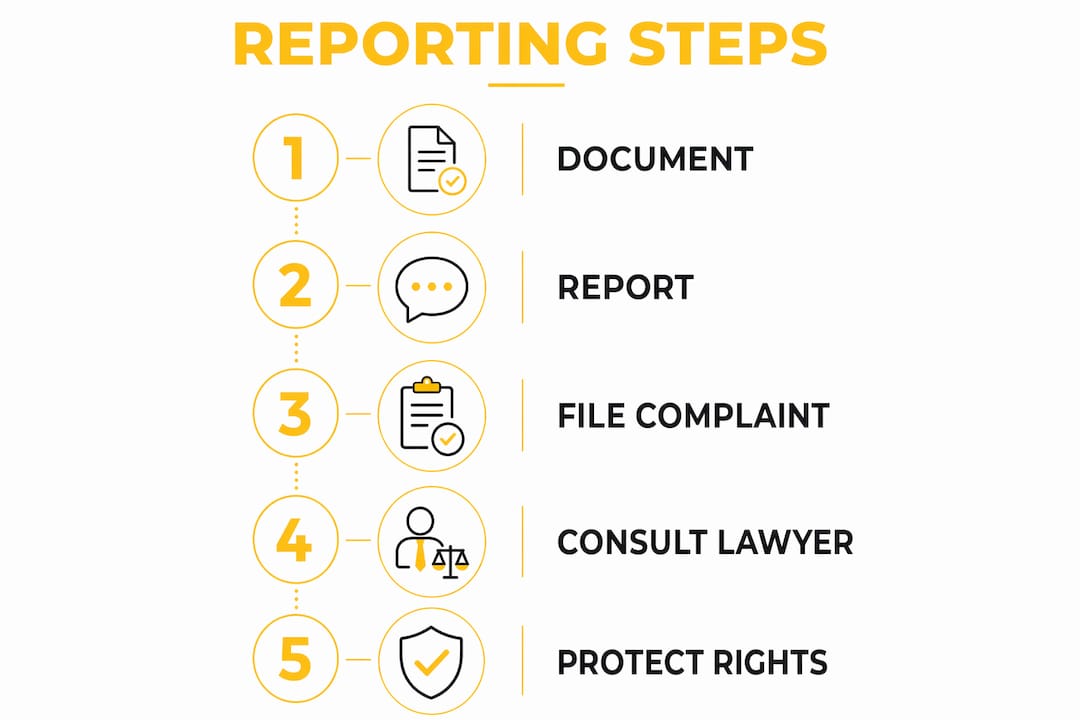
File a complaint with the California Civil Rights Department (CRD), formerly known as the DFEH. California law requires employees to file a complaint with the CRD before filing a civil lawsuit. You generally have three years from the date of the discriminatory act to file. The CRD investigates complaints and can pursue enforcement on your behalf.
Contact the EEOC if federal law applies. If your employer has 15 or more employees, you can also file with the Equal Employment Opportunity Commission. The EEOC deadline is 300 days from the discriminatory act in California. Filing with both agencies is possible and sometimes advisable.
Evaluate your employer’s policies using the Corporate Equality Index. The Human Rights Campaign Foundation’s Corporate Equality Index scores companies on LGBTQ+ workplace policies. If your employer scores poorly, that context can support your claim that the company culture enabled discrimination.
Consult a California employment lawyer before making major decisions. Accepting a settlement, signing a separation agreement, or resigning can affect your legal rights. An attorney who focuses on employee-side discrimination cases can review your situation and tell you what your options are worth before you commit to anything.
Employees who face discrimination or harassment are protected from retaliation when they report workplace issues. Retaliation includes demotion, schedule changes, increased scrutiny, or termination after a complaint. If your employer retaliates, that is a separate legal claim on top of the original discrimination.
The federal enforcement picture shifted significantly in 2025. The EEOC’s 2024 harassment guidance had explicitly recognized sexual orientation and gender identity harassment as unlawful under Title VII. A federal court in Texas vacated portions of that guidance in 2025, ruling the EEOC had overstepped its authority. The EEOC then rescinded the 2024 guidance entirely, creating a real gap in federal enforcement.
“The rescission of EEOC’s 2024 harassment guidance weakens federal enforcement but underscores the critical role of state laws like California’s FEHA.” — Ogletree Deakins, 2026
For Laguna Niguel employees, this federal shift matters less than it would in other states. California’s FEHA remains fully intact and provides protections that exceed what federal law offered even before the rescission. The Bostock ruling still stands as binding Supreme Court precedent, so Title VII’s core prohibition on sexual orientation and gender identity discrimination has not changed.
What has changed is the EEOC’s willingness to pursue harassment claims on behalf of LGBTQ+ employees at the federal level. Employees who previously might have relied on the EEOC to investigate and litigate their claims now face a less receptive federal agency. The practical implication is clear: California employees should prioritize filing with the CRD and working with California-licensed employment attorneys who know FEHA inside and out.
Watch for these developments in 2026 and beyond:
Nearly 30% of Gen Z identify as LGBTQ+, representing a substantial and growing share of the workforce. Employers in Laguna Niguel who fail to maintain inclusive workplaces face not only legal liability but also significant talent and reputational risk.
Optimum Employment Lawyers, the team behind Employees-lawyer, represents employees exclusively. The firm handles gender and sexual orientation discrimination cases throughout Orange County, including Laguna Niguel, with a focus on aggressive, personalized advocacy. Their track record includes a $2.2 million class action settlement for workers whose basic rights were violated by their employer. If you are facing workplace discrimination in California, the firm offers consultations to help you understand your options before you make any decisions. You do not have to navigate the CRD complaint process, a hostile HR department, or a settlement negotiation alone. Employees-lawyer fights on your side, not your employer’s. Learn more about your rights as a Laguna Niguel employee and take the first step toward accountability.
California’s FEHA gives Laguna Niguel employees the strongest legal protection against gender and sexual orientation discrimination in the country, independent of any federal enforcement changes.
| Point | Details |
|---|---|
| FEHA is your primary protection | California law covers employers with 5+ employees and prohibits all forms of gender and sexual orientation discrimination. |
| Federal enforcement has weakened | The EEOC rescinded its 2024 harassment guidance, making state-level filing with the CRD more important than ever. |
| Bias starts at hiring | Research shows gay-sounding speakers are perceived as 11% less employable, proving discrimination begins before day one. |
| Document every incident | Written records with dates, witnesses, and specifics are the foundation of any successful discrimination claim. |
| Retaliation is also illegal | Reporting discrimination is a protected activity, and any employer response that punishes you for reporting is a separate legal violation. |
The Fair Employment and Housing Act is California’s primary anti-discrimination law. It prohibits employers with five or more employees from discriminating based on sexual orientation, gender identity, and gender expression, and it provides broader protections than federal Title VII.
No. The EEOC’s rescission of its 2024 harassment guidance affects federal enforcement, not California law. FEHA remains fully in force and independently protects LGBTQ+ employees in Laguna Niguel regardless of federal agency changes.
You generally have three years from the date of the discriminatory act to file a complaint with the California Civil Rights Department. Missing this deadline can eliminate your right to sue, so acting promptly is critical.
Under California law, repeated misgendering after correction, denying a transgender employee access to facilities consistent with their gender identity, and outing an employee without consent all constitute unlawful harassment.
No. Retaliation against an employee for reporting discrimination or participating in an investigation is prohibited by law. If your employer takes adverse action after you report, that retaliation is itself a separate legal claim you can pursue.

© 2026 Optimum Employment Lawyers, PC
Legal Disclaimer | Privacy Policy
 Share
Share
