
(949) 954-8181 Free Case Review No recovery, no fee.
(949) 954-8181 Free Case Review No recovery, no fee.


If you work in Costa Mesa, CA, your employer does not get to treat you however they want just because California is an at-will employment state. That is one of the most damaging misconceptions workers carry into their jobs, and it costs them real money and real careers. Workplace misconduct including discrimination, harassment, retaliation, wage theft, and wrongful termination affects employees across Costa Mesa every day. This guide explains what the law actually protects, what deadlines you cannot afford to miss, and exactly what steps to take if your employer has crossed a legal line.
| Point | Details |
|---|---|
| At-will has limits | Employers cannot fire you for discriminatory, retaliatory, or contract-violating reasons even in an at-will state. |
| Discrimination deadlines are strict | You have 300 days to file a federal EEOC claim and three years under California’s FEHA. |
| Wage theft is common and provable | California’s 2026 minimum wage is $16.90/hr, and underpayment is a documented, recoverable violation. |
| Documentation wins cases | Saving texts, emails, pay stubs, and performance reviews gives your attorney the foundation to build a strong claim. |
| Free consultations exist | Many employment lawyers in Costa Mesa offer no-cost initial case reviews before you commit to anything. |
Wrongful termination is the legal term for being fired in a way that violates California law, a contract, or public policy. It does not mean every unfair firing is illegal. But it does mean a wide range of firings that employers assume are legal actually are not.
California wrongful termination claims can arise from several distinct legal grounds:
Costa Mesa employees should start gathering evidence immediately after a termination. That means collecting termination letters, pay stubs, performance reviews, and a written timeline of events. The more specific your documentation, the stronger your case becomes. Note dates, names of supervisors, and the exact reasons given for the firing.
Pro Tip: Write down everything you remember about the circumstances of your termination within 24 to 48 hours while details are fresh. Include names, dates, what was said, and who witnessed it. This contemporaneous account carries real weight with attorneys and in court.

If you are unsure whether your firing qualifies as wrongful, the right move is to speak with an employment attorney in Costa Mesa before you assume you have no case. Many workers leave significant compensation on the table simply because they never asked.
California’s Fair Employment and Housing Act (FEHA) and the federal Title VII both protect employees from discrimination and harassment based on protected characteristics. These laws cover race, gender, age (40 and over), disability, pregnancy, religion, national origin, sexual orientation, and more.
Recognizing unlawful conduct is the first step. Common signs include being passed over for promotions despite strong performance, receiving harsher discipline than colleagues in similar situations, being subjected to offensive comments tied to your identity, or being excluded from meetings and opportunities in ways that track with your protected status.
Once you experience discrimination or harassment, the procedural steps matter enormously. Here is what the process looks like:
“A right-to-sue notice is not optional paperwork. Filing without one leads to automatic dismissal of your case under California law. Get it, and act on it within the deadline.”
The difference between the EEOC route and the FEHA route matters. Federal EEOC investigations can take months or years. If you want to move faster, you can request an immediate right-to-sue notice from the California Civil Rights Department and proceed directly to court. An employment attorney can advise which path fits your situation.
Wage theft is exactly what it sounds like. Your employer takes money you earned and keeps it. It is one of the most widespread labor violations in California, and Costa Mesa workers are not immune.
California’s statewide minimum wage is $16.90 per hour in 2026. Some cities have higher local rates. If your employer pays you less than the applicable rate, that is wage theft. But underpayment is just one form.
| Type of wage violation | What it looks like |
|---|---|
| Unpaid overtime | Working more than 8 hours in a day or 40 in a week without time-and-a-half pay |
| Off-the-clock work | Being asked to prep, clean, or work before clocking in or after clocking out |
| Missed meal and rest breaks | Not receiving a 30-minute meal break for shifts over 5 hours or 10-minute rest breaks per 4 hours worked |
| Worker misclassification | Being labeled an independent contractor to avoid paying benefits and overtime |
| Tip theft | Supervisors or managers taking a share of employee tips |
The penalties for these violations are real. Employers who fail to pay wages on time face waiting time penalties equal to one day of wages for every day the payment is late, up to 30 days. That adds up fast.
If you are owed wages, you have two main options. Filing a wage claim with the California Labor Commissioner’s Office (also called the DLSE) is a free administrative process. For amounts under $10,000, small claims court is another accessible option that does not require an attorney.
Pro Tip: Keep personal copies of all your pay stubs, time records, and any written communications about your schedule or pay rate. Employers sometimes alter or destroy records after a complaint is filed. Your own copies become critical evidence.
The wage and hour violations that hit Costa Mesa workers hardest often involve misclassification. A company in the food service, retail, or gig sector labels workers as contractors to avoid overtime and benefit obligations. If you control your own schedule and tools, that classification may be legitimate. If the company controls your hours, location, and methods, you are likely an employee under California law and entitled to full wage protections.
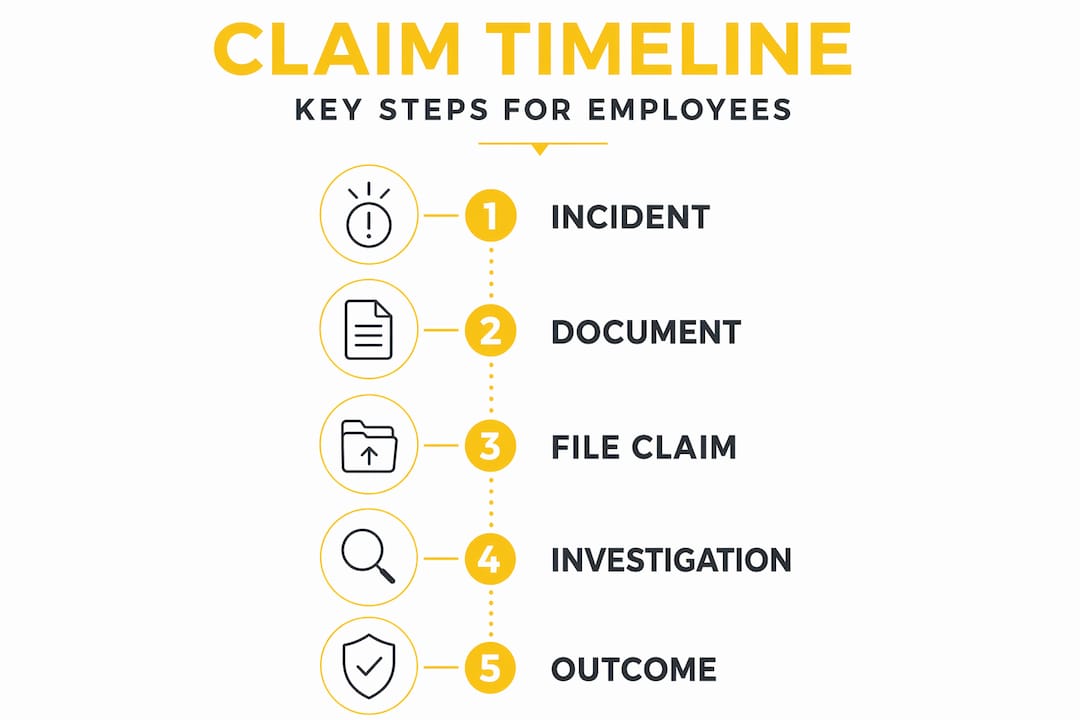
Knowing your rights is one thing. Acting on them correctly is another. Here is a clear sequence to follow after experiencing wrongful termination, discrimination, or wage theft in Costa Mesa.
Understanding possible outcomes helps you set realistic expectations. Many employment cases resolve through negotiated settlements before trial. Others proceed through agency investigations or mediation. A small number go to court. The outcome depends on the strength of your evidence, the nature of the violation, and the quality of your legal representation.
For guidance on what to do right after receiving a termination notice, the resource on responding to wrongful termination walks through the immediate steps in detail.
I have seen a consistent pattern in employment cases across Orange County, and Costa Mesa is no exception. Workers who wait too long, assume their situation is not serious enough, or try to resolve things internally without documentation almost always end up with weaker cases. The employees who fare best are the ones who treated the situation like a legal matter from day one, even before they knew they had a claim.
What I find most frustrating is how often workers underestimate California law. This state has some of the strongest employee protections in the country. The FEHA covers employers with five or more employees, which means most small businesses in Costa Mesa are covered. Retaliation protections apply even if the underlying complaint turns out to be unfounded, as long as you had a good-faith belief when you reported it.
I have also watched workers get burned by severance agreements they signed under pressure. A company hands you a check and a document on your last day and tells you to sign. That document almost always contains a release of claims. Once you sign, the legal options you had are largely gone. Never sign without at least one attorney review.
The retaliation and wrongful termination cases that result in the best outcomes share one thing: the employee built a record. Not because they planned to sue, but because they were thorough. That habit alone changes what is possible.
If you work in Costa Mesa and believe your employer has violated your rights, Employees-lawyer is the firm to call. Optimum Employment Lawyers focuses exclusively on the employee side of workplace disputes, which means every strategy, every argument, and every negotiation is built around getting you the best possible outcome, not protecting a company’s bottom line.
Their team handles wrongful termination, workplace discrimination, sexual harassment, retaliation, and wage and hour claims across Costa Mesa and Orange County. They have secured significant results for clients, including a $2.2 million class action settlement for workers whose meal break rights were violated. That kind of outcome does not happen without aggressive, focused legal advocacy.
You can start with a free, confidential consultation. Visit Optimum Employment Lawyers to speak with an attorney who will evaluate your situation without pressure and without cost. Your employer has legal counsel. You should too.
Wrongful termination in Costa Mesa occurs when an employer fires you for an illegal reason, including discrimination, retaliation, contract breach, or violation of public policy. California’s at-will employment rule does not protect employers who fire workers for these reasons.
You have 300 days to file a federal EEOC complaint and up to three years to file under California’s FEHA. After receiving a right-to-sue notice, you have one year to file a lawsuit in court.
Wage theft includes unpaid overtime, missed breaks, off-the-clock work, and misclassification as an independent contractor. You can report it by filing a claim with the California Labor Commissioner’s Office or by consulting an employment attorney for larger or more complex violations.
No. You can file a wage claim with the DLSE or in small claims court for amounts under $10,000 without an attorney. However, an employment lawyer can significantly increase your recovery in cases involving complex violations or large unpaid amounts.
No. Retaliating against an employee for reporting discrimination or harassment is illegal under both federal and California law. If you were fired or demoted after making a complaint, that retaliation itself may be a separate legal claim.

© 2026 Optimum Employment Lawyers, PC
Legal Disclaimer | Privacy Policy
 Share
Share
