
(949) 954-8181 Free Case Review No recovery, no fee.
(949) 954-8181 Free Case Review No recovery, no fee.
If you work in Mission Viejo, California, federal law protects you from sexual harassment and from retaliation for reporting it. The single most important thing to do right now is document what happened and follow your employer’s reporting policy, because strict deadlines apply: the California Civil Rights Department gives you three years to file an intake, and the EEOC’s window is far shorter. If your case is urgent or your employer has not acted, we offer a free case review.
TL;DR:
- Employees must document incidents promptly, including saving messages and witness contacts, and avoid storing evidence on employer devices.
- Sexual harassment claims can arise from a single severe incident, and California law covers harassment based on gender identity, sexual orientation, and non-sexual hostile conduct.
- The California Civil Rights Department allows three years to file an intake, but the EEOC’s federal deadline is only 180 or 300 days, requiring quick action.
- Employers are liable if harassment results in tangible employment actions or fail to take prompt corrective measures, with training mandated for workplaces of five or more employees.
- Reporting harassment protects employees from retaliation, but adverse actions afterward can support additional legal claims if employers respond inadequately.
The first few days after an incident shape how strong your case will be later. Act in this order:
California’s Fair Employment and Housing Act (FEHA) and federal Title VII recognize two legal categories of sexual harassment. Quid pro quo harassment happens when a job benefit, a raise, a promotion, or even keeping your job is tied to accepting sexual advances. Hostile work environment harassment happens when unwelcome conduct becomes severe or pervasive enough that it changes the conditions of your employment, a standard the EEOC applies nationwide.
California law covers more ground than many employees expect:
Under California Government Code section 12923, a single incident can be severe enough to create a hostile work environment on its own; you do not need a pattern of repeated conduct to have a valid claim. Courts are directed to weigh the totality of the circumstances rather than apply a narrow test that would exclude legitimate claims. If you are unsure whether what happened to you qualifies, our explainer on California sexual harassment law breaks down the statutory language further.
FEHA requires California employers to take reasonable steps to prevent and correct harassment, and it applies more broadly than federal law in several respects, including to smaller employers and a wider range of protected conduct. Title VII, the federal counterpart, overlaps with FEHA but generally applies to employers with 15 or more employees, while the Americans with Disabilities Act and Age Discrimination in Employment Act cover related but distinct forms of discrimination and retaliation that sometimes arise alongside harassment claims.
Remedies available to employees who prove their case can include:
Employers of five or more employees in California must provide sexual harassment prevention training: two hours every two years for supervisors and one hour for nonsupervisory employees, according to CRD’s harassment prevention guide. That training requirement exists because prevention, not just punishment, is the legal standard employers are held to.
Employer liability depends heavily on who did the harassing. When a supervisor’s harassment results in a tangible employment action, like firing, demotion, or a pay cut, the employer is automatically liable. When there is no tangible action, the employer can avoid liability only by proving it took prompt, reasonable corrective steps and that the employee unreasonably failed to use the reporting channels available, a standard laid out in EEOC guidance on harassment facts.
Missing a filing deadline can end a valid claim before it starts, so timing matters as much as the facts themselves.
The CRD intake deadline runs three years from the last harmful act, while the EEOC’s charge deadline is only 180 or 300 days, depending on your state, a gap that catches many employees off guard, according to the CRD and EEOC.
CRD intake can be started online through the agency’s website, and the CRD’s services page lists phone support at 800-884-1684 for employees who prefer to talk through the process first. If a deadline is close and you are not sure which agency to file with, getting counsel involved quickly is the safest way to avoid losing either option, since a lawyer can file protective paperwork while the facts of your case are still being gathered. Mission Viejo employees dealing with a same-sex hostile work environment claim face the same three-year CRD window, which we cover in more detail in our guide to filing same-sex hostile work claims.
Strong documentation turns a “he said, she said” dispute into a provable pattern, and it is often the difference between a claim that settles and one that gets dismissed.
Pro Tip: Email yourself a dated summary of each incident from your personal account the same day it happens; the timestamp alone can become important evidence later.
Documentation does more than refresh your memory. It helps prove that your employer had notice of the harassment and either failed to act or acted too slowly, which is often the exact issue that determines whether an employer can be held liable.
Once you report, California guidance expects your employer to conduct a prompt, impartial investigation that includes interviews with you, the accused, and relevant witnesses, with no assumption of guilt on either side. Interim measures should protect you without punishing you.
If your employer drags its feet, dismisses your complaint without investigating, or responds by making your job harder, that inadequate response can itself become grounds for a separate legal claim. Our guide to gender and sexual orientation discrimination in Mission Viejo workplaces covers related situations where an employer’s response, not just the original conduct, becomes the central issue.
We represent employees exclusively, never employers, which means every recommendation we make is built around what gets you the best outcome, not what protects a company’s liability. If you are in Mission Viejo and dealing with harassment that your employer has ignored, minimized, or retaliated against you for reporting, a free case review is the fastest way to find out where you stand before a deadline passes.
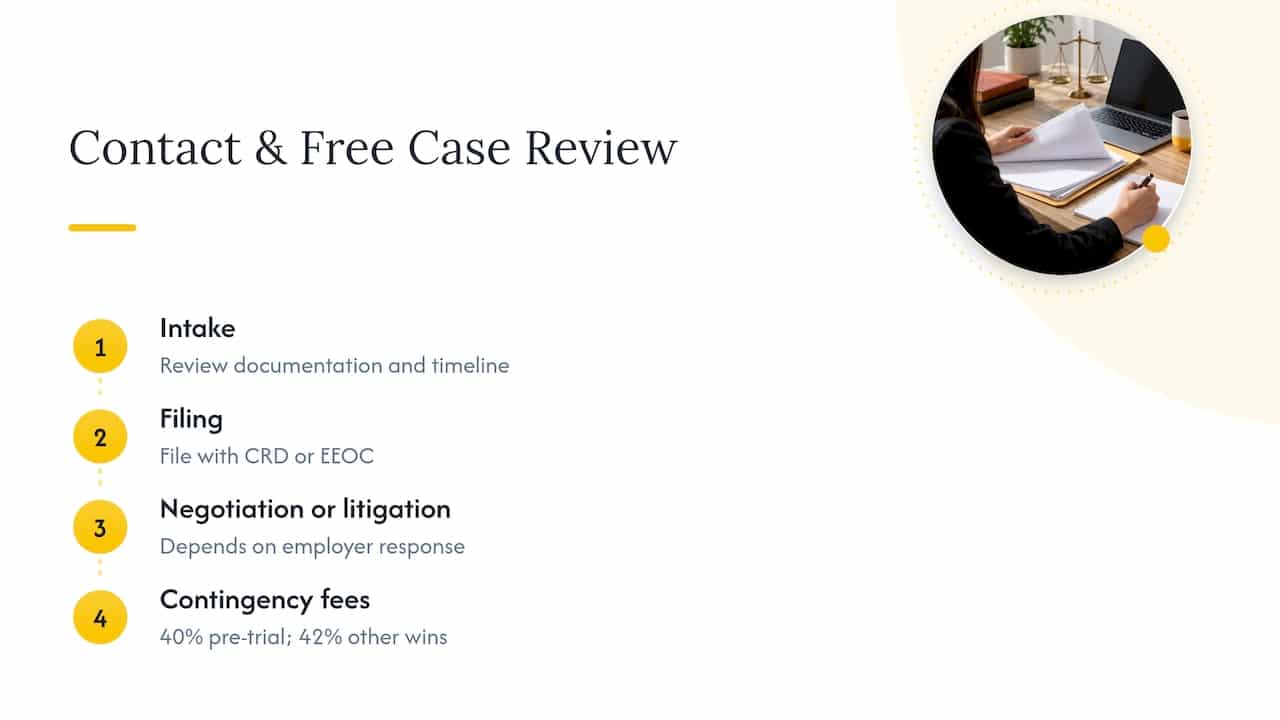
A typical engagement starts with intake, where we review your documentation and timeline, followed by filing with the CRD or EEOC if it has not already happened, and then negotiation or litigation depending on how your employer responds. We take cases on contingency, meaning you owe nothing upfront: our fee is 40% of a pre-trial settlement or 42% of any other win, so payment only comes out of money we recover for you.
Beyond sexual harassment, we handle the full range of wage and hour violations, discrimination, and retaliation claims that often surface alongside a harassment complaint, since one problem at work rarely shows up alone. If you are weighing your options, our broader Mission Viejo employee rights guide is a useful starting point before you decide whether to move forward with a claim.
This article is general information, not a substitute for advice from a qualified lawyer. Consult a qualified legal professional about your own circumstances before acting on anything here.
A private, dated incident log with specific quotes, witness names, and saved messages, photos, or documents is the core evidence employees need. Contemporaneous records, meaning notes taken close to when the incident happened, carry more weight than a recollection written months later.
Unwelcome conduct based on a protected characteristic qualifies as harassment when enduring it becomes a condition of keeping your job, or when it is severe or pervasive enough to create a hostile work environment, according to the EEOC. A single sufficiently severe incident can meet that standard under California law, even without a repeated pattern.
Definitions vary by source, but common categories include quid pro quo harassment, hostile work environment harassment, verbal harassment, physical harassment, and visual harassment involving images or gestures. California’s FEHA primarily organizes claims around the first two categories, with the others typically described as types of conduct rather than separate legal claims.
You generally have three years from the last harmful act to file an intake with the California Civil Rights Department, and typically one year after receiving a Right-to-Sue notice to file a civil lawsuit. If you also want to preserve federal claims, the EEOC deadline is far shorter at 180 or 300 days.
No, retaliation for reporting harassment or participating in an investigation is illegal under both state and federal law. Materially adverse actions like termination, demotion, or a cut in hours taken after a report can themselves support a separate legal claim, according to EEOC retaliation guidance.

© 2026 Optimum Employment Lawyers, PC
Legal Disclaimer | Privacy Policy
 Share
Share
