
(949) 954-8181 Free Case Review No recovery, no fee.
(949) 954-8181 Free Case Review No recovery, no fee.

Employees in Mission Viejo, California are protected by some of the strongest workplace rights laws in the country, covering wrongful termination, wage theft, and workplace discrimination. California’s Fair Employment and Housing Act (FEHA), the California Labor Code, and federal statutes like Title VII and the Americans with Disabilities Act (ADA) all apply to workers in Mission Viejo. The Equal Employment Opportunity Commission (EEOC) gives California employees 300 days to file a discrimination charge, while California’s FEHA extends the state court deadline to three years. Missing these deadlines ends your legal options permanently. Optimum Employment Lawyers, based in Orange County, represents Mission Viejo employees exclusively on the employee side of these disputes.

Wrongful termination in California is defined as any firing that violates state law, federal law, or public policy. California is an at-will employment state, which means employers can generally end employment for any reason. However, that rule has significant exceptions that protect Mission Viejo workers every day.
California Government Code § 12940 explicitly prohibits employers from firing employees based on protected characteristics or in retaliation for lawful conduct. The most common wrongful termination scenarios Mission Viejo employees face include:
California courts have consistently upheld the Tameny v. Atlantic Richfield Co. doctrine, which established that employees fired in violation of fundamental public policy can sue for wrongful termination even in at-will employment relationships. That 1980 California Supreme Court ruling still shapes cases filed by Mission Viejo workers today.
Documentation is the foundation of any successful wrongful termination claim. Save every performance review, email, text message, and written warning. Note the dates, times, and witnesses for any verbal conversations about your job status. If your employer’s stated reason for firing you does not match your documented record, that inconsistency becomes powerful evidence.
The statute of limitations for a wrongful termination claim tied to discrimination under FEHA is three years from the date of termination. For claims filed under federal law through the EEOC, retaliation claims must be initiated within 300 days of the adverse employment action.
Pro Tip: If you were fired within weeks of filing an internal HR complaint or a government agency report, document the exact timeline. Courts treat close temporal proximity between protected activity and termination as circumstantial evidence of retaliation.
Wage theft is defined as any employer practice that deprives workers of compensation they have legally earned. The California Labor Code sets specific standards for wage payment, overtime, meal breaks, and rest periods. Violations are widespread across Orange County industries, from retail and hospitality to healthcare and construction.
The most common wage theft scenarios affecting Mission Viejo workers follow a predictable pattern:
Optimum Employment Lawyers secured a $2.2 million class action settlement for workers whose employers systematically denied them legally required meal breaks. That case illustrates how individual violations, when multiplied across a workforce, create significant legal exposure for employers and meaningful recovery for employees.
To build a strong wage theft claim, keep personal records of your hours worked, break times, and pay stubs. Screenshot any employer communications that show you were asked to work off the clock. Employees may file wage claims with the California Labor Commissioner’s Office or pursue civil litigation. The statute of limitations for most wage claims in California is three years for statutory violations and four years for claims based on a written contract.
Pro Tip: Keep a personal log of your daily hours in a notes app or personal email. If your employer’s payroll records are inaccurate, your contemporaneous records carry significant weight with the Labor Commissioner.
Workplace discrimination is defined as adverse employment treatment based on a protected characteristic rather than job performance or legitimate business need. FEHA and federal laws including Title VII, the ADA, and the Age Discrimination in Employment Act (ADEA) all apply to Mission Viejo employees working for employers with five or more workers.
Protected categories under FEHA include race, color, religion, sex, gender identity, sexual orientation, national origin, disability, age (40 and over), pregnancy, marital status, and military or veteran status. Harassment becomes illegal when it is severe or pervasive enough to create a hostile work environment. A single incident of extreme conduct, such as a physical assault or a direct racial slur from a supervisor, can meet that threshold.
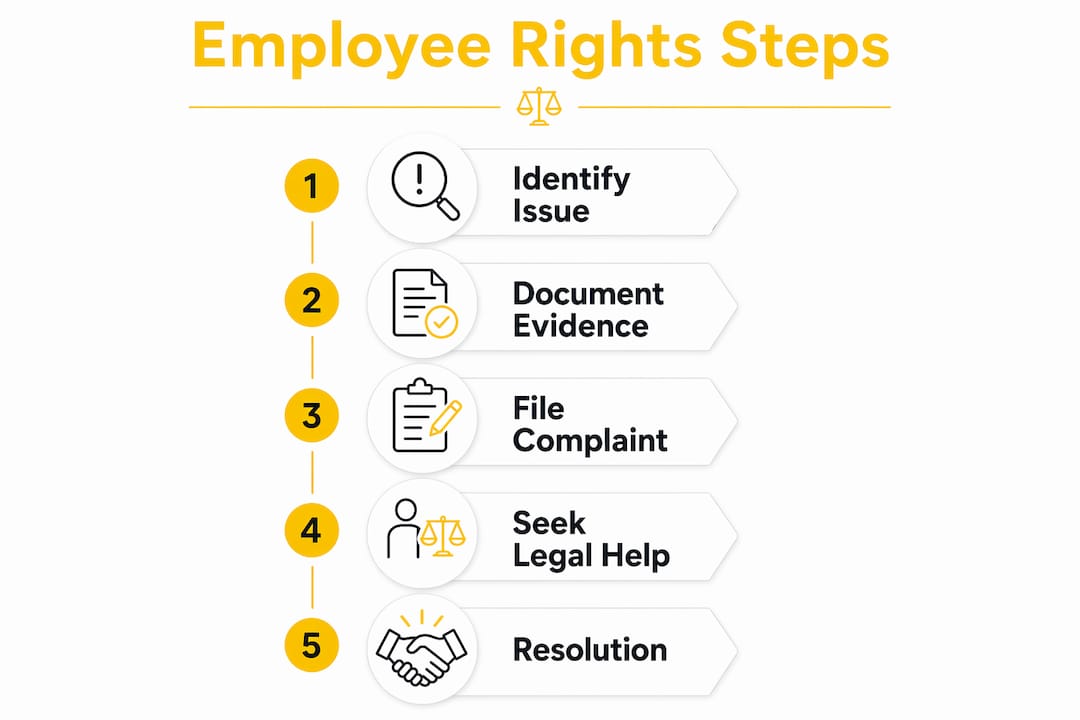
Employees in Mission Viejo who experience discrimination or harassment should take these steps:
The filing deadlines matter enormously. The federal EEOC deadline is 300 days from the discriminatory act. California’s FEHA deadline is three years, which is significantly more protective than the federal window. After the EEOC process concludes and you receive a Right-to-Sue notice, you have 90 days to file a federal lawsuit.
| Claim type | Filing deadline | Agency |
|---|---|---|
| Federal discrimination (EEOC) | 300 days from discriminatory act | EEOC |
| California FEHA discrimination | 3 years from discriminatory act | CA Civil Rights Department |
| Federal lawsuit after EEOC | 90 days from Right-to-Sue notice | Federal court |
| Wage theft (statutory) | 3 years from violation | CA Labor Commissioner |
Retaliation after a discrimination complaint is itself an independent legal violation. Retaliation claims arise when an employer demotes, cuts hours, reassigns, or fires an employee for asserting their rights. These claims carry the same remedies as the underlying discrimination claim, including back pay, front pay, emotional distress damages, and attorney fees.
Mission Viejo employees have multiple pathways for filing complaints and securing legal representation. Knowing which agency handles which type of claim saves critical time.
The primary agencies and resources available to you are:
For employees in neighboring communities, similar resources are available through Aliso Viejo employment lawyers who serve the broader South Orange County area.
The decision between filing an agency complaint and pursuing direct civil litigation depends on your goals and timeline. Agency complaints are free and can result in settlements without litigation. Civil lawsuits can produce larger recoveries, including punitive damages in egregious cases. An employment attorney can evaluate which path produces the best outcome for your specific situation. Most employment lawyers, including Optimum Employment Lawyers, take employee cases on a contingency fee basis, meaning you pay nothing unless you win.
Pro Tip: Consult an employment attorney before filing any agency complaint. The framing of your initial complaint can affect the scope of your legal claims later. An attorney can help you identify all viable claims before you commit to a filing.
California employees in Mission Viejo are protected by overlapping state and federal laws that set strict deadlines, clear remedies, and strong retaliation protections for wrongful termination, wage theft, and discrimination claims.
| Point | Details |
|---|---|
| Wrongful termination protections | California Gov. Code § 12940 prohibits firing based on protected characteristics or retaliation for lawful conduct. |
| Wage theft remedies | Employees can recover unpaid wages, premium pay for missed breaks, and penalties through the Labor Commissioner or civil court. |
| Discrimination filing deadlines | FEHA gives three years for state claims; the EEOC window is 300 days for federal claims. |
| Retaliation is a separate claim | Employer punishment for filing a complaint creates an independent legal violation with its own remedies. |
| Legal help is accessible | Optimum Employment Lawyers and state agencies serve Mission Viejo employees at no upfront cost on contingency. |
Most employees who come to me after a wrongful termination or discrimination incident share one regret: they waited too long. They spent weeks hoping the situation would resolve itself, or they feared retaliation for speaking up. By the time they sought legal advice, critical evidence had been deleted, witnesses had moved on, and in some cases, deadlines had passed.
The second pattern I see constantly is employees underestimating the strength of their case because their employer gave a plausible-sounding reason for the termination. California law does not require your employer to give a bad reason. It requires you to show that the real reason was illegal. That distinction matters enormously, and it is exactly why documentation from day one changes outcomes.
Mission Viejo has a well-educated, professionally employed workforce. Many employees here work in healthcare, technology, and financial services, industries where employers invest heavily in HR compliance on paper while tolerating toxic management in practice. The gap between written policy and daily reality is where most violations occur. Knowing your rights, keeping your own records, and acting within the legal deadlines are the three habits that separate employees who recover what they are owed from those who do not.
If you are facing wrongful termination, wage theft, or workplace discrimination in Mission Viejo, Optimum Employment Lawyers is built specifically for your situation. The firm represents employees only, never employers, across Orange County and the surrounding region. Their attorneys have secured significant recoveries for workers, including a $2.2 million class action settlement for missed meal breaks. Every case receives personalized attention, and consultations are free. The firm works on contingency, so you pay nothing unless you win. Explore your options with the Orange County employee rights team or review their full workplace discrimination services to understand exactly how they can help you.
Wrongful termination occurs when an employer fires an employee in violation of state law, federal law, or public policy, including terminations based on discrimination, retaliation, or breach of contract. California Gov. Code § 12940 is the primary statute governing these claims.
California’s FEHA gives employees three years from the discriminatory act to file a state claim, while the federal EEOC deadline is 300 days. Missing either deadline eliminates your right to pursue that specific legal pathway.
Wage theft includes unpaid overtime, missed meal or rest breaks without premium pay, off-the-clock work requirements, and delayed final paychecks. The California Labor Code sets enforceable standards for each of these violations.
Retaliation for filing a discrimination or wage complaint is an independent legal violation under California law. Retaliation claims can result in back pay, reinstatement, emotional distress damages, and attorney fees separate from the underlying complaint.
Wage theft complaints go to the California Labor Commissioner’s Office in Santa Ana. Discrimination and harassment complaints go to the California Civil Rights Department or the EEOC. A local employment attorney can help you determine which agency and which claims apply to your situation.

© 2026 Optimum Employment Lawyers, PC
Legal Disclaimer | Privacy Policy
 Share
Share
