
(949) 954-8181 Free Case Review No recovery, no fee.
(949) 954-8181 Free Case Review No recovery, no fee.

Gender and sexual orientation discrimination in Mission Viejo workplaces is illegal under California’s Fair Employment and Housing Act (FEHA), which gives employees stronger protections than federal law in nearly every measurable way. FEHA covers employers with 5+ employees, compared to the 15-employee threshold under federal Title VII. Mission Viejo employees have three years from the last discriminatory act to file a complaint with the California Civil Rights Department (CRD), more than triple the 300-day federal deadline. California also allows unlimited compensatory and punitive damages and permits claims against individual supervisors personally. If you work in Mission Viejo and believe your employer has treated you unfairly because of your gender, gender identity, gender expression, or sexual orientation, you have real legal tools available right now.
Workplace discrimination based on gender or sexual orientation is defined as any adverse employment action taken because of a protected characteristic. FEHA explicitly prohibits discrimination based on sexual orientation, gender identity, and gender expression. That scope is broader than what most employees realize.
Discrimination takes several forms in practice:
Gender identity and gender expression are legally distinct concepts under FEHA. Gender identity refers to a person’s internal sense of their own gender. Gender expression refers to how a person presents that gender outwardly through clothing, behavior, or appearance. Both are fully protected. An employer cannot discipline a transgender employee for dressing consistently with their gender identity, for example.
Pro Tip: Keep a private log of every discriminatory incident, including the date, what was said or done, who witnessed it, and any written communications. This record becomes critical evidence if you file a complaint.

The impact of these behaviors goes beyond the immediate incident. Employees who face ongoing gender bias in employment report higher rates of anxiety, reduced performance, and career stagnation. Recognizing the behavior as illegal is the first step toward addressing it.
FEHA offers Mission Viejo employees protections that go well beyond what federal law provides. The differences are not minor. They affect who is covered, how long you have to act, and how much you can recover.
| Protection area | FEHA (California) | Title VII (Federal) |
|---|---|---|
| Employer size threshold | 5+ employees | 15+ employees |
| Sexual orientation coverage | Explicit | Implied post-2020 |
| Gender identity and expression | Explicit | Implied post-2020 |
| Filing deadline | 3 years | 300 days |
| Damage caps | None | $300,000 maximum |
| Individual supervisor liability | Yes | No |
| Protected categories | 19+ categories | 7 categories |
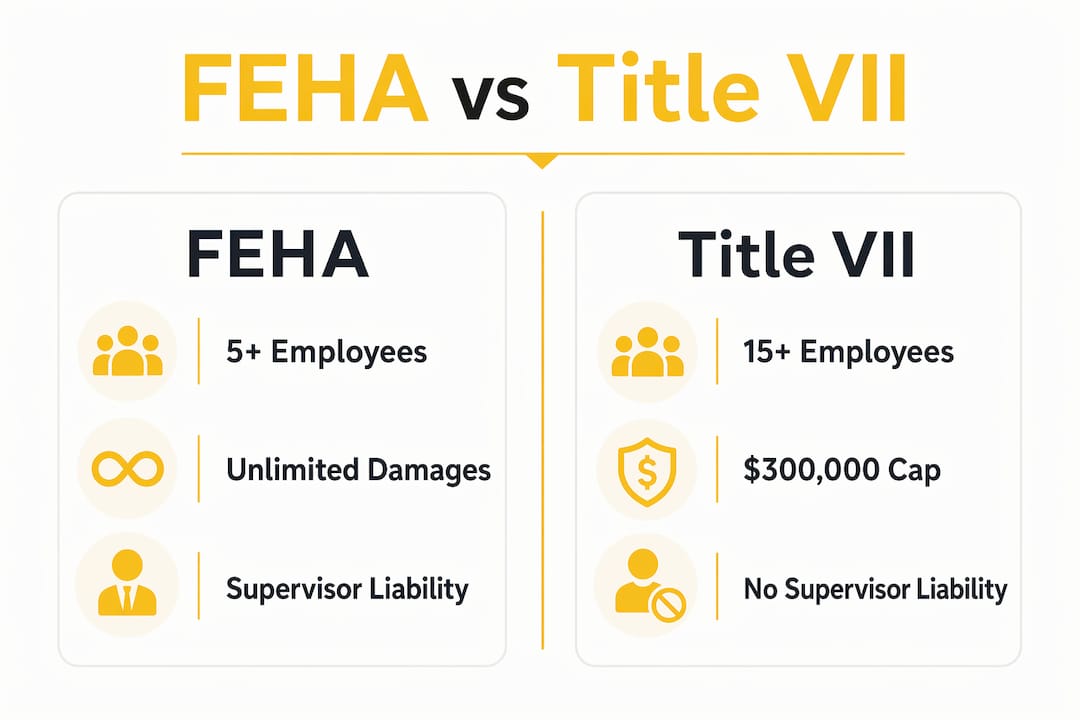
The employer size threshold matters enormously in Mission Viejo, where many businesses are small or mid-sized. A company with eight employees is fully covered under FEHA but exempt from Title VII. That means your rights exist even if your employer is too small to face federal scrutiny.
FEHA’s unlimited damages provision is a significant advantage. Federal law caps compensatory and punitive damages at $300,000 for larger employers and less for smaller ones. California removes that ceiling entirely. A jury can award whatever amount reflects the actual harm you suffered.
Individual supervisor liability is another area where California law stands apart. Under FEHA, a supervisor who personally discriminates against or harasses you can be sued as an individual, not just as a representative of the company. That creates a direct accountability mechanism that federal law does not provide.
Filing a complaint with the CRD is the official first step for most Mission Viejo employees pursuing a discrimination claim. The CRD complaint process is free, available online, and provides an immediate complaint number and confirmation upon submission. Filing online is the fastest method.
Here is how the process works:
One critical timing issue: the continuing violation doctrine does not extend the statute of limitations for discrete acts like termination or denial of promotion. Each such act has its own three-year clock. Missing that deadline on a specific incident means losing the right to claim it, even if other related acts are still within the window.
Pro Tip: Do not wait to see if the situation improves before filing. The three-year deadline sounds generous, but gathering evidence and building a strong case takes time. Consulting an employment lawyer early protects your options.
Understanding legal pre-employment screening and compliance standards can also help you recognize when an employer’s conduct crosses a legal line from the hiring stage forward.
FEHA gives Mission Viejo employees access to a wide range of financial and non-financial remedies when a discrimination claim succeeds. The law is designed to make you whole and to deter future violations.
Financial remedies include:
Non-financial remedies are equally important in many cases:
Retaliation protection runs alongside every claim. If your employer takes any adverse action against you for filing a complaint or cooperating with an investigation, that retaliation is itself a separate violation of FEHA. You can pursue both the original discrimination claim and the retaliation claim simultaneously.
The FEHA damages framework makes legal representation worth pursuing. An experienced employment lawyer can identify all available claims, calculate the full scope of your damages, and negotiate or litigate for the maximum recovery.
Taking the right steps early protects your legal rights and strengthens any future claim. Waiting or hoping the situation resolves on its own is the most common mistake employees make.
Sexual orientation equality in the workplace is not just a policy goal. It is a legal requirement in California, and Mission Viejo employees have the tools to enforce it.
California’s FEHA gives Mission Viejo employees stronger protections against gender and sexual orientation discrimination than federal law, with no damage caps, a three-year filing window, and individual supervisor liability.
| Point | Details |
|---|---|
| FEHA covers more employers | Employers with 5+ employees must comply, compared to 15+ under federal Title VII. |
| Three-year filing deadline | Each discrete discriminatory act has its own three-year clock under FEHA. |
| No damage caps | FEHA allows unlimited compensatory and punitive damages, unlike federal law. |
| Supervisors can be sued personally | Individual supervisors who discriminate or harass can face personal liability under FEHA. |
| Document and act early | Early documentation and timely filing are the two most important steps to protect your claim. |
Facing gender or sexual orientation discrimination at work is serious. You deserve a legal team that works only for employees, never employers. Optimum Employment Lawyers handles FEHA discrimination cases for Mission Viejo workers, from the initial CRD complaint through full litigation if needed. The firm has secured significant results for California employees, including a $2.2 million class action settlement, and brings that same commitment to individual discrimination claims. If you have experienced workplace discrimination in Mission Viejo, a free consultation with Optimum Employment Lawyers gives you a clear picture of your rights and your options. Reach out to schedule a consultation and get the representation you deserve.
FEHA prohibits discrimination based on sexual orientation, gender identity, and gender expression, among 19 other protected categories. It covers all employers with five or more employees in California, including those in Mission Viejo.
Mission Viejo employees have three years from the last discriminatory act to file a complaint with the CRD. The federal EEOC deadline is 300 days, making the California process the stronger option for most workers.
Yes. FEHA allows employees to hold individual supervisors personally liable for discrimination or harassment. Federal law does not provide this option.
The CRD reviews your complaint, cross-files it with the EEOC automatically, and may investigate or offer mediation. If the process does not resolve your case, the CRD can issue a right-to-sue letter so you can pursue a private lawsuit.
You can file a CRD complaint without a lawyer, but legal representation significantly improves your outcome. An employment lawyer helps you identify all available claims, gather evidence, and pursue the maximum damages available under FEHA.

© 2026 Optimum Employment Lawyers, PC
Legal Disclaimer | Privacy Policy
 Share
Share
