
(949) 954-8181 Free Case Review No recovery, no fee.
(949) 954-8181 Free Case Review No recovery, no fee.
If you took medical or family leave in Anaheim and your employer cut your hours, wrote you up, or fired you afterward, California law almost certainly protects you. Eligible employees are covered under the CFRA, FMLA, PDL, and paid sick leave statutes, and retaliation for using any of them is illegal. Your first move should be documenting the timeline and contacting the California Civil Rights Department, the U.S. Department of Labor, or the Labor Commissioner, depending on which leave was involved.
TL;DR:
- Employees may be protected from retaliation for taking leave under FMLA, CFRA, PDL, and paid sick leave laws, but eligibility thresholds and leave durations vary.
- Employers often miscalculate leave windows or impose discipline based on misapplied attendance policies, which can form the basis for retaliation claims.
- Retaliation can include subtle actions like schedule changes, exclusion from projects, or negative reviews, making documentation and timely reporting critical.
- Proving retaliation relies heavily on timing, consistency in employer explanations, and witnesses, with documented patterns being particularly persuasive.
- Filing deadlines differ by agency and law, so employees should preserve evidence early, consult legal counsel, and consider pursuing claims with specialized employee-side attorneys.
Three main statutes cover most Anaheim workers who take medical or family leave, and they don’t all apply the same way. Knowing which one fits your situation determines your filing deadline, your remedies, and even whether your employer is covered at all.
The federal Family and Medical Leave Act (FMLA) applies to private employers meeting a specified employee threshold within a given radius of the worksite. It gives eligible employees up to a legally defined period of unpaid, job-protected leave for a serious health condition, a new child, or caring for a family member with a serious illness. The U.S. Department of Labor states plainly that the FMLA prohibits both interference with these rights and retaliation against employees who exercise them. The Department’s Wage and Hour Division enforces the law and can investigate complaints directly, and the Wage and Hour Division can also pursue enforcement actions when an investigation turns up violations that go unresolved.
California’s CFRA (California Family Rights Act) runs on a lower threshold. It covers employers with just 5 or more employees, meaning a much wider swath of Anaheim businesses, from small manufacturing shops near the Anaheim Resort district to retail operations along Harbor Boulevard, fall under CFRA even when they’re too small for the FMLA. CFRA leave typically overlaps with FMLA leave when both apply, but CFRA also covers some situations FMLA does not, including leave to care for a domestic partner or leave tied to certain pregnancy-related conditions once PDL is exhausted.
Pregnancy Disability Leave (PDL), part of the Fair Employment and Housing Act (FEHA), applies to employers with 5 or more employees and provides up to four months of leave for pregnancy-related disability, separate from and in addition to CFRA bonding leave. A worker can use PDL first, then follow it with CFRA baby-bonding time, stacking protections in a way that often confuses employers into miscounting eligibility windows and making mistakes that turn into retaliation claims.
Paid sick leave adds another layer. California’s statewide paid sick leave law lets employees earn and use paid time off for their own illness or a family member’s, and some Orange County cities layer on local ordinances with slightly different accrual rules. Retaliating against an employee for using accrued sick time, even a single day, violates the California Civil Rights Department’s guidance on retaliation and separately violates the Labor Code provisions the Labor Commissioner enforces.
Here’s how the thresholds break down at a glance:
When PDL, FMLA, and CFRA overlap, as they frequently do for a pregnancy and subsequent bonding leave, your job protection can extend well beyond the 12 weeks most people assume is the cap. An employer that terminates you at week 13, assuming your leave rights expired, may have miscounted entirely, and that miscount is often exactly the kind of evidence that turns a termination into a provable retaliation claim.
Retaliation isn’t limited to getting fired the day you walk back through the door. Courts and agencies look at a much wider range of employer conduct, and some of the most damaging retaliation is also the hardest to spot because it looks like ordinary business decisions.
It helps to separate two related but distinct violations. Interference means denying or discouraging you from taking leave you’re entitled to, such as an Anaheim restaurant manager telling a line cook he can’t take CFRA leave because “we’re short staffed.” Retaliation happens after the leave, punishing you for having taken it. Both are illegal, and the Department of Labor’s guidance treats them as separate violations, which matters because you may have claims under both theories arising from the same set of facts.
The subtle actions on that list, especially the attendance-point issue, tend to be where employers get caught. The California Civil Rights Department specifically flags counting protected leave toward attendance discipline as a red flag, because it’s an objective, paper-trail action that’s easy to prove once you pull the records.
Proving retaliation comes down to three elements, and you need all three to win: you engaged in protected activity, your employer took an adverse action against you, and there’s a causal connection between the two. Miss any one of these and the claim falls apart, no matter how unfair the situation felt.
Protected activity is straightforward: requesting or taking CFRA, FMLA, PDL, or paid sick leave counts. Adverse action covers the list above: firing, demotion, pay cuts, and the subtler moves like exclusion or sudden bad reviews. The hard part is almost always causation, tying the two together in a way that convinces an investigator or a jury.
Certain kinds of evidence carry real weight in building that connection:
Employers almost never admit to retaliation outright. Instead, they’ll assert a legitimate, nonretaliatory reason, usually a claim that you were already underperforming or that a layoff was unrelated to your leave. You rebut that by showing the timing doesn’t add up, the stated reason contradicts earlier documentation, or similarly situated employees who didn’t take leave were treated more leniently for the same alleged issue.
Pro Tip: Save copies of every performance review, write-up, or informal feedback email from at least six months before your leave request through your return. A clean record beforehand followed by a sudden pile of criticism afterward is one of the most persuasive patterns an investigator will see.
Which agency you file with depends on which law was violated, and the deadlines differ enough that picking the wrong door can cost you your claim entirely.
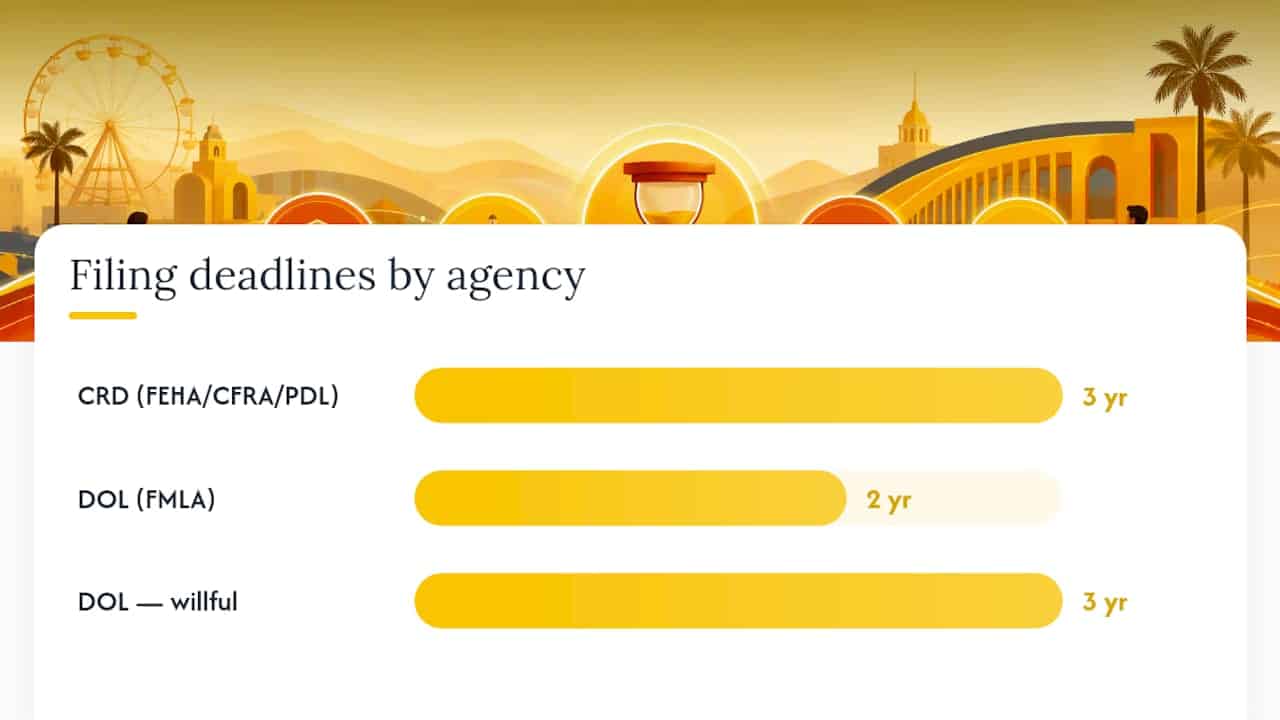
California Civil Rights Department (CRD) handles retaliation tied to FEHA, CFRA, and PDL. You generally have three years from the date of the retaliatory act to file a complaint, a window the CRD’s own guidance confirms. After filing, the CRD investigates and can issue a right-to-sue letter, which lets you take the case to civil court, or in some cases pursue the claim itself.
U.S. Department of Labor, Wage and Hour Division is the route for FMLA-specific violations. The DOL’s fact sheet sets a two-year statute of limitations, extended to three years if the violation was willful. The Wage and Hour Division investigates and can pursue enforcement, though many employees also retain private counsel to file directly in federal court rather than wait on an agency investigation.
Labor Commissioner (Division of Labor Standards Enforcement) is your route for paid sick leave retaliation and other wage-related retaliation under Labor Code §98.6. The Department of Industrial Relations outlines the filing process, and this path often moves faster than a full CRD investigation for straightforward wage-and-hour retaliation.
Steps that generally apply across all three agencies:
You can sometimes file concurrently. A retaliation claim that touches both FMLA and CFRA, for instance, might justify parallel complaints with the DOL and CRD, since the statutes overlap but aren’t identical, and a favorable finding in one can support your position in the other. This is exactly the kind of overlapping-claim situation an Anaheim-focused retaliation attorney can help you navigate correctly the first time, rather than losing time by filing in the wrong venue.
Winning a retaliation claim can produce a mix of monetary and non-monetary relief, and the scope of what’s available often surprises employees who assumed a lawsuit only meant a paycheck.
Non-monetary remedies matter too, especially the removal of unwarranted discipline from your personnel file and, in some cases, employer-wide policy changes to prevent repeated retaliation.
The California Civil Rights Department lists reinstatement and back pay as among commonly awarded remedies in retaliation cases, alongside policy corrections when the violation reflects a broader pattern rather than an isolated incident.
If you suspect retaliation, what you do in the next few days matters more than almost anything else in the life of your case. Evidence disappears fast, memories fade, and employers sometimes alter records once they sense a claim coming.
Building a clean timeline exhibit, showing the date you requested leave, when your employer acknowledged it, when the adverse action occurred, and any messages in between, is one of the most useful documents you can hand an investigator or an attorney. Agencies and courts rely heavily on concise timelines to assess causation quickly, and a well-organized one can shortcut weeks of back and forth.
Pro Tip: Keep your documentation in one dedicated folder, whether physical or digital, separate from your regular work files. Employees who wait until after termination to start organizing evidence often find their access to company systems has already been cut off.
A detailed local case example from Rancho Santa Margarita walks through exactly this kind of step-by-step evidence preservation in a real medical leave retaliation matter, and it’s worth reviewing if you want to see how these pieces fit together in practice.
Retaliation cases hinge on details that generalist attorneys, or attorneys who also represent employers in other matters, often miss. Optimum Employment Lawyers represents only employees, never employers, which means every strategic decision is made without the conflicts of interest that come from a firm splitting its practice between both sides of the table.
The firm’s founder and lead attorney, Dean Ho, has built the practice specifically around employee-side representation, covering wrongful termination, workplace discrimination, retaliation, and wage disputes. That focus shows up in results: Optimum Employment Lawyers secured a $2.2 million settlement in a class action involving missed meal breaks, and the firm has handled numerous individual retaliation and wrongful termination matters for California employees.
A few things set employee-only representation apart from a general practice firm:
For an Anaheim employee weighing whether a situation is “bad enough” to call a lawyer, the honest answer is that a free consultation costs nothing and can clarify in one conversation whether you have a viable claim worth pursuing.
Anaheim employers, from the hospitality and entertainment businesses clustered near the Resort district to the manufacturing and logistics operations spread through the city’s industrial corridors, are subject to both federal and state leave law simultaneously in most cases. That overlap generally works in the employee’s favor.
Because CFRA covers employers with just 5 or more workers while FMLA requires 50 or more, a mid-size Anaheim employer might be covered by both, and a smaller one might be covered only by CFRA and PDL. When both apply, you get whichever protection is stronger on a given point. FMLA and CFRA leave typically run concurrently rather than stacking to 24 weeks, but PDL runs separately from CFRA bonding leave, which can extend total protected time well past what either statute offers alone.
Filing deadlines differ too: the DOL gives you two years (three for willful violations) for an FMLA claim, while the CRD gives you three years for a CFRA or FEHA-based retaliation claim. An Anaheim employee whose case touches both statutes should generally preserve rights under both tracks rather than assuming one filing covers everything, since the agencies operate independently even when the underlying facts overlap.
Retaliation doesn’t look the same in every workplace, and Anaheim’s economy spans enough industries that the patterns vary noticeably by sector.
In hospitality and tourism, common near the Anaheim Resort district, retaliation often shows up as sudden shift reductions or reassignment to less lucrative stations after an employee returns from medical leave, a way of quietly punishing someone without an outright termination that would draw scrutiny.
In manufacturing and warehousing, prevalent in Anaheim’s industrial zones, attendance-point systems are a frequent vehicle for retaliation, where protected leave gets logged as an unexcused absence and eventually triggers automatic discipline under a policy the employee never realized was being misapplied.
In retail and food service, retaliation frequently appears as a sudden cut in scheduled hours or a transfer to a location with a longer commute, changes that are hard to challenge directly but add up to constructive pressure to quit.
In office and administrative roles, the pattern tends toward exclusion: removal from projects, being left off meeting invites, or a sudden reassignment of key accounts to a colleague, moves that leave no obvious paper trail but clearly change your job function.
Recognizing which pattern matches your situation helps frame the claim correctly and signals to an investigator that this wasn’t a one-off business decision.
Anaheim employees don’t have to navigate a retaliation situation alone or figure out the agency landscape from scratch. Several resources exist specifically to help.
The California Civil Rights Department accepts complaints online or by phone and provides guidance documents explaining your rights under CFRA, FEHA, and PDL. The U.S. Department of Labor’s Wage and Hour Division has a regional office serving Southern California and handles FMLA complaints and investigations. The California Labor Commissioner’s Office, part of the Department of Industrial Relations, handles paid sick leave and wage-related retaliation claims and has a public-facing filing process.
Orange County also has legal aid organizations that provide free or low-cost consultations for employees who can’t afford private counsel, and local worker rights organizations occasionally hold know-your-rights sessions relevant to leave and retaliation protections. For employees who do have a viable claim worth pursuing on contingency, firms like Optimum Employment Lawyers offer free initial consultations specifically for retaliation and wrongful termination matters, which means the cost of finding out where you stand is zero.
Anaheim’s city government and the Orange County Bar Association’s referral service are additional starting points if you’re unsure which agency or attorney fits your specific circumstances.
Retaliation rarely stays contained to a single incident. Employees who experience it commonly describe a cascading effect: anxiety about being watched more closely, sleep disruption tied to job insecurity, and a corrosive sense that returning from a legitimate medical leave somehow made them a target.
That stress often bleeds into performance in a cruel irony, since an employee distracted by fear of losing their job may genuinely start making more mistakes, which an employer can then point to as justification for the very adverse action that started the cycle. Coworkers notice too. A workplace where one employee is visibly punished for taking leave sends a chilling message to everyone else, discouraging other employees from using leave they’re legally entitled to and eroding trust in HR and management broadly.
Documenting how retaliation affected your health isn’t just about your wellbeing, though that matters plenty on its own. Contemporaneous notes about anxiety, missed sleep, or medical treatment tied to the retaliation can support an emotional distress damages claim if your case proceeds. Employees sometimes underestimate how legitimate this category of harm is in a retaliation case, treating it as secondary to lost wages, when in reality it often represents a substantial portion of case value.
The return-to-work conversation is often where retaliation risk is highest, and it’s also where a little preparation goes a long way. Employers sometimes use the return date as an opportunity to quietly change your role, and knowing what to ask for protects you.
Before your scheduled return, request in writing confirmation of your job title, reporting structure, and any accommodations you may need, particularly if your medical provider has recommended modified duties, a phased return, or schedule adjustments. Under CFRA and FMLA, you’re generally entitled to return to the same or an equivalent position, meaning comparable pay, benefits, and responsibilities, not necessarily the identical desk or exact title.
If your employer proposes a different role on your return, ask directly whether it’s considered equivalent and get the explanation in writing. Vague answers or reluctance to put the reasoning in writing is itself a signal worth documenting. If you need ongoing accommodations related to a medical condition, FEHA requires your employer to engage in a good-faith interactive process to identify reasonable accommodations, and refusing to engage in that process at all can be its own separate violation.
Keep records of every conversation about your return, including who you spoke with and what was said, since this period is exactly when subtle retaliation tends to surface.
California courts and the legislature continue to refine how CFRA, FEHA, and PDL claims get evaluated, and staying current matters because these interpretations affect how strong your claim actually is.
Recent legislative expansion has broadened CFRA’s definition of family members eligible for leave and clarified how PDL and CFRA bonding leave interact, closing gaps that employers previously exploited to shorten total protected leave time. California courts have also continued to reinforce that the 90-day rebuttable presumption under Labor Code §98.6 shifts real evidentiary weight onto employers once an employee shows adverse action within that window, making early timeline documentation increasingly decisive in how these cases resolve.
The trend across recent guidance and enforcement activity favors employees on procedural questions, particularly around what counts as an adverse action and how much weight timing evidence carries. That’s good news for Anaheim employees, but it also means employers are adjusting their own documentation practices to get ahead of these presumptions, which makes your own contemporaneous record-keeping even more valuable than it used to be.
You’ve read the law. Now here’s the practical next step: Optimum Employment Lawyers handles CFRA, FMLA, PDL, and paid sick leave retaliation cases for employees across California, including Anaheim, on a contingency-fee basis, meaning there’s no upfront cost to find out where you stand. The firm’s employee-only focus, backed by results like the $2.2 million meal-break class action settlement, means every case gets the aggressive posture that comes from representing only the worker’s side of the table.
Before your consultation, gather what you can: a written timeline of your leave request and the adverse action that followed, saved emails or texts, names of any witnesses, and copies of performance reviews from before and after your leave. Even a rough version of these documents helps the firm evaluate your case quickly.
Reach out through the Optimum Employment Lawyers contact page to schedule your free consultation. There’s no fee unless your case results in a settlement or award.
This article is general information, not a substitute for advice from a qualified lawyer. Consult a qualified legal professional about your own circumstances before acting on anything here.

© 2026 Optimum Employment Lawyers, PC
Legal Disclaimer | Privacy Policy
 Share
Share
