
(949) 954-8181 Free Case Review No recovery, no fee.
(949) 954-8181 Free Case Review No recovery, no fee.


Medical leave retaliation in Mission Viejo is illegal. Any employer who demotes, terminates, or otherwise punishes you for taking protected medical leave violates California and federal law. The California Family Rights Act (CFRA), the federal Family and Medical Leave Act (FMLA), the Fair Employment and Housing Act (FEHA), and the Americans with Disabilities Act (ADA) all prohibit employers from taking adverse action against employees who exercise their right to medical leave. Retaliation claims now account for over 55% of all EEOC charges, which tells you this is not a rare problem. If you work in Mission Viejo and suspect your employer punished you for taking leave, you have real legal options.
California employees in Mission Viejo benefit from some of the strongest overlapping legal protections in the country, covering both state and federal law. Understanding which statutes apply to your situation is the foundation of any retaliation claim.
Federal protections:
California state protections:
Mission Viejo falls under Orange County jurisdiction, and the California Civil Rights Department (formerly DFEH) actively enforces these protections in the region. Employers in the area cannot claim ignorance of these laws. If your employer has five or more employees, every one of these statutes likely applies to you. You can learn more about your California medical leave rights before deciding your next step.
Retaliation rarely looks like a manager saying, “We’re firing you because you took medical leave.” It is almost always disguised. Employees often fail to recognize indirect retaliation through new disciplinary actions or restructuring when returning from leave. Knowing the patterns is how you catch it.
The most common forms of retaliation after medical leave include:
Timing is your most powerful initial indicator. Common employer tactics post-leave include sudden restructuring and new disciplinary action specifically designed to disguise the real motivation. If the adverse action came within weeks of your return, that sequence matters legally.
Pro Tip: Write down every interaction with your supervisor and HR from the moment you return from leave. Note the date, time, what was said, and who was present. This contemporaneous record becomes critical evidence if you file a claim.

Strong retaliation claims are built on patterns, not single incidents. Successful retaliation claims depend on circumstantial evidence showing employer pretext rather than one smoking-gun moment. Here is what to gather:
“Legal action requires proving violation of statutes like FMLA and CFRA, not just unfair treatment. Detailed recordkeeping is the difference between a strong claim and a dismissed one.” — Nakase Law Firm
Documentation including leave approvals, communications, and witness statements is the backbone of every successful retaliation case. Mission Viejo employees who keep organized records from day one put themselves in a far stronger position when they meet with an attorney. You can review the broader framework for retaliation and wrongful termination under California law to understand what courts look for.
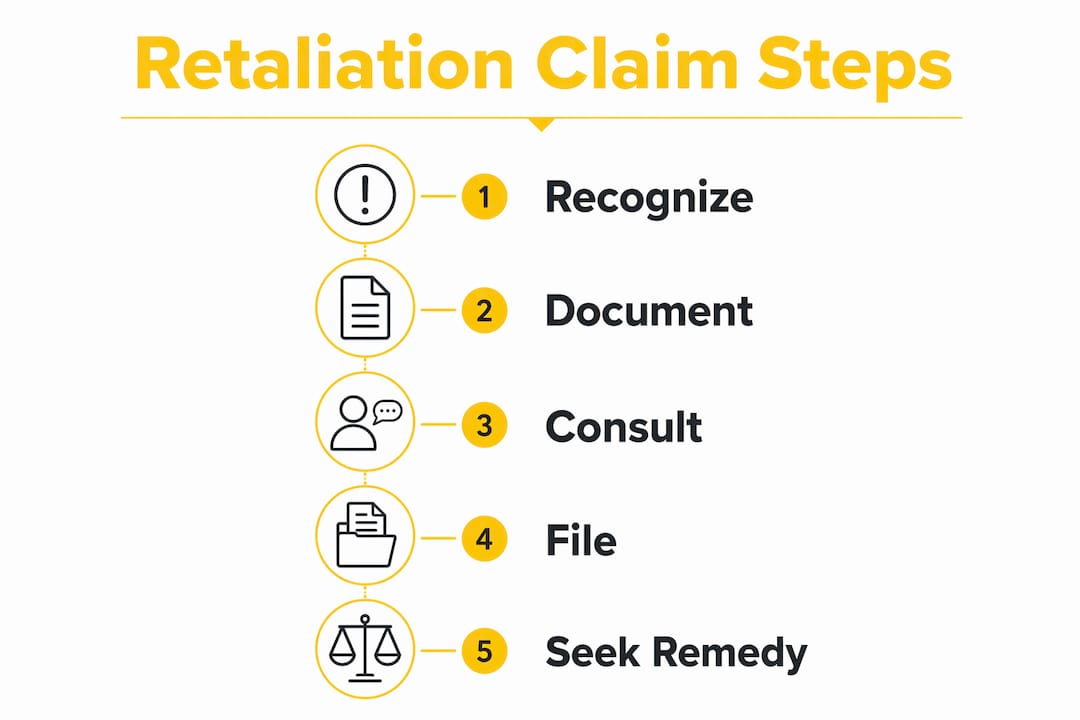
Acting quickly is not optional. Some filing deadlines are as short as 30 days from the date of the adverse action, and missing them can permanently bar your claim. Here is the sequence that protects your rights:
The remedies available to Mission Viejo employees who win retaliation cases include reinstatement to their former position, compensation for lost wages, damages for emotional distress, and in some cases punitive damages against the employer. California courts have consistently held that employers cannot use pretextual reasons to mask retaliation, and juries in Orange County have awarded substantial verdicts in employee-side cases.
Pro Tip: Do not resign before speaking with an attorney. Quitting can complicate your claim unless you can prove constructive discharge, which requires its own legal showing. Stay employed if you can safely do so while you seek legal advice.
Understanding your whistleblower and retaliation protections under California law gives you a clearer picture of how broadly the state protects workers who exercise their rights. Mission Viejo employees also have access to local employment law resources specifically focused on Orange County cases.
Medical leave retaliation in Mission Viejo is illegal under CFRA, FMLA, FEHA, and the ADA, and employees who act quickly with strong documentation have real legal recourse against employers who violate these protections.
| Point | Details |
|---|---|
| Multiple laws protect you | CFRA, FMLA, FEHA, and ADA all prohibit retaliation for taking protected medical leave in Mission Viejo. |
| Timing is key evidence | Adverse actions taken within days or weeks of returning from leave strongly indicate retaliation in court. |
| Document everything | Leave approvals, performance reviews, emails, and witness statements form the core of a successful claim. |
| Deadlines are short | Some retaliation complaint deadlines start at 30 days, making immediate legal consultation critical. |
| Remedies are substantial | Winning employees can recover lost wages, emotional distress damages, and in some cases punitive damages. |
Optimum Employment Lawyers represents Mission Viejo employees who have been punished for taking protected medical leave. The firm focuses exclusively on employee-side cases, which means every strategy, every argument, and every negotiation is built around protecting your rights. Their attorneys have secured significant results for California workers, including a $2.2 million class action settlement, and they bring that same aggressive approach to individual retaliation and wrongful termination cases throughout Orange County. If you believe your employer retaliated against you for taking medical leave, contact Optimum Employment Lawyers for a free consultation. Time-sensitive deadlines apply, so do not wait.
Medical leave retaliation occurs when an employer takes an adverse action, such as termination, demotion, or a hostile work environment, because an employee exercised their right to protected leave under CFRA, FMLA, FEHA, or the ADA.
Some deadlines begin as soon as 30 days after the adverse action, while EEOC claims generally allow up to 300 days in California. Consulting an attorney immediately after the adverse action is the safest approach.
Yes, and this is called pretext. Courts look at the full pattern of employer behavior, including timing and prior performance reviews, to determine whether the stated reason is genuine or a cover for retaliation.
California employees who prevail in retaliation cases can recover back pay, front pay, emotional distress damages, attorney fees, and in cases of egregious employer conduct, punitive damages.
You are not legally required to have an attorney, but retaliation claims involve complex procedural rules and short deadlines. An experienced employment attorney significantly improves your chances of a successful outcome.

© 2026 Optimum Employment Lawyers, PC
Legal Disclaimer | Privacy Policy
 Share
Share
