
(949) 954-8181 Free Case Review No recovery, no fee.
(949) 954-8181 Free Case Review No recovery, no fee.
If your employer demoted you, cut your hours, put you on a performance improvement plan, or fired you after you took medical or family leave, you likely have a viable retaliation claim under California law. That pattern, protected leave followed by sudden adverse action, is exactly what CFRA, FMLA, and FEHA are designed to address. The single most important thing you can do right now is preserve every piece of evidence before it disappears and contact an employee-side attorney.
Three immediate actions to take today:
Pro Tip: Save copies of your performance reviews and any positive feedback from before your leave. A clean record before leave and a suddenly negative one after is some of the most persuasive causation evidence you can bring to a lawyer.
Claims can be filed with the California Civil Rights Department (CRD, formerly the DFEH), the U.S. Equal Employment Opportunity Commission (EEOC), or the U.S. Department of Labor (DOL) / Wage and Hour Division, depending on which statute covers your situation. Deadlines are strict. Contact Optimum Employment Lawyers for a free case review — the firm works on a contingency basis, meaning no recovery means no fee.
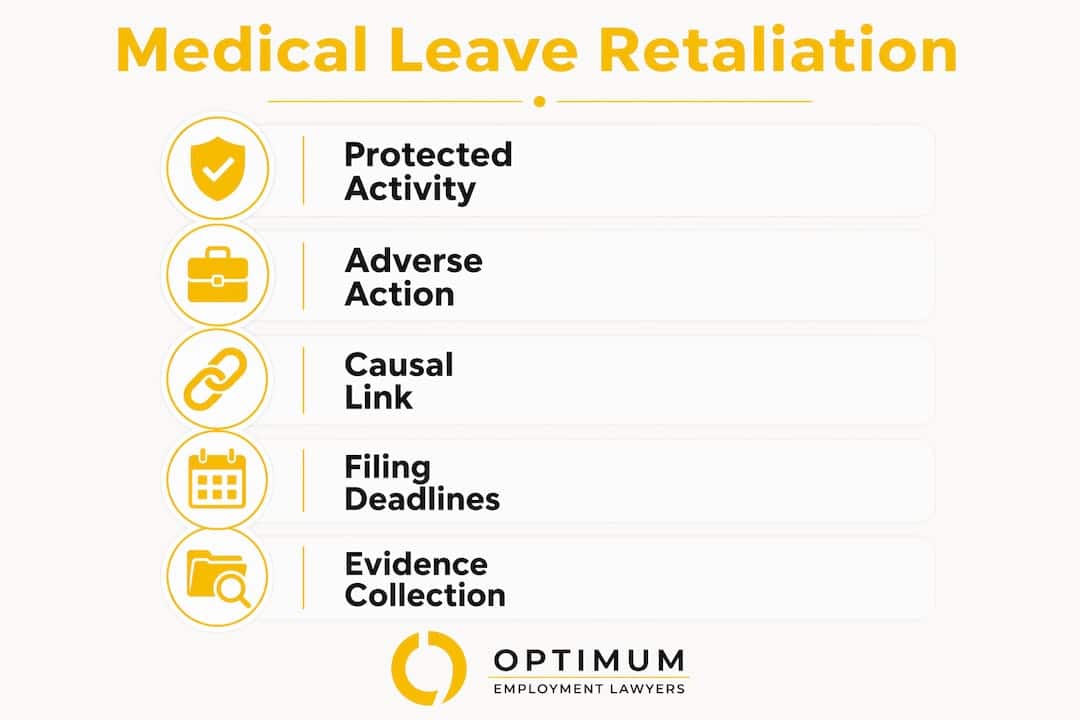
To win a retaliation claim under California law, you must establish three elements: a protected activity, an adverse employment action, and a causal link showing the protected activity was a substantial motivating reason for the adverse action. Each element has more reach than most employees expect.
Protected activity covers requesting or taking leave under CFRA or FMLA, seeking a disability accommodation under FEHA, or even complaining internally that you believe your employer is violating the law. You do not need to use legal terminology — you just need to make it reasonably clear you think something illegal is happening.
Adverse employment action under California law is broader than termination. The California Supreme Court’s decision in Yanowitz v. L’Oreal established that courts look at the cumulative impact of employer conduct, not just a single dramatic event. Removal of key duties, altered schedules, exclusion from projects, or a sudden string of negative reviews can collectively satisfy this element.
Causal link is assessed using a totality-of-the-circumstances test. Suspicious timing, comments about your leave, and differential treatment compared to coworkers who did not take leave are all circumstantial evidence courts consider.
How the statutes interact for Rancho Santa Margarita workers:
One important nuance: a 2025 tentative ruling in BC680213 (Judge Armen Tamzarian) clarified that taking medical leave itself may not qualify as “opposition” under every FEHA subsection, but CFRA § 12945.2(k) separately and explicitly prohibits retaliation for taking leave. An experienced attorney will identify which statutory route is strongest for your specific facts.
Retaliation rarely looks like a villain twirling a mustache. Most of the time it is a slow accumulation of adverse treatment that begins right after an employee returns from leave, and California law captures all of it.
Common employer actions that can constitute retaliation:
Consider a pattern that plays out in Orange County workplaces: an employee at a Rancho Santa Margarita company takes eight weeks of CFRA leave for a serious medical condition. She returns to find her largest client account reassigned, her performance review rating dropped from “exceeds expectations” to “needs improvement” with no specific examples cited, and her schedule shifted to hours that conflict with her medical follow-up appointments. No single act is a firing. Together, under Yanowitz, they form a textbook pattern-of-conduct claim.
Timing matters enormously. When adverse actions cluster within weeks of a leave request or return date, courts treat that proximity as circumstantial evidence of causation. Comments from a manager like “we need someone more reliable” or “we can’t keep covering for you” made around the time of leave are exactly the kind of statement an attorney will want documented.

Early evidence preservation is often the difference between a strong claim and one that is hard to prove. Employers know this, which is why documentation tends to disappear or get revised after a dispute arises.
Collect the following immediately:
Store copies outside your work systems. Email them to a personal account or save them to a personal device. Do not rely on your work laptop or company email server.
Pro Tip: Gather evidence of how your employer treated similarly situated coworkers who did NOT take leave. If a colleague with a comparable record was not put on a PIP or had their hours cut, that comparison directly rebuts the employer’s claim that the action was performance-based rather than retaliatory.

The CRD’s retaliation guidance specifically notes that selective application of policies is strong evidence of pretext. Practitioners also warn that employers often avoid immediate termination after leave to avoid obvious retaliation, instead using progressive adverse actions over weeks or months. Proactive, contemporaneous documentation of small harms is what catches this pattern.
Filing deadlines for retaliation claims are strict, and missing them can permanently bar your claim. Act promptly — in some cases you have as little as 180 days from the adverse action.
| Agency / Forum | Claim Type | Typical Deadline | Notes |
|---|---|---|---|
| California Civil Rights Department (CRD) | FEHA retaliation (CFRA, disability, accommodation) | Three years from the incident | Administrative exhaustion required before civil suit |
| EEOC | Federal discrimination / retaliation (Title VII, ADA) | 180 days from adverse action | California’s FEHA extends the window to three years |
| DOL / Wage and Hour Division | FMLA retaliation | Two years (three years if willful) | Can also file private civil suit |
| California Superior Court | Civil FEHA lawsuit | After CRD issues right-to-sue notice | Must exhaust CRD first for FEHA claims |
The three-year window for CRD/FEHA claims is longer than many employees expect, but do not treat it as a reason to wait. Evidence fades, witnesses move on, and employer records get purged. The continuing violation doctrine, recognized in Yanowitz and subsequent California decisions, may allow earlier adverse acts outside the limitations window to be included if they connect to acts within the period — but that argument is far easier to make with contemporaneous documentation.
For FEHA-based claims, administrative exhaustion is required: you must file with the CRD before you can sue in California Superior Court. FMLA claims can go directly to the DOL or private civil suit, but the statutory periods are shorter. Consult an attorney before filing anything — procedural missteps at the administrative stage can limit your options in court.
Immediate filing priorities:
A successful medical-leave retaliation claim in California can result in meaningful financial and non-financial relief. Remedies available include:
Administrative outcomes through the CRD or DOL tend to resolve faster and often include non-monetary relief such as policy changes, updated accommodation procedures, or training requirements. Civil litigation opens the door to the full range of damages, including punitive awards. Settlements frequently include confidentiality provisions and structured non-monetary terms alongside the financial component, and an experienced attorney will negotiate both.
Optimum Employment Lawyers investigates retaliation claims, preserves evidence, handles administrative filings, negotiates settlements, and litigates in court when necessary — all on the employee’s side, exclusively.
The firm’s process for Rancho Santa Margarita clients:
The firm’s track record includes significant settlements in class actions involving missed meal breaks, demonstrating the kind of results aggressive, employee-focused advocacy produces. Optimum Employment Lawyers handles Rancho Santa Margarita cases through in-person and virtual consultations, with direct familiarity with Orange County courts and local employer practices. The contingency fee structure means you pay nothing unless the firm recovers for you. To start a free case evaluation, contact the firm directly.
You can also review the firm’s medical and family leave retaliation practice page for a summary of the legal actions available to employees in your situation.
Bring concise, time-ordered records and a short written timeline of events. The clearer your intake materials, the faster an attorney can assess your claim and identify the strongest filing route.
Bring to your consultation:
After the consultation, take these steps immediately:
During intake, your attorney will ask about the timeline of your leave, the timing of adverse actions relative to your return, your employer’s stated reasons for those actions, and any prior performance record. That comparison, clean record before leave, sudden problems after, is often the core of the claim. California’s CFRA and FMLA protections are the statutory framework your attorney will map your facts against.
Employees in Rancho Santa Margarita facing retaliation after medical leave should preserve evidence immediately, document timing and statements, file promptly with the CRD, EEOC, or DOL as appropriate, and contact Optimum Employment Lawyers for a free consultation.
| Point | Details |
|---|---|
| Three-part legal test | Prove protected activity, adverse employment action, and a causal link under CFRA, FMLA, or FEHA. |
| CRD filing window | File with the California Civil Rights Department within three years of the incident for FEHA-based claims. |
| Evidence preservation | Collect emails, performance reviews, pay records, and witness names before evidence disappears or is altered. |
| Remedies available | Back pay, front pay, reinstatement, emotional distress, punitive damages, and attorney fees are all recoverable. |
| Optimum Employment Lawyers | Handles Rancho Santa Margarita retaliation cases on contingency — no recovery means no fee. |
The sources below are the primary references for the legal standards, filing procedures, and case law discussed in this article. Bring relevant citations to your consultation so your attorney can map the strongest filing route.
| Source | What it covers | Why it matters |
|---|---|---|
| California Civil Rights Department — Retaliation Factsheet | FEHA retaliation standards, three-year filing window, CRD intake process | Primary agency for FEHA-based retaliation claims; defines protected activity and adverse action |
| Cal. Code Regs. Tit. 2, § 11094 | CFRA anti-retaliation and non-interference regulations | Prohibits using CFRA leave as a negative factor in any employment decision |
| Yanowitz v. L’Oreal, Cal. Supreme Court | Adverse action definition; totality-of-circumstances causation; continuing violation doctrine | Foundational case for pattern-of-conduct and cumulative-harm retaliation theories |
| DOL / Wage and Hour Division — FMLA | Federal FMLA protections, employer obligations, filing with WHD | Governs federal leave retaliation claims; two-year (three-year willful) filing window |
| California Civil Rights Department — calcivilrights.ca.gov | CRD intake portal, complaint forms, agency guidance | Starting point for filing a FEHA retaliation complaint in California |
| Gov. Code § 12940 — California Legislature | FEHA statutory text, including retaliation and accommodation provisions | The statute itself; useful for understanding the full scope of protected activity |
| OneGov — California legislation tracker | Pending and recent California legislative changes affecting leave and retaliation law | Track any amendments to CFRA, FEHA, or related statutes that may affect your claim |
For Orange County litigation, cases filed after CRD exhaustion typically proceed in the Orange County Superior Court, located in Santa Ana. Your attorney will advise on venue and whether federal court is preferable for any federal law claims.
Facing retaliation after medical leave is disorienting — you followed the rules, took leave you were legally entitled to, and came back to a workplace that punished you for it. Optimum Employment Lawyers exists specifically for this situation. The firm represents only employees, never employers, which means every strategy, every filing decision, and every negotiation move is made with your recovery as the only goal.
For Rancho Santa Margarita employees, the firm offers a free initial case evaluation with no obligation. If the firm takes your case, it works on contingency: you pay nothing unless there is a recovery. That structure puts the firm’s interests squarely on your side. With a track record that includes a $2.2 million class action settlement and deep experience in Orange County employment disputes, Optimum Employment Lawyers is positioned to move quickly on evidence preservation, administrative filings, and, when necessary, litigation.
Request your free case review today and bring the timeline and documents described in this article. The sooner you act, the stronger your position.
This article provides general legal information about California employment law and is not legal advice for your specific situation. Filing deadlines and legal standards can vary based on individual facts. Consult a qualified California employment attorney to evaluate your claim and confirm the current rules that apply to you.

© 2026 Optimum Employment Lawyers, PC
Legal Disclaimer | Privacy Policy
 Share
Share
