
(949) 954-8181 Free Case Review No recovery, no fee.
(949) 954-8181 Free Case Review No recovery, no fee.
Yes — most nonexempt workers in Laguna Beach can recover unpaid overtime under California wage-and-hour law, and the process starts with three steps you can take today.
California law is among the most worker-protective in the country. The California Labor Commissioner’s Office (DLSE) enforces overtime rules regardless of your immigration status, and the U.S. Department of Labor’s Wage and Hour Division provides a parallel federal route. You have real options. The only thing that shrinks them is waiting.
California Labor Code § 510 sets three distinct overtime triggers, and most Laguna Beach workers are surprised to learn that all three can apply in the same workweek.
The “suffered or permitted” standard is what catches most employers off guard. Under DLSE overtime rules, if your employer knew or reasonably should have known you were working extra hours, those hours must be paid — even if the employer never approved the overtime. Telling a worker “we don’t pay overtime” does not make it legal to withhold it.
Common violations in Laguna Beach workplaces include:
Exemption alert: A job title that sounds managerial does not automatically make you exempt from overtime. DLSE exemption guidance is clear: employees must satisfy both a duties test and a minimum salary threshold to qualify for the executive, administrative, or professional exemptions. If your employer calls you a “manager” but your actual day-to-day work is the same as hourly coworkers, you may still be entitled to overtime pay. The salary level alone is not enough — the nature of the work is what the DLSE examines.
Pro Tip: If you were reclassified from hourly to salaried without any change in your actual job duties, that is a red flag worth investigating. Salaried status is not a blanket exemption under California law.
The strength of a wage claim depends almost entirely on documentation. Employers are required to maintain accurate time records, but when those records are missing, incomplete, or manipulated, your own evidence fills the gap.
Evidence checklist for a Laguna Beach wage claim:
The DLSE recommends that workers keep a private log of hours worked, separate from employer-controlled records. Courts and hearing officers give significant weight to detailed contemporaneous notes when employer records are incomplete or inconsistent. A good daily entry includes: date, start time, stop time, break times (actual, not scheduled), tasks performed, and location.
Sample hour-reconstruction table:
| Date | Scheduled Hours | Actual Hours Worked | Overtime Hours | Supporting Document |
|---|---|---|---|---|
| June 2 | — | — | — | Email at evening hours, timecard |
| June 3 | — | — | — | Manager text in evening |
| June 4 | — | — | — | GPS log, clock-out receipt |
| June | — | — | — | Calendar entry |
| Week Total | — | — | — |

Build a summary table for every week in your claim period. The accumulated overtime total is essential for estimating your damages.
Pro Tip: Export timestamps from work apps and email servers immediately — many platforms purge logs on a rolling 30-day or 90-day cycle. Screenshot everything and store copies in a personal account your employer cannot access. For disputed electronic records, note the date you captured each screenshot and keep the originals unedited.
The answer is often more than workers expect, because California law stacks multiple remedies on top of the base unpaid wages.
Step 1: Calculate your regular rate of pay. This is not always your hourly wage. The DLSE overtime FAQ explains that the regular rate includes hourly earnings, salary, piecework earnings, and commissions. If you earn multiple rates in a workweek, you use a weighted average.
Step 2: Apply the overtime multiplier.
Worked example:
| Item | Calculation | Amount |
|---|---|---|
| Regular rate | hourly wage | hourly wage |
| Daily OT (2 hours at 1.5×) | two times regular rate | — |
| Doubletime (1 hour at 2×) | one times overtime rate | — |
| Weekly OT (3 additional hours at 1.5×) | three times regular rate | — |
Multiply that across the weeks in your claim period and the number grows fast.
Additional recoverable items under California law:
One note on alternative workweek schedules: some Laguna Beach employers use a legally adopted 4/10 schedule (four 10-hour days). Under a valid alternative workweek, daily overtime does not kick in until after 10 hours. But the schedule must be properly adopted by a two-thirds vote of the affected work unit and filed with the DLSE. An improperly adopted alternative workweek does not eliminate daily overtime obligations.
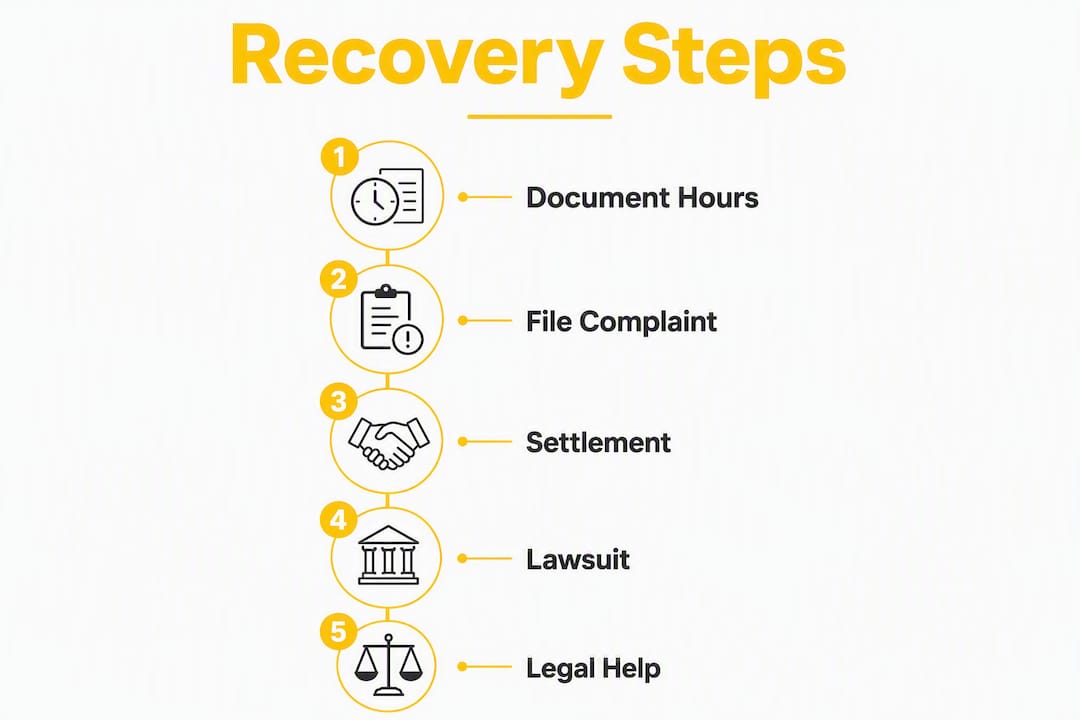
You have four practical paths. They are not mutually exclusive, and the right starting point depends on your evidence, the amount owed, and whether your employer is likely to cooperate.

Start here only when you have a genuine reason to believe HR will act and you want a written record of the employer’s response. Send a written complaint to HR or your direct supervisor, keep a copy, and note the date. If the employer corrects the error and pays what is owed, the matter is resolved. If they retaliate or ignore you, the written complaint becomes evidence in your DLSE or court filing.
This is the most common route for Laguna Beach workers with individual claims. The DLSE wage-claim process works in three stages:
DLSE claim checklist:
Pro Tip: Treat the settlement conference like a hearing. Organize your evidence chronologically, prepare a one-page summary of hours and amounts owed, and be ready for the employer to dispute your records. Hearing officers notice when a worker arrives prepared.
The U.S. Department of Labor’s Wage and Hour Division enforces the federal Fair Labor Standards Act (FLSA). California’s overtime rules are generally more protective than federal law, so most Laguna Beach workers get better results through the DLSE. The federal route becomes relevant when your employer operates across state lines, when the DLSE lacks jurisdiction, or when you want a parallel investigation running simultaneously. The FLSA also has a different statute of limitations (see the next section).
When the unpaid amount is large, when multiple coworkers share the same violation, or when the employer refuses to participate in the DLSE process, a private lawsuit or representative action under California’s Private Attorneys General Act (PAGA) may recover significantly more. Unpaid overtime representation through an employment attorney opens access to class-wide damages, civil penalties, and injunctive relief that the DLSE cannot award. Optimum Employment Lawyers has secured a $2.2 million class-action recovery in a meal-break case, which illustrates the scale that representative actions can reach.
Timeline expectations: DLSE claims that settle at the conference stage often resolve within 3–6 months. Cases that go to a hearing typically take 6–12 months or longer. Private lawsuits, especially class actions, can run 1–3 years, but the recoverable amounts are often substantially higher.
Missing a filing deadline can permanently bar your claim. California and federal law set different windows, and the clock starts running from the date each violation occurred, not the date you discovered it.
California DLSE filing windows:
These are the standard windows the DLSE lists for wage claims. Different violation types carry different deadlines, so if your claim spans multiple issues, the applicable window may vary by claim type.
Federal FLSA deadline:
Continuing violations: In some cases, each paycheck that underpays overtime is treated as a separate violation, which means the three-year window applies to each paycheck individually rather than to the first violation only. This doctrine can extend how far back your claim reaches.
If a deadline is close: Stop reading and act. Collect every piece of evidence you can access right now. Contact a California employment lawyer immediately. Some tolling doctrines may pause the clock, but you need counsel to evaluate whether they apply to your specific situation. A missed deadline is almost never recoverable.
DLSE also accepts claims from workers of any immigration status. The agency enforces wage laws regardless of immigration status, which means fear of disclosure is not a legal barrier to filing.
California law prohibits retaliation against any worker who files a wage claim, raises wage-hour concerns internally, or cooperates with a DLSE or DOL investigation. The prohibited actions are specific and broad.
Employers may not:
If any of these happen after you raise a wage concern, document everything immediately, and learn more about recovering your lost wages after an injury from this Car Accident Lost Wages Recovery: Your Step-by-Step Guide. Write down dates, times, what was said, who was present, and any changes to your schedule, pay, or duties. Save every email, text, or written notice you receive. A retaliation claim can be filed with the Labor Commissioner separately from your wage claim, and it can add substantial additional damages to your recovery.
The timing of adverse actions matters enormously. A termination that comes three days after you file a DLSE claim is far more suspicious than one that comes 18 months later, and hearing officers and judges notice that pattern. Retaliation evidence also strengthens your underlying wage claim by showing the employer was aware of the violation and chose to punish you rather than correct it.
Pro Tip: Create a separate retaliation log the moment you file any complaint. Date every entry. Note every interaction with management that feels different from before. If a supervisor who used to greet you warmly suddenly stops speaking to you, write it down. Small behavioral changes, documented consistently, build a compelling pattern.
Self-filing a DLSE claim works well for straightforward cases with clear records and a cooperative employer. But several situations consistently produce better outcomes with legal representation.
Consider hiring counsel when:
Optimum Employment Lawyers operates on a contingency-fee basis for qualifying cases, meaning no upfront payment is required. The firm’s fee comes from the recovery, so there is no financial risk to consulting them. The firm focuses exclusively on employee-side representation across California, handles DLSE claims, hearings, and class or representative actions, and has documented large-scale recoveries including significant class-action settlements in meal-break cases.
For a free case evaluation, bring the following to your consult:
The firm will assess the strength of your evidence, estimate potential damages including penalties, and advise whether a DLSE claim, a private lawsuit, or a class action is the right path for your situation.
Pro Tip: Bring more documentation than you think you need. An employment lawyer can tell you quickly what is useful and what is not, but they cannot evaluate evidence you left at home. A well-organized folder of records makes a consult far more productive.
Laguna Beach workers can recover unpaid overtime, waiting-time penalties, and meal-break premiums under California law by preserving evidence, filing a DLSE wage claim within the applicable deadline, and consulting an employment lawyer when the stakes are high.
| Point | Details |
|---|---|
| California overtime triggers | Daily overtime starts after 8 hours; doubletime after 12 hours; weekly overtime after 40 hours in a workweek. |
| Filing deadlines | Most wage and hour claims have a 3-year window under DLSE rules; act before the clock runs out. |
| Evidence is everything | Private contemporaneous logs, pay stubs, and digital timestamps are the foundation of any successful wage claim. |
| Additional penalties available | Waiting-time penalties under Labor Code § 203 and meal-break premiums can significantly increase total recovery. |
| Optimum Employment Lawyers | The firm handles DLSE claims, hearings, and class actions for Laguna Beach workers on a contingency-fee basis with no upfront cost. |
If you have been working hours that never showed up on your paycheck, Optimum Employment Lawyers offers something most workers in Laguna Beach do not know they can access: aggressive, employee-side legal representation with no upfront fees. The firm takes wage and hour cases on contingency, meaning its fee comes from your recovery, not your pocket.
The firm handles the full range of wage disputes, from individual DLSE claims and settlement conferences to multi-employee class actions and PAGA representative suits. Its documented $2.2 million class-action recovery in a meal-break case reflects the scale of results that organized, evidence-driven representation can achieve for California workers.
Laguna Beach workers dealing with unpaid overtime, misclassification, or retaliation after a complaint can request a free case evaluation to get a clear picture of what they may be owed and which recovery path fits their situation.
This article provides general legal information about California wage-and-hour law. It is not legal advice. Consult a qualified employment attorney or the California Labor Commissioner’s Office to evaluate your specific situation and confirm current rules.
These are the primary resources for filing wage claims, reviewing overtime rules, and understanding your rights as a Laguna Beach worker under California and federal law.

© 2026 Optimum Employment Lawyers, PC
Legal Disclaimer | Privacy Policy
 Share
Share
