
(949) 954-8181 Free Case Review No recovery, no fee.
(949) 954-8181 Free Case Review No recovery, no fee.
Unpaid wages in Huntington Beach occur when an employer fails to pay wages, overtime, commissions, or a final paycheck that California law requires. Every Huntington Beach employee is protected by the California Labor Code and the Division of Labor Standards Enforcement (DLSE), commonly called the Labor Commissioner’s Office. The California statewide minimum wage in 2026 is $16.90 per hour, setting the floor for any wage claim filed in Orange County. If your employer has paid you less than that, shorted your overtime, or withheld your final check, you have the legal right to recover every dollar owed.
The California Labor Commissioner’s Office is the fastest starting point for most Huntington Beach wage claims. The DLSE handles wage-and-hour enforcement including unpaid wages, missed breaks, and retaliation claims through an administrative process that does not require a civil lawsuit first. That distinction matters. Filing administratively costs you nothing in court fees, and the DLSE’s process is specifically designed to resolve claims faster than traditional litigation.
Here is how the process works, step by step:
One critical category to include in your claim is waiting-time penalties. Under Labor Code §203, waiting-time penalties accrue up to 30 days at one day’s pay per day late when an employer fails to deliver a final paycheck on time. Those penalties can add up to a full month of wages on top of what you are already owed.
Pro Tip: Download or photograph every pay stub the moment you receive it. Defective pay stubs are powerful evidence under Labor Code §226, and employers sometimes alter or destroy records once a claim is filed.

Contrast the administrative route with a civil lawsuit. A lawsuit in Orange County Superior Court allows you to seek broader damages and a jury trial, but it takes longer and involves attorney fees upfront unless you find counsel on contingency. The DLSE administrative process is the right first move for most employees, especially when the dollar amount is under $25,000.
Wage theft in California extends well beyond a missed paycheck. The California Labor Code identifies several distinct categories of violations, each carrying its own penalties and recovery rules. Huntington Beach employees should recognize all of them.
Common wage theft violations include:
| Violation Type | Typical Claim |
|---|---|
| Minimum wage underpayment | Back pay plus interest |
| Overtime miscalculation | 1.5x or 2x rate for unpaid hours |
| Missed meal or rest break | One hour premium pay per violation |
| Late final paycheck | Up to 30 days waiting-time penalty |
| Inaccurate pay stub | $50–$100 per pay period, up to $4,000 |
| Contractor misclassification | All unpaid wages, overtime, and benefits |
The financial recovery available to Huntington Beach employees goes beyond simply recouping unpaid hours. California law layers multiple penalty categories on top of the base wages owed, and those penalties often exceed the original underpayment.
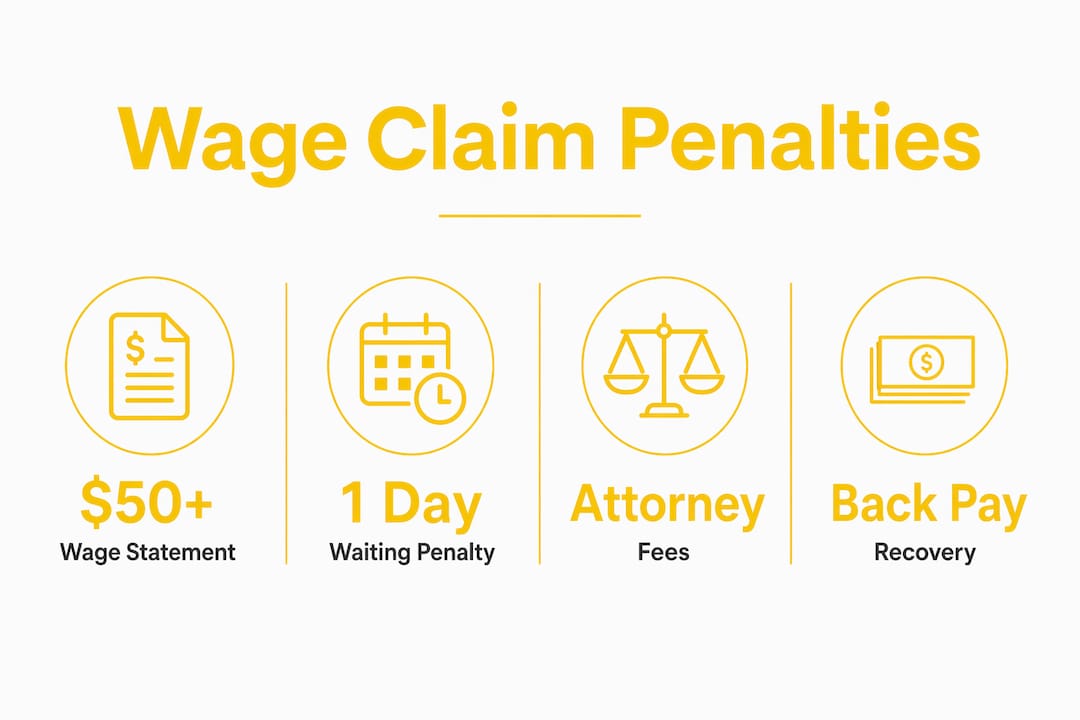
Waiting-time penalties are the most significant multiplier. The calculation of waiting-time penalties depends on when the employee actually receives final wages, not when the employer claims to have processed them. If your employer mailed a check three weeks after your termination, penalties accrue for those three weeks. At a daily rate based on your regular pay, 30 days of penalties can equal a full month’s salary.
Wage statement penalties under Labor Code §226 start at $50 for a first violation and $100 for each subsequent pay period. Penalties can reach $4,000 per employee when violations span multiple pay periods. The law presumes injury when a pay stub is defective, which removes a significant burden of proof from your shoulders.
Attorney’s fees and costs are recoverable under the California Labor Code and the Private Attorneys General Act (PAGA). PAGA allows employees to sue on behalf of themselves and other workers, collecting 25% of civil penalties while 75% goes to the state. This mechanism gives individual employees access to class-wide leverage even without a certified class action.
One legal nuance worth understanding is the good faith dispute defense. Employers can use this defense to avoid waiting-time penalties if they prove a genuine, credible disagreement over the wages owed. The defense does not erase the underlying wage obligation. It only eliminates the penalty multiplier. An employer who simply delays payment without a real dispute cannot claim good faith.
Pro Tip: Save every text message, email, and voicemail related to your pay. Courts and DLSE hearing officers treat written communications as direct evidence of willful nonpayment, which defeats the good faith defense and maximizes your penalty recovery.
Protecting your wage rights starts before a dispute arises. Employees who maintain organized records from day one recover more money faster than those who scramble to reconstruct their work history after a problem surfaces.
Follow these steps to build a strong position:
The Huntington Beach employment market includes industries like hospitality, retail, construction, and healthcare, all of which have documented histories of wage violations in California. Workers in these sectors are especially likely to encounter overtime miscalculations and misclassification schemes. Knowing the rules puts you ahead of most employees who discover the problem only after leaving a job.
Huntington Beach employees can recover unpaid wages, waiting-time penalties, and pay stub penalties through the California Labor Commissioner’s Office or civil litigation, with the administrative route being the fastest and most accessible first step.
| Point | Details |
|---|---|
| File with the DLSE first | The administrative wage claim process is faster and costs nothing in court fees. |
| Know the 2026 minimum wage | California’s $16.90 per hour floor applies to all Huntington Beach employees. |
| Waiting-time penalties multiply fast | Late final paychecks accrue one day’s pay per day late, up to 30 days. |
| Pay stub violations carry real money | Inaccurate pay stubs trigger up to $4,000 per employee in statutory penalties. |
| Act within the statute of limitations | Most wage claims must be filed within three years of the violation. |
Employees-lawyer, operating as Optimum Employment Lawyers, focuses exclusively on employee-side cases throughout California, including Huntington Beach wage disputes involving unpaid overtime, missed meal breaks, and final paycheck violations. The firm has secured significant results for workers, including a $2.2 million class action settlement for missed meal breaks. Consultations are confidential, and the firm handles wage and hour cases with no upfront fees. If you believe your employer owes you wages, contact Optimum Employment Lawyers to review your claim and understand every category of recovery available to you under California law.
Unpaid wages include any regular pay, overtime, commissions, bonuses, or final paycheck that an employer fails to deliver on time and in full. California law also treats missed meal and rest break premiums as unpaid wages.
The statute of limitations is generally three years for California Labor Code violations and four years for claims under the Unfair Competition Law. Filing as early as possible preserves your evidence and maximizes your recovery.
Retaliation against an employee for filing a wage claim is illegal under California law. The DLSE investigates retaliation claims alongside wage disputes, and employees who face retaliation may recover additional damages.
Waiting-time penalties under Labor Code §203 equal one day of pay for each day a final paycheck is late, up to a maximum of 30 days. The penalty calculation is based on when the employee actually receives the check, not when the employer claims to have sent it.
You do not need an attorney to file an administrative wage claim with the Labor Commissioner’s Office. However, claims involving misclassification, PAGA penalties, or employer retaliation benefit significantly from specialized legal representation to identify all available recovery categories.

© 2026 Optimum Employment Lawyers, PC
Legal Disclaimer | Privacy Policy
 Share
Share
