
(949) 954-8181 Free Case Review No recovery, no fee.
(949) 954-8181 Free Case Review No recovery, no fee.
Huntington Beach workers can recover unpaid wages by filing a wage claim with the California Labor Commissioner’s Office, which investigates violations and enforces state labor law. You do not need to hire an attorney to start the process, and California protects all workers regardless of immigration status. The two most relevant laws are California Labor Code § 510, which governs overtime pay, and California Labor Code § 203, which imposes waiting time penalties when employers fail to pay final wages on time.
The recovery process covers more than a missing paycheck. You can claim regular wages, overtime, missed meal and rest period premiums, unlawful deductions, commissions, vacation pay, and business expenses. Penalties on top of those amounts can add up fast.
| Violation Type | Governing Law | What You Can Recover |
|---|---|---|
| Unpaid overtime | Labor Code § 510 | 1.5 times or double regular rate |
| Late final paycheck | Labor Code § 203 | Up to 30 days of daily wages |
| Missed meal period | IWC Orders | One hour of pay per violation |
| Missed rest period | IWC Orders | One hour of pay per violation |
| Bounced paycheck | Labor Code § 203 | One day’s pay per day, up to 30 days |

Filing a claim is free. The Labor Commissioner’s Office handles the investigation, schedules a settlement conference, and, if needed, holds a formal hearing where a hearing officer issues a binding decision.
Gathering your documents before you file makes the process faster and your claim stronger. You are not legally required to have records because employers must maintain accurate time and payroll records, but your own evidence helps.
Documents to collect:
Once you have what you can find, fill out DLSE Form 1, the Initial Report or Claim. If your hours varied week to week, also complete DLSE Form 55. For commission claims, attach DLSE Form 155. Submit copies only. Never send originals at this stage; hearing officers may request originals later if the employer disputes your records.
| Filing Method | How | Estimated Processing Start |
|---|---|---|
| Online portal | dir.ca.gov/dlse | Immediate submission |
| District office email | Within days of receipt | |
| Labor Commissioner’s Office | Allow mailing time | |
| In person | Local district office | Same day |
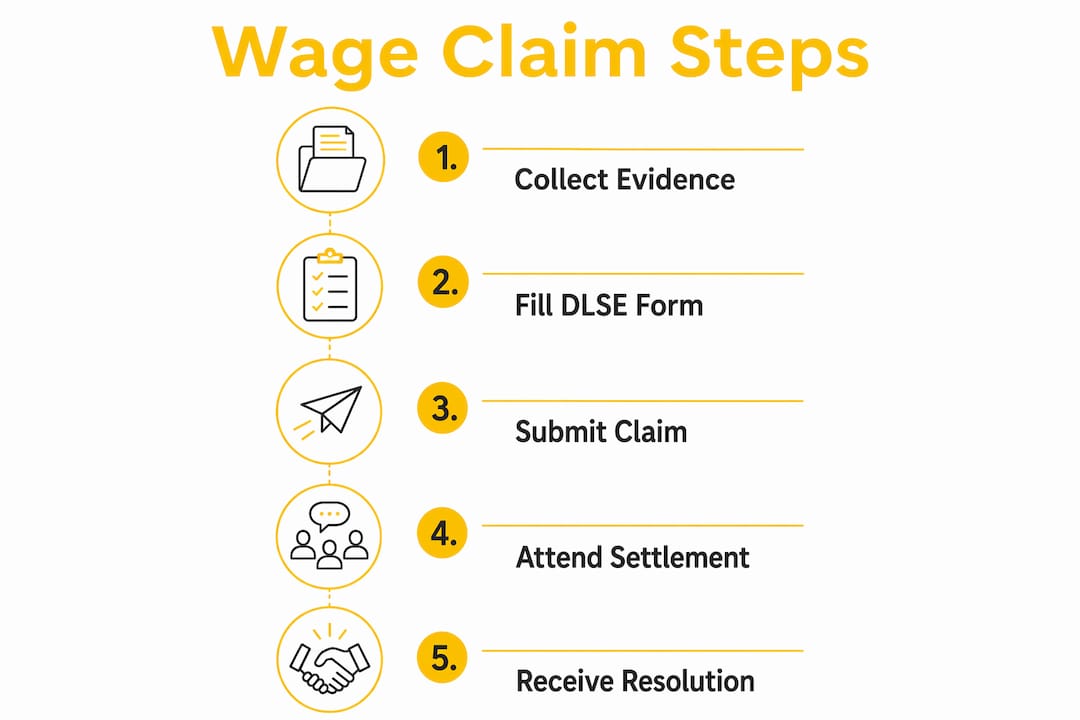
After submission, the district office assigns a Deputy Labor Commissioner who reviews the claim and determines next steps. You will receive a notice by mail with the date, time, and location of your settlement conference.
Pro Tip: Save every communication with your employer about pay, hours, or termination in a dedicated folder. Screenshot text messages and email threads. If a dispute goes to a formal hearing, this paper trail can be the difference between winning and losing.
California’s labor laws give Huntington Beach workers real teeth when employers steal wages. Labor Code § 510 requires overtime pay at 1.5 times your regular rate for any hours over 8 in a day or 40 in a week, and double pay for hours over 12 in a single day or for all hours on a seventh consecutive workday. These rules cover non-exempt employees 18 and older, including minors aged 16–17 not otherwise restricted.
Labor Code § 203 adds a financial sting for employers who drag their feet on final paychecks. If you were discharged, your final wages are due immediately. If you quit with at least 72 hours’ notice, same rule applies. Quit without notice? Your employer has 72 hours. Miss that window willfully, and the penalty equals your daily wage rate multiplied by every calendar day the wages stay unpaid, up to 30 days. That includes weekends and holidays.
Protections and penalties at a glance:
Wage theft is not a minor HR issue. California treats willful nonpayment as a serious violation, and the penalty structure reflects that.
Missing a deadline can forfeit your right to recover wages entirely. California sets different statutes of limitations depending on the type of violation.
| Violation | Filing Deadline |
|---|---|
| Bounced check or denied payroll record access | 1 year |
| Most wage violations (minimum wage, overtime, meal/rest breaks, sick leave, illegal deductions) | 3 years |
| Written employment contract | 4 years |
| Waiting time penalties (Labor Code § 203) | 3 years |
One detail that catches workers off guard: filing a wage claim with the DLSE does not stop waiting time penalties from accruing. Only filing a lawsuit in civil court stops the clock. So if your employer owes you a final paycheck and you file with the Labor Commissioner’s Office, the penalty keeps growing until the employer pays or you file in court.
Act quickly. The longer you wait, the more you risk losing older pay periods to the statute of limitations, and the harder it becomes to reconstruct records.
Pro Tip: Write down the exact date your employment ended and the date you received or did not receive your final paycheck. These two dates determine your waiting time penalty calculation and your filing deadline.
After you file, the Labor Commissioner’s Office assigns your claim to a Deputy Labor Commissioner who reviews the facts and decides the best path forward. Most claims go to a settlement conference first.
The claim process in stages:
| Stage | Purpose | Typical Duration |
|---|---|---|
| Intake and assignment | Review and notify parties | Several weeks |
| Settlement conference | Negotiate resolution | One session |
| Formal hearing (if needed) | Evidence review and decision | Scheduled after conference |
| ODA issuance | Binding ruling served to parties | After hearing |
| Enforcement (if employer defaults) | DLSE enters ODA as court judgment | As needed |
If the employer appeals the ODA to civil court, the DLSE may represent workers who cannot afford an attorney. If the employer simply ignores a ruling in your favor, the DLSE can convert the ODA into a court judgment with the same force as any other money judgment.
Documenting your claim thoroughly is the single most reliable way to strengthen your position. Employers often contest hours worked or claim payments were made, so your own records, even rough notes, fill gaps that employer records leave open.
Optimum Employment Lawyers focuses exclusively on employee-side cases in California, including wage theft claims for Huntington Beach workers. The firm secured a large settlement in a class action involving missed meal breaks, a violation that many workers overlook because it seems minor. It is not. One missed 30-minute meal period per shift, multiplied across months of employment, adds up to real money.
If your employer contests the claim at the settlement conference and no resolution is reached, the case moves to a formal hearing. At that stage, the hearing officer reviews all submitted evidence, hears testimony under oath, and issues an ODA. The employer cannot simply walk away from that ruling.
If the employer ignores the ODA entirely, the DLSE files it as a court judgment on your behalf. That judgment carries the same legal weight as any civil court order, meaning the employer’s assets can be subject to collection. You can also hire a private attorney to pursue collection independently.
For larger disputes or cases involving multiple employees, a class action lawsuit may be the right path. California courts have handled class actions against well-known employers in the hospitality, retail, and construction sectors, often recovering back wages for dozens or hundreds of workers at once.
Start with your base hourly rate and total hours worked, then layer in every category of unpaid compensation.
Regular wages cover all non-overtime hours your employer failed to pay. Overtime adds 1.5 times your regular rate for hours 8–12 in a day or over 40 in a week, and double time beyond 12 hours in a day. Meal period premiums add one hour of pay at your regular rate for each workday a compliant 30-minute meal break was not provided. Rest period premiums work the same way: one hour of pay per workday a 10-minute rest break was denied.
If you were paid by piece rate or commission, you still must have earned at least minimum wage for every hour worked. Compare your total pay against total hours to check. Add any unlawful deductions, unreimbursed business expenses, and accrued vacation pay the employer refused to pay out. Then, if your final paycheck was late, calculate the waiting time penalty by multiplying your daily wage rate by the number of calendar days the wages remained unpaid, up to 30.
You can file a wage claim without an attorney, and the Labor Commissioner’s Office guides you through the process. But an attorney becomes worth the cost in specific situations: your claim involves a large dollar amount, your employer has legal representation, you were misclassified as an independent contractor, or your case involves retaliation or wrongful termination on top of unpaid wages.
Most California employment attorneys handling wage claims work on a contingency basis, meaning you pay nothing unless you win. California Labor Code also allows courts to award attorney’s fees to prevailing employees in wage cases, which means your employer may end up paying your legal costs. If you need California employment representation, Optimum Employment Lawyers handles wage claims for Huntington Beach workers and takes cases on contingency. For workers in the broader Los Angeles area, employment law resources are also available nearby.
Most wage claims settle before reaching a formal hearing. A settlement gives you money faster and avoids the uncertainty of a hearing officer’s decision. The tradeoff is that you typically accept less than the full amount claimed, and you sign a release waiving future claims related to the same dispute.
A court judgment, by contrast, can include the full amount of unpaid wages, waiting time penalties, interest, and attorney’s fees. It takes longer and involves more risk, but the potential recovery is higher. If your employer has a pattern of wage violations or your claim involves a class of workers, going to court often produces a better outcome than settling individually.
California law allows workers to recover interest on unpaid wages from the date the wages were due. The standard prejudgment interest rate under California law is 7% per year on unpaid wage amounts. That figure compounds over time, so the longer your employer delays, the more they owe.
Beyond interest, workers may also recover liquidated damages equal to the amount of unpaid minimum wages under Labor Code § 1194.2. Civil penalties under Labor Code § 210 apply for late payment of wages during employment. These penalties are separate from and in addition to the unpaid wages themselves. An Irvine unpaid wages attorney or a Huntington Beach-focused firm can help you identify every category of damages your specific situation supports.
Some employment contracts include mandatory arbitration clauses, which require disputes to be resolved by a private arbitrator rather than through the Labor Commissioner’s Office or a court. California has limited the enforceability of some arbitration agreements in employment contracts, particularly those signed as a condition of employment after January 1, 2020, under AB 51. However, the legal landscape around arbitration agreements continues to evolve, and whether your clause is enforceable depends on its specific terms.
Mediation is a voluntary process where a neutral third party helps both sides reach a settlement. Unlike arbitration, mediation is not binding unless both parties agree to the outcome. It can be faster and cheaper than a formal hearing or trial, and it preserves more control for you over the final terms. If your employer proposes mediation, consult an attorney before agreeing, since a mediated settlement typically includes a full release of claims.
Huntington Beach workers who act quickly, document thoroughly, and understand California’s penalty structure recover significantly more than those who wait or file incomplete claims.
| Point | Details |
|---|---|
| File with the Labor Commissioner | Submit DLSE Form 1 online, by email, mail, or in person to start your wage recovery. |
| Know your deadlines | Most wage violations carry a 3-year filing window; written contracts allow 4 years. |
| Waiting time penalties keep accruing | Only a court filing stops Labor Code § 203 penalties; a DLSE claim does not. |
| Document everything yourself | Your own notes and records strengthen claims even though employers bear the recordkeeping duty. |
| Retaliation is illegal | California law protects you from adverse employer actions for asserting your wage rights. |

© 2026 Optimum Employment Lawyers, PC
Legal Disclaimer | Privacy Policy
 Share
Share
