
(949) 954-8181 Free Case Review No recovery, no fee.
(949) 954-8181 Free Case Review No recovery, no fee.


If you work in Laguna Niguel and your employer is skipping your rest breaks, California law already has your back. Nonexempt employees working shifts of at least 3.5 hours are entitled to a paid 10-minute rest break for every four hours worked, or major fraction thereof, under the Industrial Welfare Commission Wage Orders and California Labor Code Section 226.7. When an employer fails to provide that break, the penalty is additional pay at your regular rate for each workday the break was denied. That extra hour is legally classified as a wage, not a bonus or goodwill gesture, which means it carries the same legal weight as your regular paycheck.
Here is what Laguna Niguel employees need to know right now:
California sets some of the strictest rest break standards in the country, and Laguna Niguel employers are bound by every one of them.
The baseline rule is straightforward: one net 10-minute paid rest break for every four hours worked, or for any period that is a “major fraction” of four hours. The DLSE defines “major fraction” as anything over two hours. So a six-hour shift earns one break, a seven-hour shift earns one break, and a shift of more than eight hours earns two. The break must be consecutive, not split into two five-minute chunks.
Timing matters too. The break should fall as close to the midpoint of each four-hour work segment as the job allows. If the nature of the work makes the exact midpoint impossible, the employer must still get as close to it as practicable. Scheduling a break at the very start or end of a work segment does not satisfy the law.
The physical space matters as well. Employers must provide a resting area that is separate from restrooms. Using the bathroom during a shift does not count as a rest break, and an employer cannot legally treat it as one. The DLSE is explicit: the intent of the rest break requirement is genuine rest, not a bathroom policy.
Rest breaks are also distinct from meal breaks in two important ways. Meal breaks are unpaid and last at least 30 minutes; rest breaks are paid and last 10 minutes. An employer cannot combine them, swap one for the other, or count a meal break as satisfying a rest break obligation.
Premium pay and wage statements. When an employer misses the mark, Labor Code Section 226.7 kicks in automatically. The employer owes one additional hour of pay at the employee’s regular rate for each workday a required break was not provided. Under the California Supreme Court’s ruling in Naranjo v. Spectrum Security Services, Inc. (S258966), that premium pay must also be reported on the employee’s wage statement under Labor Code Section 226. Employers who skip that reporting step face additional liability on top of the unpaid premiums.
Key rule: Premium pay for missed rest breaks is a wage under California law, subject to a three-year statute of limitations. Every missed break from the past three years is potentially recoverable.
Rest break violations are not always obvious. Some employers deny breaks outright. Others create conditions where taking a break feels impossible, which California courts treat as equally unlawful.
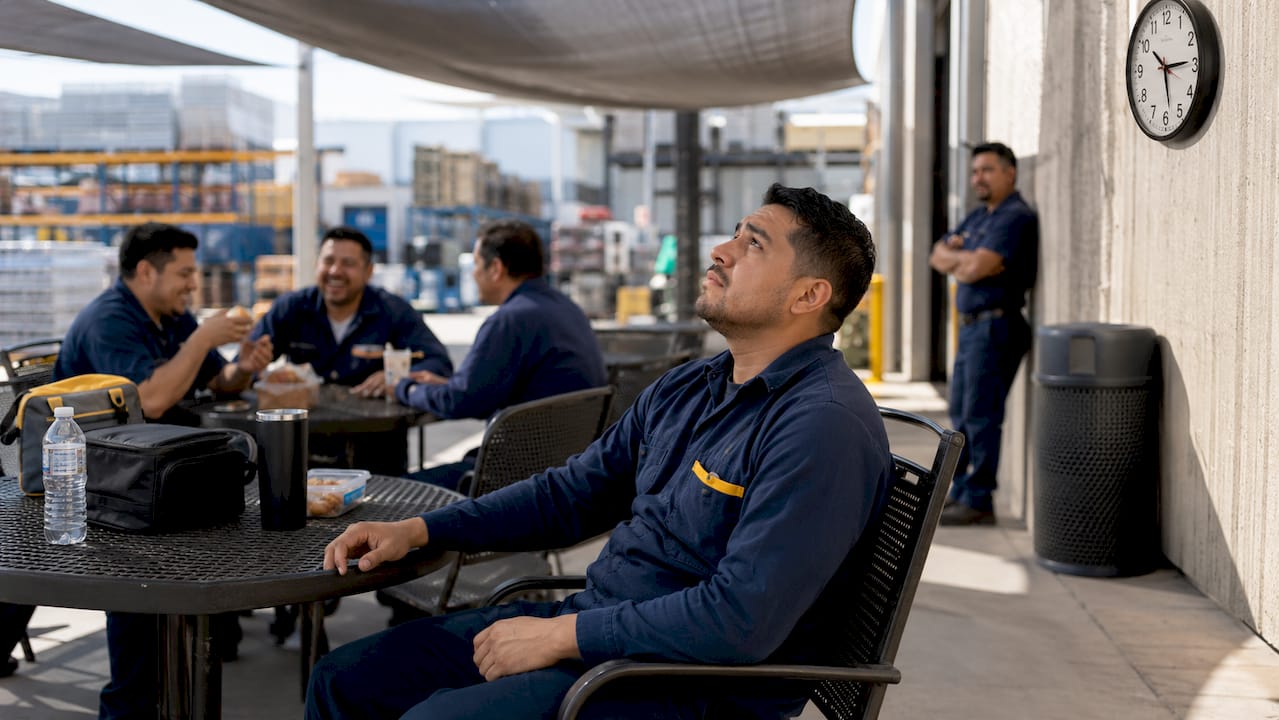
Outright denial. The clearest violation is an employer who simply tells workers they cannot take breaks, or who schedules shifts so tightly that no break window exists. This is common in fast-paced retail environments along the Crown Valley Parkway corridor in Laguna Niguel, where staffing shortages often push workers through full shifts without a pause.
On-call breaks. Being physically away from your workstation does not make a break duty-free if you are still required to monitor a radio, respond to calls, or stay available for work. California law is clear that on-call rest breaks violate the requirement that employees be relieved of all duties. Security firms, healthcare support services, and hospitality employers in Laguna Niguel frequently run into this problem, and courts have consistently sided with employees.
Pressure to skip breaks. An employer does not have to say “don’t take your break” to be liable. If the workplace culture, scheduling policy, or management behavior makes workers feel they cannot step away without consequences, that pressure is legally actionable. The California Supreme Court addressed this directly in Brinker Restaurant Corp. v. Superior Court (2012), holding that employers cannot undermine a formal break policy through coercive scheduling or implicit pressure.
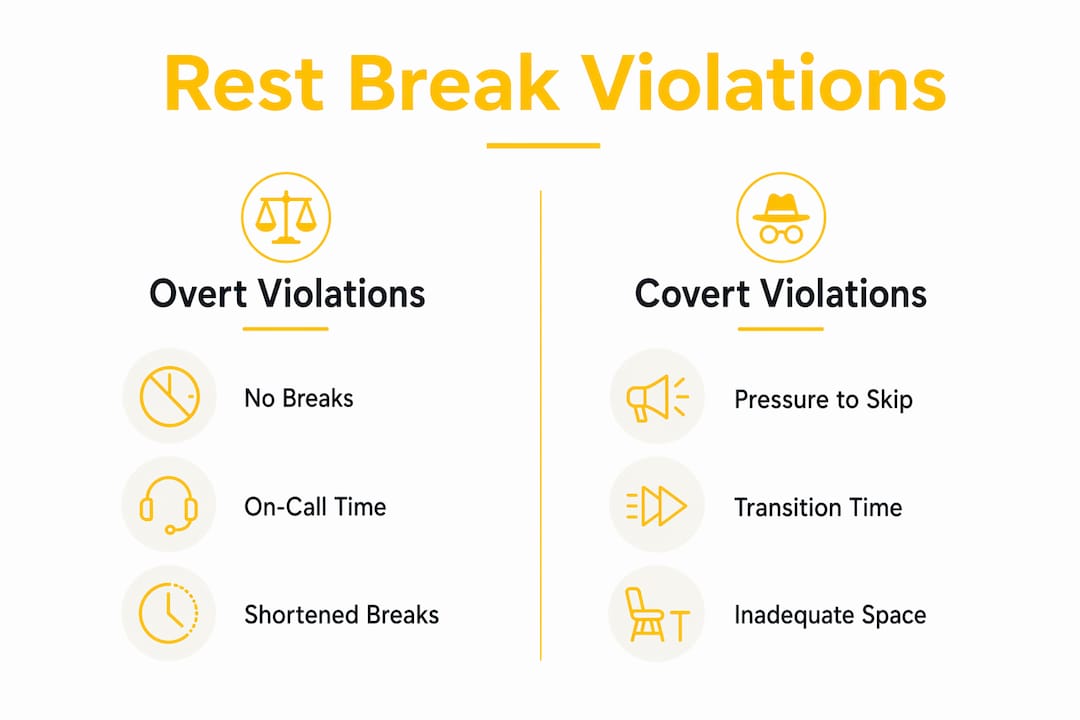
Counting transition time as rest time. Walking from one workstation to another, waiting for equipment, or standing in line for a time clock does not count toward the 10-minute rest period. The break clock starts only when the employee is genuinely free of all duties, and the 10 minutes must be consecutive.
Breaks given at the wrong time. A break provided at the very beginning or end of a shift, rather than near the midpoint of the work segment, may not satisfy the legal requirement. Timing is part of the obligation, not an afterthought.
Common Laguna Niguel sectors where violations occur:
Pro Tip: Document every denied or interrupted break in real time. Note the date, shift start and end times, whether a break was offered, and any manager comments. A simple notes app on your phone works. This record becomes your evidence if you file a claim.
The law gives Laguna Niguel employees two direct paths to recover premium pay for missed rest breaks: file a wage claim with the California DLSE, or file a lawsuit in civil court. Both routes can result in the same recovery, one additional hour of pay at your regular rate for each workday a break was denied, but the court route also opens the door to additional penalties if your employer failed to report the premiums on your wage statements.

Filing with the California DLSE. The Labor Commissioner’s Office handles wage claims statewide. You can file online, by mail, or in person. The DLSE investigates the claim, holds a settlement conference, and if no resolution is reached, schedules a hearing. There is no filing fee. The DLSE office serving Orange County, which covers Laguna Niguel, is located in Santa Ana. For workers who want to report a violation without filing a full wage claim, the Bureau of Field Enforcement (BOFE) accepts reports and can conduct workplace inspections.
Filing a lawsuit. Employees can bypass the DLSE and go straight to court, particularly when the violation is part of a pattern affecting multiple workers. Class action lawsuits are a powerful tool here. Naranjo v. Spectrum Security Services, Inc. is a direct example: Gustavo Naranjo, a security guard required to stay on duty during meal breaks, filed a class action on behalf of Spectrum employees and ultimately secured a ruling from the California Supreme Court confirming that missed-break premium pay must appear on wage statements. The case (S258966) set precedent that benefits every California worker in a similar situation.
The three-year window. Claims for unpaid rest break premiums must be filed within three years of the violation, per the California Supreme Court’s ruling in Murphy v. Kenneth Cole Productions, Inc. (2007). That means if your employer has been denying breaks for years, every violation within the past three years is potentially recoverable. For workers who were terminated, any unpaid premium pay must also be included in the final paycheck under the same wage payment deadlines that apply to regular wages.
Wage statement violations add up. Under Naranjo, an employer who fails to report missed-break premiums on pay stubs is not just behind on premium pay. That employer also faces liability under Labor Code Section 226 for issuing inaccurate wage statements. The penalties stack, and they can significantly increase the total value of a claim.
Retaliation is illegal. If you raise a rest break concern and your employer responds by cutting your hours, changing your schedule, or making threats, that is retaliation. California law prohibits retaliation against workers who assert their labor rights, including threats related to immigration status. A retaliation claim can be filed separately with the DLSE under Labor Code Section 98.7.
Pro Tip: Before you file anything, pull your pay stubs for the past three years and check whether any “rest break premium” line appears. If your employer was denying breaks and those premiums are missing from your wage statements, you likely have two separate claims: one for the unpaid premiums and one for the inaccurate wage statements.
Optimum Employment Lawyers focuses exclusively on employee-side cases throughout California, including Laguna Niguel. The firm’s employment attorneys in Laguna Niguel can evaluate your situation, calculate what you are owed across the full three-year window, and pursue the strongest available claim, whether through the DLSE or in court.
A genuine rest break is yours to use however you choose, within reason. California law does not dictate how employees spend their 10 minutes, only that the time is completely free from work obligations.
What you can do:
What your employer cannot require you to do:
One distinction that surprises many workers: rest breaks cannot be waived. Under California law, employees and employers can mutually agree to waive a meal break under specific conditions, but no such waiver exists for rest breaks. If your employer has you sign a document saying you voluntarily skipped your breaks, that document does not eliminate the employer’s liability. The obligation to provide the break, and to pay the premium if it was missed, remains.
The restroom rule is also worth knowing. Using the restroom during your shift is a separate right from your rest break. An employer cannot count a bathroom trip as your 10-minute break, and the DLSE has been consistent on this point for decades. The IWC Orders specifically require that resting facilities be in an area separate from toilet rooms, which signals that the two are not interchangeable.
Lactation breaks operate under a parallel but distinct framework. Under Labor Code Section 1030, employers must provide reasonable break time for employees to express breast milk. If that lactation break runs concurrently with an already-scheduled rest break, it satisfies both obligations. If it does not, the lactation break need not be paid. Violations of lactation accommodation rules carry a separate penalty of $100 per day and can be reported to the DLSE’s Bureau of Field Enforcement.
If you are an outdoor worker in Laguna Niguel, you have one additional right: California law requires employers to allow outdoor workers to take a break to cool down in the shade whenever needed to prevent heat illness, regardless of the standard break schedule. This right exists on top of your regular rest break entitlements.
If your employer in Laguna Niguel has been denying rest breaks, cutting them short, or keeping you on call during what should be your free time, you have concrete legal options. A California employment lawyer at Optimum Employment Lawyers can review your pay stubs, calculate your unpaid premiums, and file your claim before the three-year window closes. The consultation costs you nothing, and the firm works exclusively for employees.
California rest break law gives Laguna Niguel employees the right to one paid 10-minute break per four-hour work segment, and every missed break triggers a one-hour premium wage the employer must pay and report on your pay stub.
| Point | Details |
|---|---|
| Who qualifies for rest breaks | Nonexempt employees working shifts of 3.5 hours or more are entitled to at least one paid 10-minute rest break. |
| Employer duty goes beyond offering breaks | Employers must authorize, permit, and relieve employees of all duties; pressure to skip breaks is legally actionable. |
| Missed break penalty | One additional hour of pay at the employee’s regular rate is owed for each workday a required break was not provided. |
| Statute of limitations | Claims for unpaid rest break premiums must be filed within three years of each violation, per Murphy v. Kenneth Cole Productions, Inc. |
| Wage statement liability | Under Naranjo v. Spectrum Security Services, Inc. (S258966), missed-break premiums must appear on pay stubs; omitting them creates additional liability under Labor Code Section 226. |

© 2026 Optimum Employment Lawyers, PC
Legal Disclaimer | Privacy Policy
 Share
Share
