
(949) 954-8181 Free Case Review No recovery, no fee.
(949) 954-8181 Free Case Review No recovery, no fee.
Meal break violations in Lake Forest, CA, occur when employers fail to provide legally mandated unpaid meal breaks and paid rest breaks to nonexempt employees as required by California Labor Code Section 512 and Labor Code Section 226.7. These violations are not minor oversights. Every missed or interrupted break triggers a premium pay obligation, and Lake Forest workers who experience these violations regularly may be owed significant back wages. Optimum Employment Lawyers has recovered $2.2 million in a single class action case involving missed meal breaks, which shows how quickly these claims add up across a workforce.
California sets some of the strictest workplace break regulations in the country. Lake Forest employees covered by Industrial Welfare Commission (IWC) wage orders must receive the following:
The difference between meal and rest breaks matters legally. Rest breaks are paid time and count as working hours. Meal breaks are unpaid, but only when the employee is completely free from work obligations. Rest breaks cannot be waived under any circumstances. A first meal break can be waived by mutual consent if the shift is no longer than 6 hours. A second meal break can be waived only if the total shift does not exceed 12 hours and the first meal break was not waived.
Pro Tip: If your employer tells you that you can “skip” your rest break and leave early instead, that arrangement does not comply with California law. Rest breaks must be provided, not traded for early departure.
A meal break violation happens any time an employer fails to provide a legally compliant break. Lake Forest workers encounter these violations in several common forms:
Employers often mislabel breaks as “on-duty” meal breaks without meeting the strict legal criteria. An on-duty meal break is only lawful when the nature of the work prevents the employee from being relieved, and the employee signs a written agreement that is revocable at any time. That agreement must be specific to the job duties. A retail cashier or a warehouse picker almost never qualifies for an on-duty meal break under California law.
Pro Tip: Keep a personal log on your phone. Every time a break is missed, shortened, or interrupted, note the date, the time, and what happened. This record becomes critical evidence if you file a claim.
California law gives employees a direct financial remedy for every missed or noncompliant break. California employers must pay one additional hour at the employee’s regular rate of pay for each missed meal or rest break per workday. This payment is called premium pay.

Premium pay is not calculated on base hourly rate alone. The calculation must include nondiscretionary bonuses and commissions. Many employers underpay premium wages by ignoring bonuses, which means the actual amount owed is higher than what appears on the pay stub.
The daily cap matters. Missing both a meal and a rest break on the same day entitles you to two hours of premium pay total for that day, one hour per violation type. You cannot stack multiple premiums for the same type of break violation within a single day.
The statute of limitations is three years. Premium pay under Section 226.7 is classified as wages, not penalties, which gives employees a three-year window from the date of each violation to file a claim. Each workday violation restarts its own three-year clock. That means violations from 2023 are still actionable in 2026.
Beyond premium pay, employers face additional consequences:
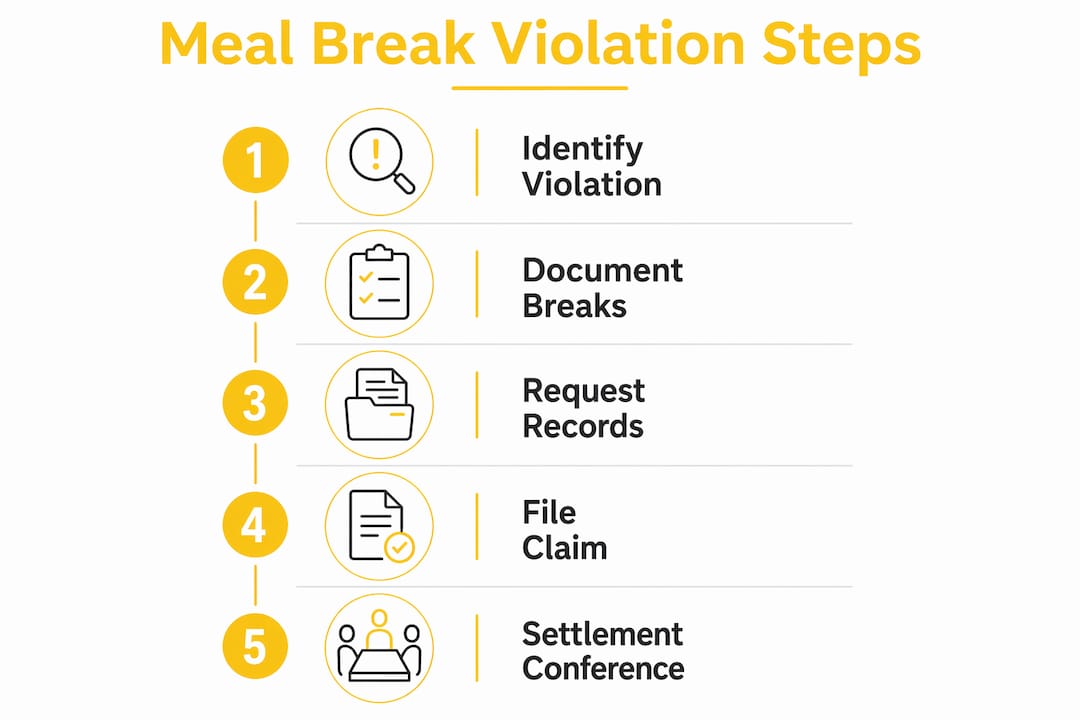
Strong documentation is the foundation of a successful meal break claim. Employer time records are often inaccurate or incomplete. Contemporaneous personal logs corroborate your account and significantly strengthen your position against employer records.
Here is what to collect before filing:
Filing a claim with the California Labor Commissioner involves a settlement conference first, where both sides attempt to resolve the dispute. If no settlement is reached, the case proceeds to a formal hearing before a hearing officer. Either party can appeal the decision to the California Superior Court. The process can take several months, but it is free to initiate and does not require an attorney.
Pro Tip: Request your time records and pay stubs in writing and keep a copy of the request. If your employer fails to respond within 21 days, that failure can itself support your claim.
For employees in Lake Forest with complex claims or large amounts owed, working with an employment law attorney familiar with California wage and hour law gives you a significant advantage in calculating the full amount owed and navigating the process.
Not every employee in Lake Forest is covered by California’s meal break rules. California’s break laws do not apply to exempt employees, specifically those classified as “white collar” professionals who meet both a salary test and a duties test. Exempt status requires earning at least twice the state minimum wage on a monthly salary basis and primarily performing executive, administrative, or professional duties.
The table below summarizes the key exceptions:
| Category | Rule |
|---|---|
| Exempt employees (white collar) | Not entitled to meal or rest breaks under California wage orders |
| On-duty meal break | Allowed only with written, revocable agreement and qualifying job duties |
| First meal break waiver | Permitted by mutual consent for shifts of 6 hours or less |
| Second meal break waiver | Permitted only if the first break was not waived and shift is 12 hours or less |
| Federal truck drivers | Subject to federal Hours of Service rules, not California break law in some situations |
One nuance specific to Orange County employers: some companies operating across multiple states attempt to apply out-of-state break policies to their Lake Forest workforce. That practice is unlawful. California law governs any work performed in California, regardless of where the employer is headquartered.
Employees in Lake Forest dealing with unpaid meal break claims have a clear legal path forward, but the details of premium pay calculations, statute of limitations, and documentation requirements are easy to get wrong without guidance.
Optimum Employment Lawyers focuses exclusively on employee-side cases in California, including wage and hour violations like missed meal and rest breaks. Their team has direct experience with Lake Forest workers and understands how local employers operate. The firm’s $2.2 million class action settlement for missed meal breaks reflects the real financial stakes involved. If you believe your employer has violated your break rights, you can speak with an attorney at Optimum Employment Lawyers to review your situation and understand what you may be owed.
California employees in Lake Forest are entitled to premium pay for every missed or noncompliant meal or rest break, and claims can reach back three years from the date of each violation.
| Point | Details |
|---|---|
| Premium pay per violation | Employers owe one hour of pay at the regular rate for each missed meal or rest break per workday. |
| Daily cap on premium pay | Missing both a meal and a rest break in one day entitles you to a maximum of two hours of premium pay. |
| Three-year filing window | Each workday violation carries its own three-year statute of limitations for filing a wage claim. |
| Documentation is critical | Personal logs, pay stubs, and time records are the strongest evidence in a meal break claim. |
| Exempt employees are excluded | White-collar employees who meet salary and duties tests are not entitled to California break protections. |
A meal break violation occurs when an employer fails to provide a 30-minute, duty-free, uninterrupted meal break before the end of the 5th hour of a shift. Working through lunch, being interrupted, or being required to stay on call all constitute violations.
California law entitles you to one additional hour of pay at your regular rate for each missed meal break per workday. If your pay includes nondiscretionary bonuses, those must be factored into the calculation.
You have three years from the date of each violation to file a claim, because premium pay is classified as wages under California Labor Code Section 226.7. Each missed break starts its own three-year clock.
An on-duty meal break agreement is only lawful when the nature of the work genuinely prevents you from being relieved of all duties. The agreement must be in writing and you must be able to revoke it at any time.
Yes. Rest breaks are paid time and cannot be waived under any circumstances, while meal breaks are unpaid and can sometimes be waived by mutual consent. Missing a rest break triggers the same one-hour premium pay obligation as a missed meal break.

© 2026 Optimum Employment Lawyers, PC
Legal Disclaimer | Privacy Policy
 Share
Share
