
(949) 954-8181 Free Case Review No recovery, no fee.
(949) 954-8181 Free Case Review No recovery, no fee.
Rest break violations occur when California employers fail to provide legally required paid 10-minute rest breaks for every four hours worked, triggering premium pay penalties and potential legal claims under California Labor Code Section 226.7. Fountain Valley workers in warehouses, retail stores, healthcare facilities, and manufacturing plants face these violations regularly. The California Division of Labor Standards Enforcement and the Private Attorneys General Act (PAGA) both give you tools to fight back. If your employer has been skipping your breaks, you are owed money. Understanding exactly what the law requires is the first step toward collecting it.
California law requires a paid 10-minute rest break for every four hours worked, or major fraction thereof. That phrase “major fraction” means any shift longer than two hours counts toward the next break threshold. The schedule is straightforward: shifts between 3.5 and 6 hours require one break, shifts of 6–10 hours require two breaks, and shifts of 10–14 hours require three breaks. These numbers are not suggestions. They are legal minimums set by the California Industrial Welfare Commission.
Rest breaks must be paid and completely duty-free. Your employer cannot ask you to stay near your workstation, monitor equipment, or remain available during a rest break. Any interruption that cuts the break short invalidates it entirely. That is a critical distinction from meal breaks, which can sometimes be waived by mutual agreement. Rest breaks cannot be waived under any circumstances, even if you voluntarily choose to skip one.

Timing matters too. California guidelines require rest breaks to fall near the middle of each four-hour work period. An employer who schedules your only break at the very start or end of a shift is not complying with the law. Fountain Valley workers in physically demanding jobs, such as logistics, food processing, and construction, are especially vulnerable to this kind of scheduling abuse.
Rest break requirements at a glance:
Pro Tip: If your employer tells you that skipping a break is fine because you agreed to it, that agreement has no legal force. California law overrides any verbal or written waiver of rest breaks.
To understand how rest break rules interact with exempt employee status, check whether your job classification actually qualifies for break protections. Most hourly workers in Fountain Valley do.
The financial consequences for employers who violate California rest break rules are specific and non-negotiable. Employers owe one additional hour of premium pay per missed rest break per workday, calculated at the employee’s regular hourly rate. That premium pay obligation cannot be reduced, waived, or settled away without a proper legal process.
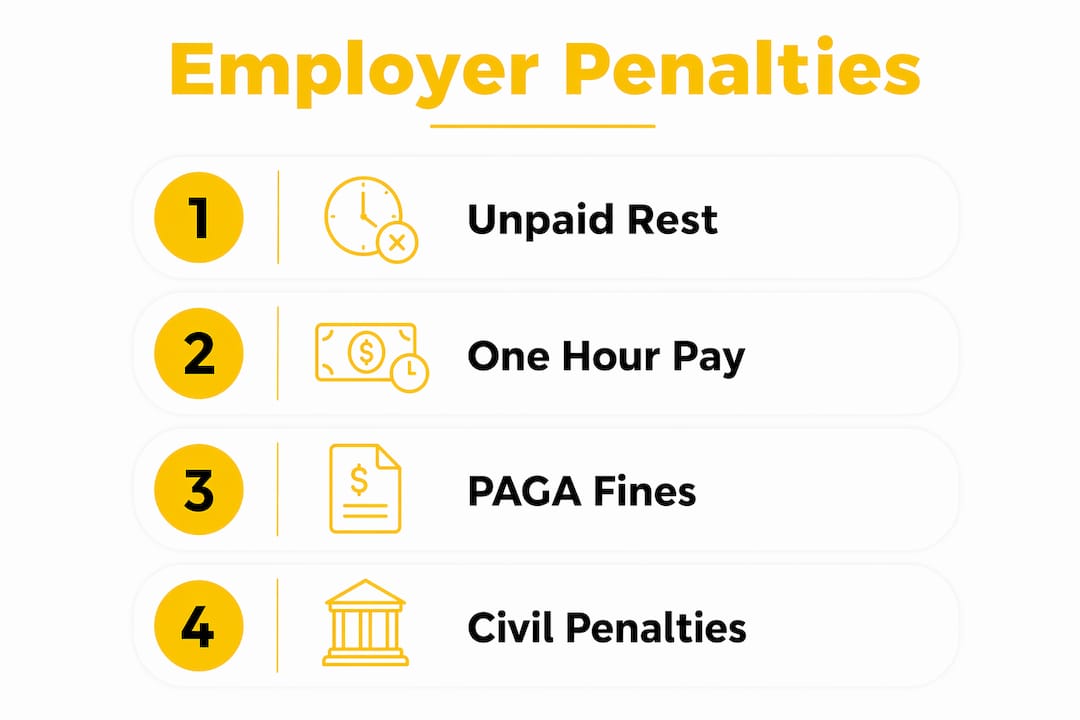
One detail that surprises many workers: if you miss two rest breaks in a single day, your employer owes you only one hour of premium pay for rest break violations that day, not two. Premium pay is calculated per violation type per day, not per individual break missed. However, missed meal breaks generate a separate premium pay obligation. So a worker who misses both a meal break and two rest breaks in one shift is owed two hours of premium pay total: one for the meal break and one for the rest break violations.
Here is how the penalties stack up in practice:
PAGA claims allow employees to pursue civil penalties beyond just their own unpaid wages. Under 2024 PAGA reforms, penalties are capped at 15–30% of the maximum if employers demonstrate reasonable compliance efforts. Even with those caps, civil penalties across a group of workers can reach substantial totals. Employees have up to three years to file rest break premium pay claims in California. That three-year window means violations from years ago are still recoverable.
Premium pay counts as wages for payroll tax purposes. That classification matters because it affects how your claim is calculated and reported, making the total value of a successful claim larger than workers often expect.
The California Supreme Court’s decision in Donohue v. AMN Services fundamentally shifted how rest break cases work. That ruling established a rebuttable presumption from employer time records: if your employer’s own records show no rest break was taken, a violation is presumed. The burden then shifts to the employer to prove otherwise.
Employers can rebut that presumption, but only with strong evidence. They need clear, consistently enforced written break policies and documented acknowledgments from employees confirming they received and understood those policies. A vague employee handbook buried in an onboarding packet rarely satisfies that standard. The practical effect of Donohue v. AMN Services is that employers with sloppy recordkeeping face serious exposure in rest break litigation.
The distinction between providing an opportunity to take a break and actually ensuring a break is taken matters here. California law requires employers to provide the opportunity. However, if an employer’s time records show no break occurred, that record itself triggers the presumption of a violation. Employers cannot simply claim they “offered” breaks without documentation to back it up.
What employees should document to build a strong claim:
Pro Tip: Keep a personal log in a notes app on your phone. Record the date, your shift hours, and what happened with each break. Timestamp your entries. This contemporaneous record can be more persuasive than employer time records alone.
Legal experts confirm that detailed employee documentation effectively challenges employer records, especially when supervisors gave verbal instructions to skip breaks. Your notes do not need to be formal. They need to be consistent, specific, and written at the time the event occurred.
Knowing your rights is one thing. Acting on them requires a clear sequence of steps that protects your claim and maximizes your recovery.
Start by building your record immediately. Write down every shift where a break was denied, shortened, or interrupted. Note the date, the time, who was present, and what was said. Do this the same day it happens. Memory fades and courts favor contemporaneous records over recollections made months later.
Steps to protect your rest break claim:
You can file a wage claim directly with the California Labor Commissioner’s Office, also known as the Division of Labor Standards Enforcement. That process is free and does not require an attorney. However, a private attorney can often recover more through litigation or settlement, particularly when PAGA penalties are involved. Employees-lawyer has secured significant recoveries for California workers in wage and hour cases, including a $2.2 million settlement in a class action involving missed meal breaks.
Pro Tip: Filing a written internal complaint before you leave the job is not required, but it strengthens your case. It shows you raised the issue and gives your employer a chance to fix it. If they ignore the complaint, that fact becomes evidence of willful violation.
Workers in Fountain Valley who believe their coworkers face the same violations should ask an attorney about a PAGA representative action. A single employee can file on behalf of all affected coworkers, and the civil penalties recovered benefit the entire group.
California rest break law gives Fountain Valley employees clear rights, specific remedies, and a three-year window to file claims for every missed paid break.
| Point | Details |
|---|---|
| Break schedule is fixed by law | One break per 3.5–6 hour shift, two for 6–10 hours, three for 10–14 hours. |
| Premium pay is mandatory | Employers owe one hour of pay at your regular rate for each day with missed rest breaks. |
| Breaks cannot be waived | Unlike meal breaks, rest breaks are strictly mandatory regardless of employee agreement. |
| Donohue v. AMN Services shifts burden | Employer records showing no break creates a legal presumption of violation against the employer. |
| Three-year filing window | Employees have up to three years to file premium pay and PAGA claims for rest break violations. |
Rest break violations in Fountain Valley workplaces are not minor oversights. They are wage theft, and California law gives you real remedies. Employees-lawyer focuses exclusively on employee-side cases, including rest break premium pay claims, PAGA actions, and class actions involving wage and hour violations. The firm has recovered millions for California workers, including a $2.2 million settlement in a missed meal break class action. If your employer has been skipping your breaks, you may be owed more than you realize. Contact an experienced California employment lawyer at Employees-lawyer for a free case evaluation. Claim deadlines are real, and waiting costs you money.
A rest break violation occurs when an employer fails to provide a paid, duty-free 10-minute break for every four hours worked or major fraction thereof, as required by California Labor Code Section 226.7.
No. California law does not allow employees to waive rest breaks under any circumstances. Unlike meal breaks, rest breaks are strictly mandatory regardless of any agreement between you and your employer.
Your employer owes you one additional hour of pay at your regular hourly rate for each workday on which a rest break was missed, separate from any meal break premium pay owed.
California employees have up to three years to file a rest break premium pay claim. PAGA civil penalty claims have a one-year filing deadline, so acting promptly protects your full recovery.
A PAGA claim lets one employee file for civil penalties on behalf of all affected coworkers. Under 2024 reforms, penalties are capped at 15–30% if the employer shows compliance efforts, but total recoveries across a workforce can still be substantial.

© 2026 Optimum Employment Lawyers, PC
Legal Disclaimer | Privacy Policy
 Share
Share
