
(949) 954-8181 Free Case Review No recovery, no fee.
(949) 954-8181 Free Case Review No recovery, no fee.
If your employer in Orange denied your meal or rest break, California law likely entitles you to premium pay and other remedies. The usual fix is one extra hour of pay for each missed break, so start saving pay stubs, schedules, and any texts or emails about the break policy now. From there, a free consult with an employee-side lawyer can tell you whether you have a claim worth pursuing.
TL;DR:
- California generally requires an uninterrupted 30 minute meal break after five hours and paid 10 minute rest breaks per four hours worked.
- A second meal break usually applies after ten hours, but limited written waivers, certain union agreements, and some exempt roles can change the default rules.
- A missed, denied, shortened, or interrupted required break can trigger an extra hour of pay at the regular rate for that day, plus possible penalties.
- Save pay stubs, timecards, schedules, messages, and notes; records and coworker accounts can challenge claims that breaks were waived or policies were followed.
- You can raise concerns with HR, file a state wage claim, or consult an employee lawyer; filing deadlines make prompt evidence gathering and advice important.
California wage and hour rules set clear thresholds for when a break is owed, and most violations trace back to an employer missing one of these marks. Workers in Orange who clock more than five hours in a shift are generally entitled to an uninterrupted, unpaid 30-minute meal period. A second meal break usually applies once a shift runs past 10 hours, though employees and employers can sometimes agree in writing to waive it under specific conditions.
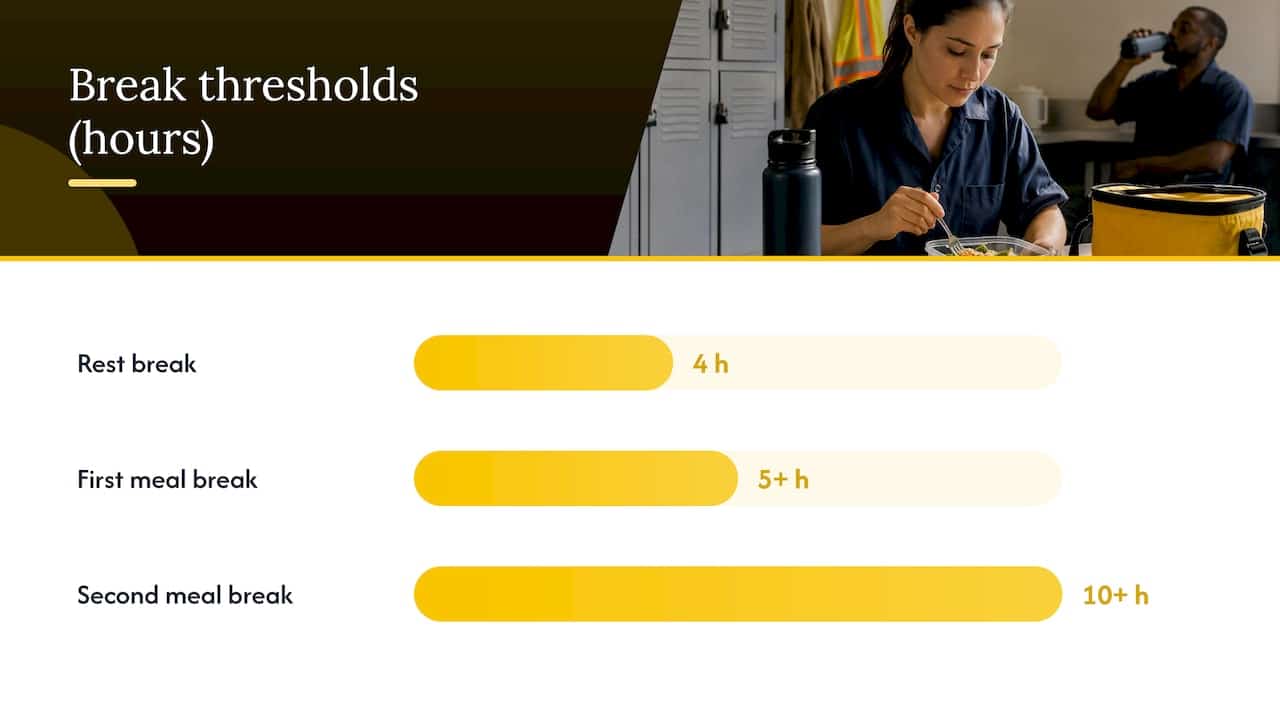
Rest breaks work on a different clock. They are paid, typically run about 10 minutes, and apply for every four hours worked or major fraction of that time. Unlike meal breaks, rest periods count as time worked, so an employer cannot deduct pay for them.
A few exceptions complicate the picture:
If your shift in Orange regularly runs past five or ten hours and you cannot point to a signed waiver, that is a strong sign your employer owes you something.
Meal and rest break violations rarely look like an employer flatly refusing to let someone eat. They show up in smaller, repeated behaviors that add up over weeks or months of a work schedule.
When employees push back, employers commonly raise a handful of defenses: time records that were rounded in the company’s favor, a break policy posted in a breakroom that nobody actually follows, or a claim that the employee waived the break voluntarily. These defenses tend to fall apart against consistent documentation. Pay stubs that never show premium pay, time clock records that contradict the posted schedule, and co-worker statements describing the same interruptions all undercut an employer’s paperwork-based defense. Written communications, such as a text telling someone to come back early from lunch, are often the most persuasive evidence of all.
The strength of a meal break claim usually comes down to what an employee can prove, not just what happened. Acting quickly protects evidence before it disappears from a payroll system or a manager’s memory.
Pro Tip: Keep a simple running log, even a notes app entry, each time a break gets cut short. A contemporaneous record carries more weight than a memory reconstructed months later.
Once you have your documentation together, you generally have three paths: raise it internally with HR, file a wage claim with California’s Division of Labor Standards Enforcement, or consult an employee-side lawyer who can evaluate whether an individual claim, a group claim, or something larger makes sense. Wage claims carry filing deadlines, so the sooner you gather your records and talk to someone about your options, the more protected your claim is likely to be.
Most meal and rest break claims settle around a familiar set of remedies rather than going to a lengthy trial. Understanding the realistic outcomes helps you decide how hard to push and which path fits your situation.
The scope of a claim depends on how many people were affected. An individual lawsuit addresses one employee’s losses, a class action groups together employees who experienced the same policy, and a PAGA action lets an employee pursue penalties on behalf of the state for labor code violations affecting a broader workforce. Each path has its own filing deadlines, so the timeline for acting matters as much as the dollar amount at stake.
Our practice focuses on one side of the employment relationship: the employee’s. We evaluate meal and rest break cases from the perspective of what you are owed and how to get it.
We maintain resources for employees across Orange County, including nearby cities, so the intake process begins with lawyers familiar with regional employer practices.
Meal and rest break law does not end at the 30-minute and 10-minute marks. Employees with medical conditions, such as diabetes requiring scheduled eating or medication, are generally entitled to breaks that accommodate those needs, often through the same reasonable accommodation process that applies to other disabilities under state and federal law. An employer that refuses to adjust break timing for a documented medical need may be creating a second legal problem on top of any wage violation.
Religious accommodation works similarly. An employee who needs a break timed around prayer obligations, or who needs a quiet, private space to express breast milk, which California law separately requires employers to provide, is entitled to a good-faith effort from the employer to make that work. These accommodation obligations exist independently of the standard meal and rest break rules, so a break schedule that technically satisfies the 30-minute and 10-minute requirements can still violate the law if it ignores a legitimate medical or religious need.
Employees who raise these needs and get pushback, whether a flat refusal or pressure to drop the request, should document the request and the employer’s response the same way they would document a missed lunch. The paper trail matters just as much here as it does in a straightforward wage claim.
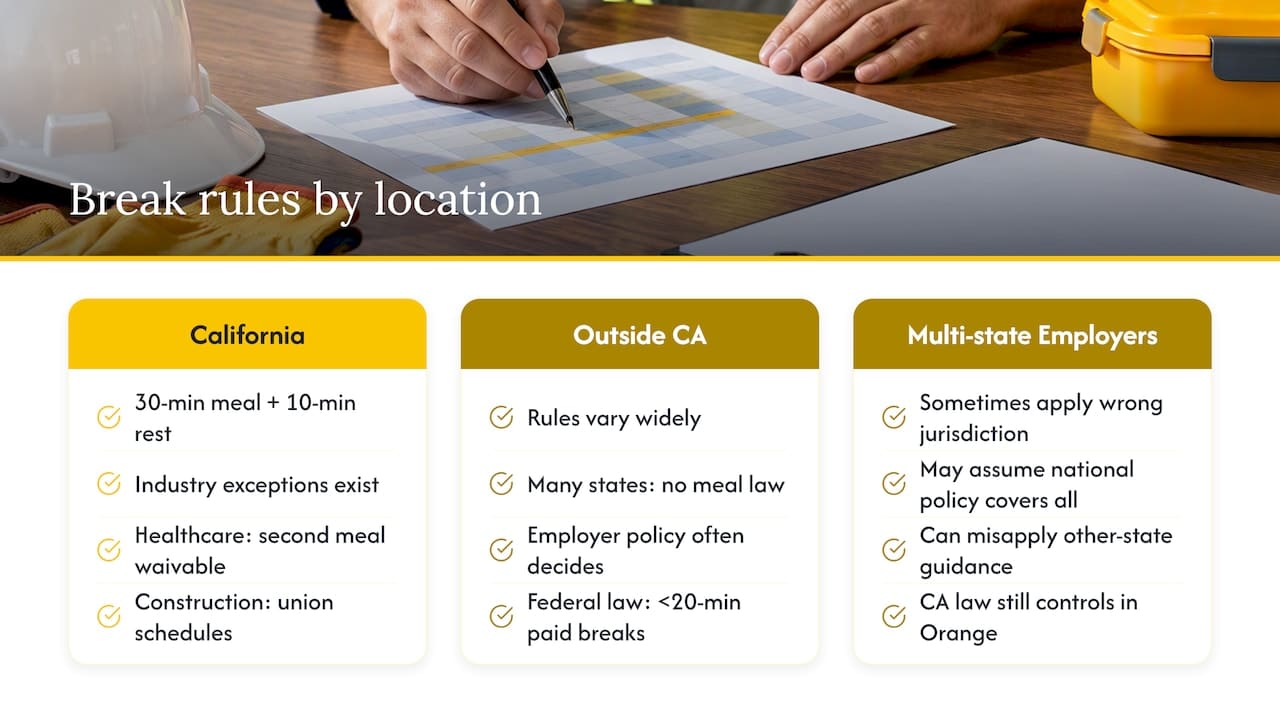
California’s 30-minute meal and 10-minute rest break framework applies broadly, but several industries carry their own wrinkles. Healthcare workers in certain roles can waive a second meal break even on longer shifts under specific collective agreements. Unionized construction trades sometimes follow break schedules set by industry-wide agreements rather than the default statutory timing. Transportation workers covered by federal hours-of-service rules may see their break timing interact with both state and federal requirements at once.
Outside California, meal and rest break protections vary widely. Many states have no statutory meal break requirement at all, leaving the matter to employer policy or federal wage law, which does not mandate breaks but does require that any break under 20 minutes be paid. Employers that operate across state lines sometimes apply the wrong jurisdiction’s rules to California staff, either by accident or by assuming a national policy covers everyone. For employees working in Orange, the California standard controls regardless of where a parent company is headquartered.
Even within California, some employers reference wage-theft prevention guidance built for other states when drafting break policies. A wage theft prevention resource built around Minnesota’s requirements, for example, has no bearing on a California meal break claim, and policies borrowed from another state’s framework do not excuse noncompliance here.
Employees covered by a collective bargaining agreement sometimes operate under different break terms than the default California statute provides, but only within limits. A valid collective bargaining agreement can set alternative meal and rest break schedules for certain industries, including construction, drilling, and some healthcare roles, as long as the agreement expressly addresses break terms, hours of work, and wages.
That flexibility does not mean a union contract can eliminate break protections altogether. If your union agreement is silent on meal and rest breaks, the standard statutory rules still apply. If your employer claims a union contract excuses a missed break, it is worth confirming that the contract actually contains the specific language required to modify the default rule, since many agreements do not. Employees who are unsure whether their union contract changes their break entitlements should ask their union representative for the specific contract language, not just a general assurance that “it’s covered.”
If you believe your employer has shorted you on meal or rest breaks, the fastest way to find out where you stand is a free case review with our team. We take meal and rest break cases on a contingency-fee basis, which means you pay nothing upfront, and our fee comes out of what we recover for you, whether that is a pre-trial settlement or another successful outcome.
Before you reach out, gather what you can:
We cover meal break and related wage and hour claims for employees throughout Orange, and you can reach our team directly through our contact page to schedule your free consult.
This article is general information, not a substitute for advice from a qualified lawyer. Consult a qualified legal professional about your own circumstances before acting on anything here.
California law requires employers to provide a 30-minute unpaid meal break once a shift exceeds five hours, but the law does not force an employee to eat during it. An employee can waive the break voluntarily when the shift is six hours or less, as long as both sides agree.
A 12-hour shift typically requires two 30-minute meal breaks and three paid 10-minute rest breaks under California’s standard framework. Some industries covered by a valid collective bargaining agreement may follow a different schedule for longer shifts.
A standard, uninterrupted 30-minute lunch break is generally unpaid, but an interrupted or on-duty meal break must be paid as hours worked. If you are asked to stay reachable or return early, that time should show up as paid work on your pay stub.
No, an employer cannot deduct time for a meal break that was not actually taken or that was interrupted by work duties. Doing so is a common form of wage theft, and it often entitles the employee to the missed premium pay plus the wages for the time actually worked.

© 2026 Optimum Employment Lawyers, PC
Legal Disclaimer | Privacy Policy
 Share
Share
