
(949) 954-8181 Free Case Review No recovery, no fee.
(949) 954-8181 Free Case Review No recovery, no fee.
If you work in Dana Point and your employer denied you a rest break, California law entitles you to a paid ten-minute break for every four hours worked, and a missed break generally means one extra hour of pay at your regular rate. Document the date, the reason given, and who denied it, then file a wage claim with the California Labor Commissioner’s Office or talk to a California employee-side lawyer before the three-year filing window closes.
TL;DR:
- Most rest break violations in Dana Point stem from scheduling issues, interruptions, or requiring employees to stay reachable, rather than outright refusals.
- Courts have ruled that being on-call or reachable during rest breaks violates law even if the employee is not actively interrupted.
- Missed rest breaks entitle employees to one hour of premium pay per violation, which counts as wages and affects wage statement accuracy and potential penalties.
- File a claim promptly within three years, with options including wage claims, PAGA notices, or class actions, depending on how many employees are affected.
- Proper documentation, including time logs and witness statements, is crucial to proving violations and securing full compensation.
Every hourly employee working a shift over three and a half hours in Dana Point has a legal right to a paid rest period. That right doesn’t come from company policy or an employee handbook. It comes from the California Department of Industrial Relations, which enforces wage orders issued by the Industrial Welfare Commission (IWC), along with Labor Code § 512.1.
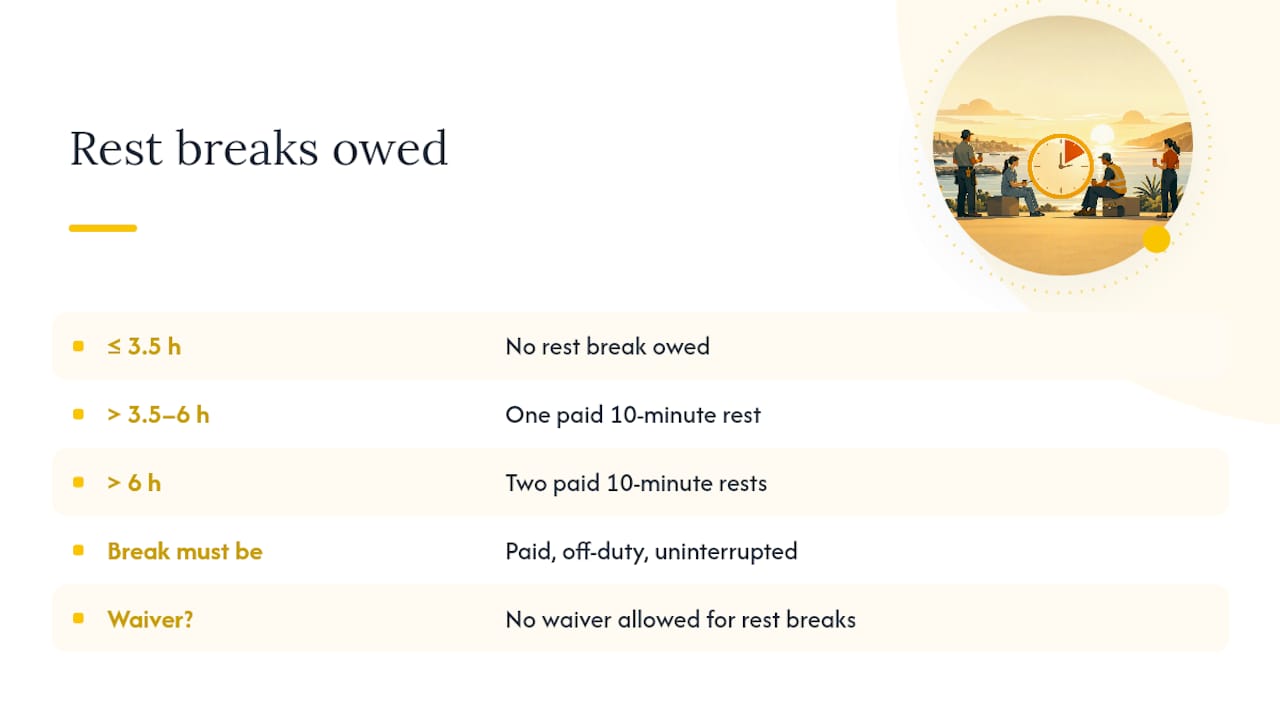
The rule is straightforward on paper: a net ten-minute paid rest period for every four hours worked or major fraction thereof (anything over two hours counts as a major fraction) triggers the obligation A shift of six hours earns one ten-minute break, two ten-minute breaks for shifts over six hours, and no rest break is required for shifts of three and one-half hours or less.
Three things have to be true for a break to actually count as a rest period under the law. First, it has to be paid, meaning the 10 minutes counts as hours worked and shows up on your paycheck the same as any other time on the clock. Second, it has to be off duty, which means no answering calls, no covering the register, no staying reachable on a radio. Third, it has to be a full, uninterrupted 10 minutes, not eight minutes because a manager needed you back early.
Employers are also supposed to schedule rest breaks “as near the middle of each work period as practicable,” according to DLSE guidance. That’s a scheduling nudge, not an absolute rule, and courts do allow some flexibility when the middle of a shift genuinely conflicts with business needs. What employers cannot do is skip breaks altogether or make employees sign away their right to them. Unlike meal breaks, which can sometimes be waived under specific conditions, there is no waiver mechanism for rest breaks. If you worked the hours, the break was owed.
Violations rarely look like an employer flatly announcing “no breaks today.” They look like a manager interrupting a break to answer a customer question, a scheduling system that packs shifts so tightly no 10-minute window exists, or a policy requiring employees to keep a radio or phone on “just in case” during their break.
Two California Supreme Court decisions shape how these cases get evaluated now.
Certain industries see this constantly. Restaurant servers get pulled off breaks to run food. Security guards get told to stay near the gate “in case something comes up.” Healthcare workers on understaffed floors get breaks that exist on paper but never happen in practice. Employers sometimes argue operational necessity or claim the employee voluntarily skipped the break, but courts generally require the employer to prove it actually made the break available, not just that it existed in a written policy.
Dana Point employees generally have three paths for pursuing unpaid rest break premiums, and picking the right one depends on how many people were affected and how much money is actually at stake.
Pro Tip: Before choosing a route, add up how many pay periods were affected and multiply by one hour of pay at your regular rate. If that number is small and the violation was limited to you, a DLSE claim is usually faster. If dozens of coworkers faced the same scheduling problem, PAGA or a class action captures far more value.
The decision often comes down to four factors: how many employees were affected, the size of the unpaid premium exposure, whether you want compensation or you want the employer’s conduct penalized more broadly, and how close you are to the three-year statute of limitations.
The penalty for a missed rest break is one additional hour of pay at your regular rate, for every workday a compliant break wasn’t provided. “Regular rate” is not always your flat hourly wage. It generally includes non-discretionary bonuses and shift differentials, which is why calculations based on base pay alone frequently shortchange employees, according to payroll guidance from CalChamber.
The stakes are higher than a lot of employees realize. The Naranjo decision confirmed that this premium pay counts as wages, not a standalone penalty, which means it has to appear on wage statements and follow standard wage-timing rules. That has two direct consequences: an employer who fails to pay it correctly may also be on the hook for wage-statement violations under Labor Code § 226, and if the premium wasn’t paid at termination, waiting-time penalties under Labor Code § 203 can start stacking up daily.
Because premium pay is treated as wages, the three-year statute of limitations for wage claims applies. If your last missed break happened two years ago, you’re still inside the window. If it happened four years ago, that particular day likely falls outside it, though ongoing violations can still support a claim for the more recent period.
Winning a rest break claim almost always comes down to what you can prove, not just what happened. DLSE and legal guides consistently point to contemporaneous documentation as the difference between a fast settlement and a drawn-out dispute, per documentation guidance for California employees.
Start recording these details the same day, not weeks later:
Then build corroborating evidence around your own notes: witness statements from coworkers who saw the same pattern, copies of your schedule, timeclock or punch-log reports, text messages from managers, and pay stubs showing whether a premium was ever paid.
You’re entitled to request your own payroll and personnel records from your employer. If they refuse or stall, that refusal itself becomes relevant, and an attorney can pursue those records through formal discovery or subpoena.
Pro Tip: Screenshot scheduling software and timeclock apps as soon as you notice a pattern. Employers can and sometimes do overwrite digital logs, but a dated screenshot on your own phone holds up well as evidence.
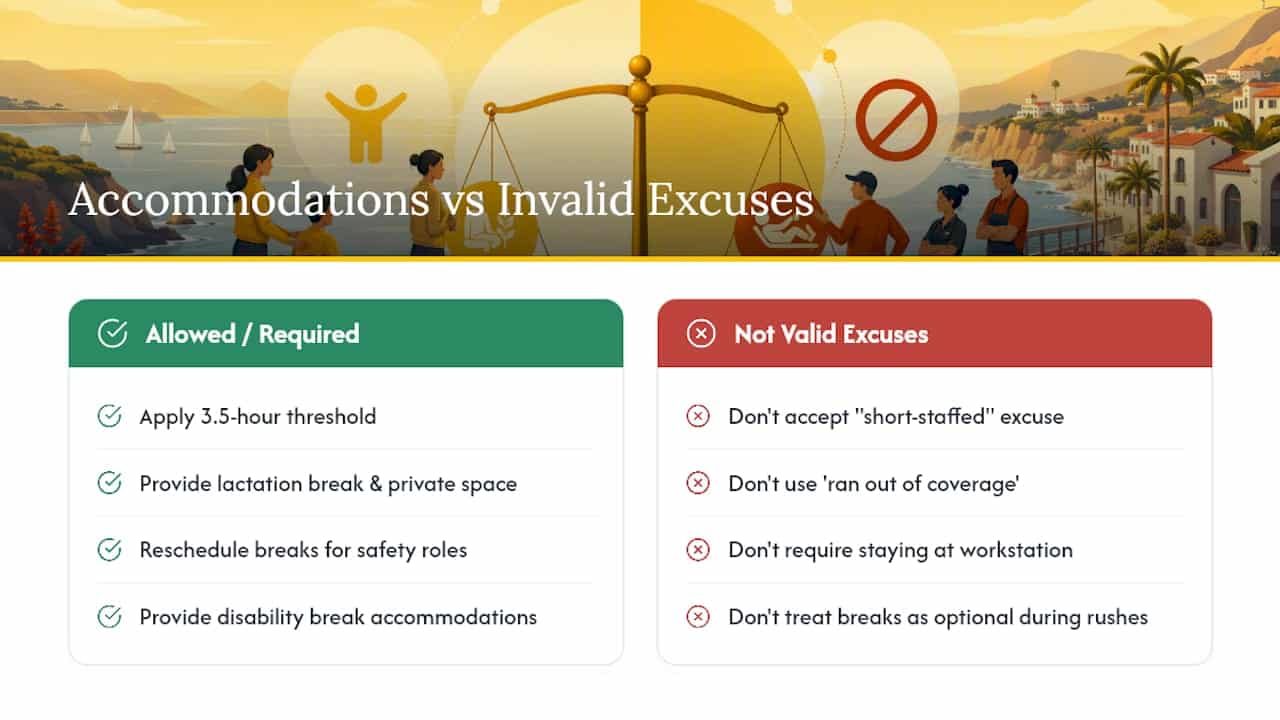
The rest break rule has very few built-in exceptions, and none of them work the way employers often claim. Shifts of 3.5 hours or less don’t require a break at all, since the law only kicks in once you cross that threshold. Beyond that, the law doesn’t recognize “we were short-staffed” or “it’s a busy season” as valid reasons to skip a break entirely.
Some accommodations exist for specific circumstances. Lactating employees are entitled to reasonable break time and a private space for expressing milk, layered on top of, not instead of, standard rest breaks. Certain safety-sensitive positions may have break timing adjusted for operational reasons, but the total break time owed doesn’t disappear, it just gets rescheduled.
What doesn’t qualify as a valid exception: a manager saying breaks are “first come, first served” and simply running out of coverage, a policy requiring employees to stay near their workstation “just in case,” or an unwritten expectation that busy shifts mean no breaks. If your job in Dana Point involves retail, hospitality, or food service, and your manager treats breaks as optional during rushes, that’s a pattern worth documenting rather than accepting.
Employees with disabilities may also be entitled to additional or modified break accommodations under separate disability protections, layered on top of the standard rest break entitlement rather than replacing it.
Rest break violations and overtime violations often travel together, but they’re calculated separately, and mixing them up can cost you money on a claim.
A missed rest break earns one hour of premium pay per workday. That premium doesn’t count as “hours worked” for overtime purposes, so it won’t push you over the 8-hour daily or 40-hour weekly overtime threshold on its own. What often happens instead is that the same scheduling failure causing missed breaks also causes unpaid overtime, because employees who never got a real break stayed on the clock working through it, extending their actual hours without extra pay.
If you worked through your rest break rather than being denied it outright, that time may need to be counted as hours worked for overtime calculations, separate from the premium pay owed for the missed break itself. An employee who worked a 10-hour shift, never got either of the two rest breaks owed, and clocked out at the scheduled time may be owed overtime for hours 9 and 10, plus two hours of rest break premium pay, as two distinct amounts.
This is where documentation matters again. A time log showing you were on the clock during what should have been a break period supports both an overtime claim and a rest break claim at once, and an employer who underpays one violation has often underpaid the other too.
Collective bargaining agreements (CBAs) can modify some wage and hour rules in California, but rest breaks aren’t as flexible as employers sometimes suggest. Meal period waivers can, in narrow circumstances, be altered by a valid CBA for certain unionized industries. Rest breaks generally don’t have that same broad carve-out.
If you’re a union employee in Dana Point covered by a CBA, the first place to check is the contract’s actual language on breaks, not what your shop steward or manager assumes it says. Some CBAs specify alternative break scheduling, like combining two 10-minute breaks into one 20-minute break during a shift, which can be lawful if it still delivers the same total paid, off-duty rest time. What a CBA cannot do is eliminate rest breaks entirely or convert them into unpaid time.
Where a CBA does specify different scheduling, the burden is generally on the employer to show the agreement complies with the underlying wage order protections, not just that a contract exists. If you’re covered by a union contract and you’re not sure whether your employer’s break policy actually matches what the agreement says, that mismatch is worth raising with your union representative and, if it goes unresolved, with an employment lawyer.
Confusing rest breaks and meal breaks is one of the fastest ways to weaken a wage claim, because the rules, the paperwork, and the remedies aren’t identical.
A rest break is 10 minutes, paid, and counted as hours worked. It requires no clock-out and no separate signature. A meal break is 30 minutes, unpaid, and generally requires the employee to be relieved of all duty, plus a specific clock-out and clock-in on the timecard. Meal breaks also come with a waiver option in some limited circumstances, particularly for shorter shifts, something rest breaks don’t have.
The remedy is identical on the surface, one hour of premium pay per violation, per workday, but you can be owed both premiums on the same day if your employer denied you a compliant meal period and a compliant rest period. That’s not double-counting the same violation; it’s two separate legal failures with two separate remedies. Employees sometimes leave money on the table by only pursuing one when both happened. For a deeper look at how these overlap, the firm’s guide on rest breaks, lunch periods, and meal breaks breaks down the distinctions further, and the dedicated page on meal break violations covers the meal-specific rules in detail.
Optimum Employment Lawyers represents employees exclusively, never employers, which means every strategy decision on a rest break case is made with your recovery in mind, not an employer’s liability exposure. Representation runs on a contingency fee, so there’s no upfront cost to find out whether you have a claim worth pursuing.
The firm handles the parts of a rest break case that are hardest to manage alone: evaluating whether your documentation supports a DLSE claim, filing that claim or a PAGA notice on your behalf, preparing and filing a civil suit when the scale of the violation calls for it, and negotiating settlements once liability is established. That last piece is where real numbers show up. The firm’s case history includes a $2.2 million class settlement involving missed meal breaks, the kind of outcome that reflects what’s possible when wage-and-hour violations are pursued aggressively rather than settled quietly.
If you’re in Dana Point and think your rest breaks have been shortchanged, bring your pay stubs, your schedule records, and any notes you’ve kept to a free case review. Explore the full range of wage and hour services the firm handles, or go straight to request a case review and get a straight answer on where you stand.
For readers who want to check the source material directly, the DLSE’s rest period guidance and its wage claim filing instructions lay out the administrative process. Labor Code § 512.1 covers the statutory premium requirement, and the Naranjo opinion explains why missed-break pay counts as wages.
This article is general information, not a substitute for advice from a qualified lawyer. Consult a qualified legal professional about your own circumstances before acting on anything here.
Only if you were genuinely relieved of all duty and voluntarily chose to work through it, or a valid waiver applies for shorter shifts. If your employer deducted the time but you were still working, that’s an unpaid wages issue on top of a potential meal break violation, and it should be documented the same way as a missed break.
California law requires a paid, off-duty 10-minute rest break for every four hours worked or major fraction of four hours, under IWC wage orders and Labor Code § 512.1. Employers who fail to provide a compliant break owe one hour of premium pay at the employee’s regular rate for each violated workday.
Yes, restaurants are held to the same rest and meal break rules as any other California employer, with no blanket exception for busy shifts or being short-staffed. Servers, cooks, and hosts working over 3.5 hours are entitled to a paid rest break, and violations in the restaurant industry are common enough that courts and the DLSE treat scheduling failures as a recognized pattern.
Employees can only skip a meal break under narrow waiver conditions, generally for shifts of six hours or less, and the waiver must be voluntary rather than pressured by a manager. Rest breaks work differently since there’s no general waiver option, so an employer generally cannot rely on an employee “choosing” to skip a rest break as a defense.
Optimum Employment Lawyers works on a contingency fee basis, meaning there’s no upfront cost, and the fee is a percentage of what’s recovered through settlement or a court award. Current fee percentages and case terms are available directly through the firm.

© 2026 Optimum Employment Lawyers, PC
Legal Disclaimer | Privacy Policy
 Share
Share
