
(949) 954-8181 Free Case Review No recovery, no fee.
(949) 954-8181 Free Case Review No recovery, no fee.


Disability discrimination is defined as unlawful adverse treatment of an employee based on a physical or mental disability. In Dana Point workplaces, this conduct violates California’s Fair Employment and Housing Act (FEHA), one of the strongest employee protection laws in the country. FEHA covers employers with 5 or more employees, giving California workers broader protections than the federal Americans with Disabilities Act (ADA). The California Civil Rights Department (CRD) and the Equal Employment Opportunity Commission (EEOC) both enforce these rights. If your employer has fired you, denied you a promotion, or refused a reasonable accommodation because of a disability, you have legal options.
FEHA covers employers with 5 or more employees, which means most Dana Point workers are protected from the moment they are hired. That threshold is lower than the federal ADA standard of 15 employees, so California law reaches further and protects more people. The law covers every stage of employment: hiring, firing, promotions, pay, job assignments, and workplace accommodations.
Your rights under FEHA include:
California law also requires employers to provide annual notices of employee rights. Under the Workplace Know Your Rights Act, employers must post annual rights notices by february 1 each year, detailing protections and anti-retaliation rights. That requirement took effect in 2026 and gives Dana Point employees a concrete, recurring reminder of their legal standing.
Pro Tip: Request a copy of your employer’s most recent rights notice. If they cannot produce one, that failure may itself be relevant evidence in a discrimination claim.

Reporting disability discrimination follows a specific legal process, and missing a deadline can cost you your case. California employees must file with the CRD within 3 years of the last discriminatory act. The CRD generally completes its investigation within 1 year after you file. That timeline gives you a realistic window to plan, but waiting too long still carries risk.
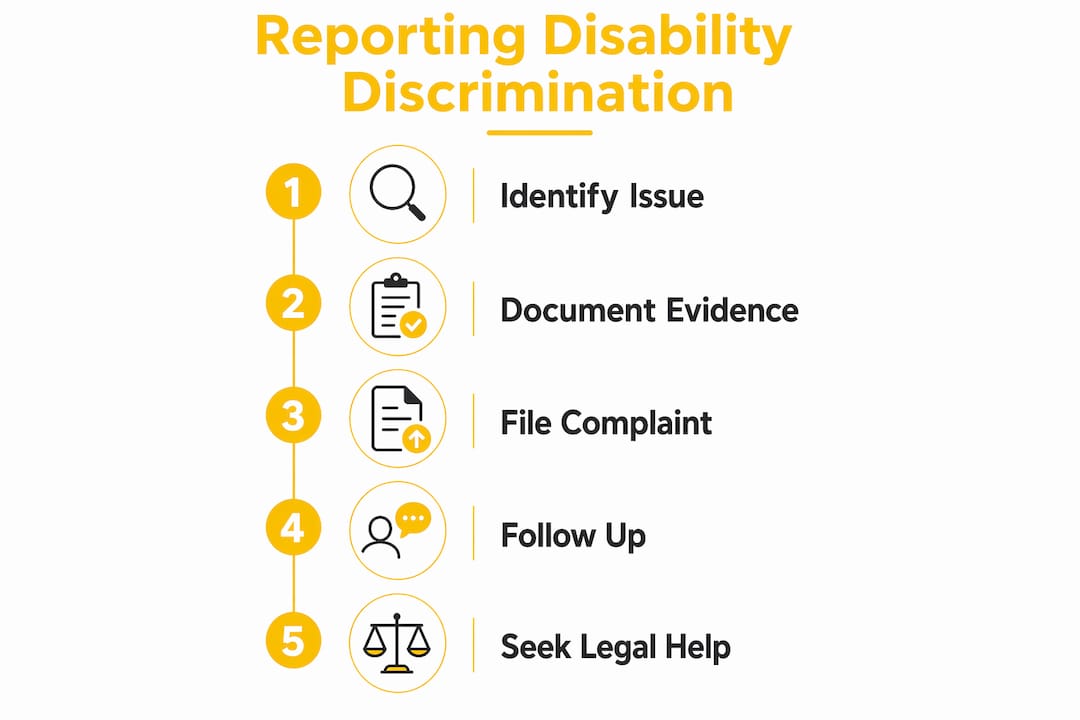
Federal EEOC claims carry shorter deadlines: 180 days in states without a state agency, or 300 days in California where the CRD operates. California employees almost always file with the CRD first, which also satisfies the EEOC cross-filing requirement.
The complaint process works like this:
Employees often wait too long because they believe their case must be airtight before they act. Early factual documentation is more important than a perfect legal theory. Write down what happened while the details are fresh.
Pro Tip: Send your internal HR complaint by email, not verbally. An email timestamp proves when your employer received notice, which matters enormously if retaliation follows.
A reasonable accommodation is any change to the work environment or job duties that allows a qualified employee with a disability to perform the essential functions of their role. California law defines this broadly. Examples include modified schedules, remote work arrangements, ergonomic equipment, reassignment to a vacant position, or leave for medical treatment.
FEHA’s accommodation duties attach once an employer knows or should know about a disability. You do not need to submit a formal written request using specific legal language. If you tell your manager that your back condition makes it painful to stand for eight hours, your employer’s obligation begins at that moment.
The interactive process is a mandatory, good faith dialogue between you and your employer to identify a workable accommodation. California Code of Regulations Title 2, Section 11069 requires employers to engage in this process promptly. Failure to engage in the interactive process is an independent FEHA violation, separate from any discrimination claim. That distinction matters because it centers the legal claim on documented employer conduct rather than proving discriminatory intent.
Common employer failures in the interactive process include:
The table below shows the difference between a legally compliant interactive process and a deficient one:
| Compliant employer conduct | Deficient employer conduct |
|---|---|
| Responds to accommodation request within days | Delays response for weeks or months with no explanation |
| Meets with employee to discuss needs and options | Sends a form letter and closes the matter |
| Documents all communications in writing | Handles all discussions verbally with no record |
| Explores multiple accommodation options | Offers one option and denies the request if it fails |
| Considers reassignment when modification is not feasible | Terminates employee without exploring alternatives |
If your employer skipped any of these steps, that conduct alone may support a legal claim. You can learn more about your rights to accommodation under California law before deciding how to proceed.
Retaliation is defined as an adverse employment action taken against an employee because they disclosed a disability, requested an accommodation, or filed a discrimination complaint. Adverse employment actions after disability disclosure are strong evidence of retaliatory intent. The timing between your disclosure and the adverse action is often the most powerful fact in a retaliation case.
Retaliation does not always look like termination. It can be subtle. Common examples include:
“At-will employment does not permit illegal termination. Any adverse action taken after a disability disclosure suggests retaliatory intent and may constitute an independent legal violation under FEHA.”
California’s at-will employment rule allows employers to terminate workers for any lawful reason. The key word is lawful. At-will status does not protect an employer who fires you because you asked for a schedule change to attend physical therapy. That termination is illegal regardless of your employment classification.
Proving retaliation requires documentation of timing and adverse actions. Write down every negative change in your employment conditions after your disclosure or complaint. Save emails, performance reviews, and any written communications that show a shift in how your employer treated you. A disability attorney consultation can help you organize this timeline before you file.
The strongest retaliation cases share one feature: a clear, documented sequence of events. Disclosure or complaint comes first. Adverse action follows quickly. That sequence, backed by written evidence, is difficult for an employer to explain away.
California employees in Dana Point facing disability discrimination have enforceable rights under FEHA, including the right to accommodations, a mandatory interactive process, and full protection from retaliation.
| Point | Details |
|---|---|
| FEHA covers most Dana Point employers | Any employer with 5 or more employees must comply with California disability discrimination law. |
| CRD filing deadline is 3 years | California employees must file a CRD complaint within 3 years of the last discriminatory act. |
| Interactive process is mandatory | Failure to engage in good faith accommodation discussions is an independent FEHA violation. |
| Retaliation is illegal regardless of at-will status | Adverse actions after disability disclosure or accommodation requests can support a separate legal claim. |
| Documentation is your strongest asset | Internal email complaints and written timelines create the evidence base for any successful case. |
Disability discrimination cases turn on facts, timing, and documentation. Optimum Employment Lawyers works exclusively on the employee side, which means every strategy they develop is built around your interests, not your employer’s. They serve Dana Point employees facing wrongful termination, denied accommodations, and retaliation tied to disability disclosures. Their team has secured significant results for California workers, including a $2.2 million class action settlement. If you believe your employer has violated your rights, contact Optimum Employment Lawyers for a consultation. Getting a clear picture of your legal position is the first step toward doing something about it.
Disability discrimination is unlawful adverse treatment of an employee based on a physical or mental disability under FEHA. It covers hiring, firing, pay, promotions, and the denial of reasonable accommodations.
California employees must file with the CRD within 3 years of the last discriminatory act. Federal EEOC claims carry a shorter deadline of 300 days for California workers.
No, but your employer must engage in a good faith interactive process to explore workable options. Refusing to participate in that process at all is an independent FEHA violation.
No. Terminating an employee for requesting an accommodation is illegal retaliation under FEHA, even if you are classified as an at-will employee.
Document every incident in writing and report the issue internally by email before filing externally. Early documentation proves your employer was on notice and strengthens any future legal claim.

© 2026 Optimum Employment Lawyers, PC
Legal Disclaimer | Privacy Policy
 Share
Share
