
(949) 954-8181 Free Case Review No recovery, no fee.
(949) 954-8181 Free Case Review No recovery, no fee.
If you work in Seal Beach and your employer skips your lunch break, California law is on your side. Nonexempt employees who work more than five hours are entitled to a 30-minute, duty-free, unpaid meal period under Labor Code § 512, and every missed break triggers one additional hour of pay at your regular rate. That premium is a wage, not a courtesy.
Here is what to do right now:
You have three years from each violation to file. That clock starts the day the break was missed, so waiting costs you money.
California sets some of the strongest workplace break regulations in the country. The rules apply to nonexempt employees statewide, including workers in Seal Beach, and they come from two sources: Labor Code § 512 and the Industrial Welfare Commission (IWC) Wage Orders that govern specific industries.

Meal break entitlements at a glance:
| Hours Worked | Meal Break Required | Notes |
|---|---|---|
| More than 5 hours | One 30-minute unpaid meal period | May be waived by mutual consent if shift is 6 hours or less |
| More than 10 hours | Second 30-minute unpaid meal period | May be waived if shift is 12 hours or less and first break was not waived |
| 6 hours or less | First meal period may be waived | Both parties must agree in writing |
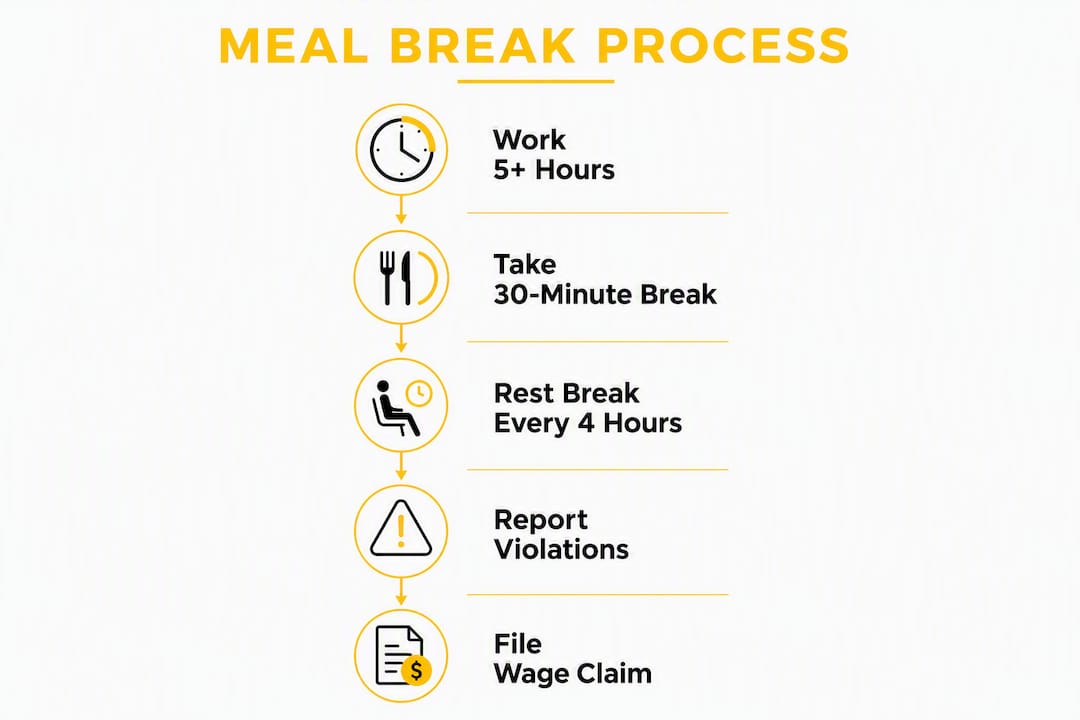
Rest breaks follow a separate rule. Employers must provide one paid 10-minute rest period for every four hours worked, or major fraction thereof. A worker clocking a 3.5-hour shift gets no rest break; a worker on an 8-hour shift gets two.
A few details that trip up employers:
One missed meal break = one additional hour of pay at your regular rate. The same rule applies to each missed rest break. Both premiums can apply on the same workday.
Because these premiums are wages under California law, your employer must also report them on your paystub. Failure to do so can trigger separate penalties under Labor Code § 226.
Seal Beach has a mix of restaurants, retail shops, healthcare facilities, and security operations. Each industry produces its own pattern of break violations, and most of them do not look like a deliberate policy on the surface.
Industries and scenarios where violations are most common:
Scheduling itself can create violations. If an employer builds a shift where no coverage exists during a break window, the employee is effectively denied relief even without anyone saying “skip your lunch.” Incentive structures matter too: piece-rate or commission pay that rewards continuous work can pressure employees to skip breaks voluntarily, but the employer still owes the premium.
“An employer’s obligation is not merely to make a break available in theory. The employer must actually relieve the employee of all duty and relinquish control over how the employee spends that time.” — DLSE FAQ: Meal Periods
Pro Tip: In a fast-paced work environment, send yourself a text or email the moment a break is missed. A timestamped message to your own phone saying “no lunch again, 12:30 PM, covered for Maria” creates a contemporaneous record that is far more credible than memory alone.

The premium remedy is one additional hour of pay at the employee’s regular rate for each missed meal or rest break. That sounds simple, but the “regular rate” is where most employees underestimate what they are owed.
Your regular rate of pay is not just your base hourly wage. It must include nondiscretionary bonuses and commissions, which raises the per-violation amount for many workers.
What goes into the regular rate:
A discretionary bonus (a one-time gift at the employer’s sole discretion) is excluded. Everything else that is promised or tied to performance counts.
A simple calculation example:
Suppose a Seal Beach retail employee earns $18/hour and received a $200 nondiscretionary sales bonus in a 40-hour week. Their regular rate is not $18. It is ($18 × 40 + $200) ÷ 40 = $23/hour. A missed meal break on that day costs the employer $23, not $18. Over a year of missed breaks, that gap adds up fast.
If both a meal break and a rest break are missed on the same day, two separate premiums apply: two additional hours of pay at the regular rate for that day.
Because these premiums are classified as wages, your employer’s failure to pay them and report them on your paystub can trigger additional penalties under Labor Code § 226. Tools like WageCop or similar break calculators can give you a rough estimate, but they often miss the bonus and commission components of the regular rate. A DLSE examiner or an employment attorney will catch those gaps.
The DLSE wage claim process is designed to be accessible without a lawyer, though having one helps in contested cases. Here is the step-by-step path for a Seal Beach employee.
Steps to file:
Evidence checklist to prepare before you file:
The statute of limitations for meal and rest break wage claims is three years from the date of each violation. Missing that window means losing the right to recover those premiums.
Pro Tip: If your employer uses a digital scheduling or timekeeping app, take screenshots of your schedule and any break-waiver prompts before you leave the job. Employers sometimes modify records after a claim is filed, and your screenshots are timestamped proof of what the system showed at the time.
Employers facing break claims typically raise a handful of arguments. Some are legally sound; most are not.
Defenses that can hold up:
Defenses that typically fail:
“The on-duty meal period is an exception, not a default. It applies only when the nature of the work prevents relief — not when relief is merely inconvenient or expensive to arrange.” — DLSE FAQ: Meal Periods
One practical note on on-duty meal agreements: the employee’s right to revoke is real and immediate. If you signed one and now want out, you can revoke it in writing. After revocation, the employer must provide a duty-free meal period going forward.
Filing a DLSE claim on your own is possible, but the cases that produce the largest recoveries usually involve an attorney. Here is why.
An employment lawyer does several things the DLSE process does not automatically do for you. They calculate the full regular rate, including bonuses and commissions that employees routinely miss. They identify whether a pattern of violations qualifies for a class action or a PAGA (Private Attorneys General Act) representative claim, which can multiply the recovery significantly. They also handle situations where employer records are incomplete or have been altered, marshaling your personal logs and witness statements into a coherent evidentiary record.
What an attorney can add to your case:
Optimum Employment Lawyers has represented California employees in exactly these situations. The firm secured a $2.2 million settlement in a class action involving missed meal breaks, a result that reflects both the volume of violations and the proper calculation of the regular rate across a workforce. For Seal Beach employees, the firm maintains a local resource and intake page specifically for Orange County workers navigating DLSE claims and wage disputes.
Optimum Employment Lawyers works on a contingency fee basis. You pay nothing upfront. The firm is paid a percentage of what is recovered, so there is no financial barrier to getting a professional evaluation of your case.
Local resources for Seal Beach employees:
California’s meal and rest break laws give Seal Beach nonexempt employees a clear right to premium pay for every missed break, and a three-year window to recover it through the DLSE or the courts.
| Point | Details |
|---|---|
| Meal break entitlement | Nonexempt employees get a 30-minute unpaid meal period after 5 hours; a second after 10 hours. |
| Premium pay per violation | One additional hour at the regular rate for each missed meal or rest break, per workday. |
| Regular rate includes bonuses | Nondiscretionary bonuses and commissions raise the regular rate and increase what you are owed. |
| Filing deadline | You have three years from each violation to file a DLSE wage claim. |
| Optimum Employment Lawyers | The firm secured a $2.2M settlement for missed meal breaks and offers free case evaluations for Seal Beach employees. |
Missed meal breaks are not a minor inconvenience. For workers in Seal Beach dealing with a pattern of skipped lunches, denied rest periods, or an employer who insists breaks were “available,” the financial exposure can reach thousands of dollars per employee and far more in a class action.
Optimum Employment Lawyers focuses exclusively on employee-side cases in California. The firm handles wage and hour claims, DLSE filings, PAGA representative actions, and class actions, all on a contingency fee basis. You pay nothing unless the firm recovers money for you. An initial consultation covers your specific situation: your hours, your pay structure, the nature of the violations, and whether a DLSE claim or a civil action gives you the stronger path.
Contact Optimum Employment Lawyers to request a free case review. The intake process is straightforward, and the Seal Beach team can assess your claim quickly.
When to file with the DLSE vs. hire counsel: The DLSE process works well for straightforward unpaid-premium claims with clear records. If your employer’s records are missing, if violations affected multiple coworkers, or if the regular-rate calculation involves bonuses or commissions, an employment attorney will typically recover more and handle the complexity. Both paths are available, and a free consultation with Optimum Employment Lawyers will tell you which fits your situation.
This article provides general legal information about California meal and rest break laws. It is not legal advice. Confirm current rules with the DLSE, the California Department of Industrial Relations, or a qualified employment attorney before taking action.

© 2026 Optimum Employment Lawyers, PC
Legal Disclaimer | Privacy Policy
 Share
Share
