
(949) 954-8181 Free Case Review No recovery, no fee.
(949) 954-8181 Free Case Review No recovery, no fee.
If you work in Fullerton and someone at your job is making unwanted sexual advances, sexual comments or offensive remarks about your sex, gender or sexual orientation, California law is on your side, and it is stronger than the federal rules. The Fair Employment and Housing Act (FEHA) covers almost every Fullerton employer, gives you three years to file with the state, and protects you from being punished for speaking up. This guide explains what counts as harassment, who can be held responsible, what to do this week, and how a claim moves from a complaint to a lawsuit.
The EEOC describes sexual harassment as unwelcome sexual advances, requests for sexual favors, and other verbal or physical conduct of a sexual nature. It also includes offensive remarks about a person’s sex, gender or sexual orientation, even when nothing sexual is said. The conduct has to affect your job, interfere with your work, or create an intimidating, hostile or offensive environment.
In practice, in a Fullerton office, restaurant, warehouse, clinic or campus, that can look like:
California also reaches conduct that is severe or pervasive enough to create a hostile work environment. One extreme incident can be enough. So can a steady pattern of smaller ones. For a deeper walkthrough of both types, see our guide to quid pro quo and hostile work environment claims in California.
Two differences matter most.
More employers are covered. Under Title VII, an employer needs 15 or more employees. FEHA applies to employers with five or more. A small Fullerton business with eight employees is outside federal sexual harassment law but inside California’s.
You get more time. The CRD says you generally have three years from the last harmful incident to file a discrimination or harassment complaint. The EEOC says that in harassment cases you must file within 180 or 300 days of the last incident, depending on your state’s rules.
| California (FEHA) | Federal (Title VII) | |
|---|---|---|
| Employer size covered | 5 or more employees | 15 or more employees |
| Agency | California Civil Rights Department | EEOC |
| Filing window | Generally 3 years from last incident | 180 or 300 days from last incident |
Three years is a ceiling, not a target. Evidence fades, witnesses leave and managers change jobs. The sooner you act, the stronger your file.
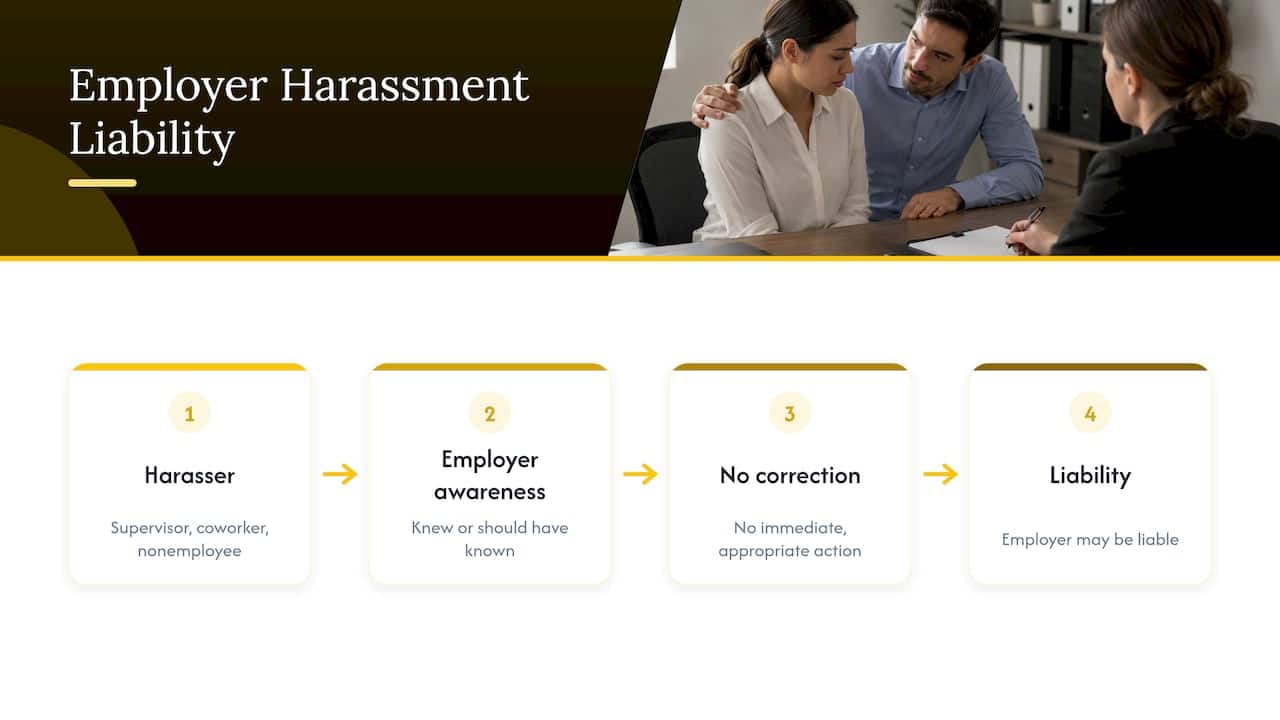
Many people assume only the person who harassed them is at fault. That is not how it works. Under both federal and California law, an employer can be liable for harassment by a supervisor, a co-worker, or a non-employee such as a client or customer when it knew or should have known and failed to take immediate, appropriate corrective action.
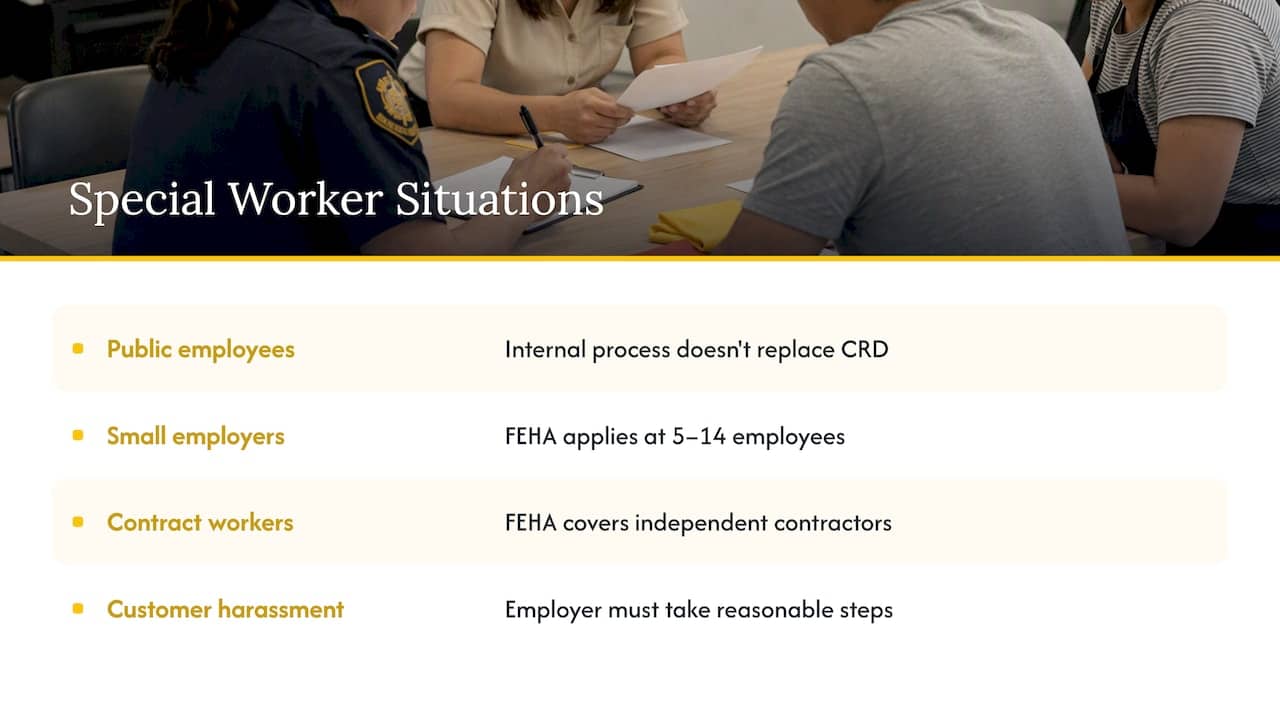
The CRD’s guidance adds that FEHA protects not only employees but also applicants, unpaid interns, volunteers and independent contractors from harassment. If you are paid as a contractor but work like an employee, that classification may itself be an issue worth reviewing.
Individual supervisors can face exposure too. We explain how in our article on supervisor liability in California.
California employers with five or more employees must give sexual harassment prevention training. Supervisors and non-supervisors must be trained every two years, and new hires within six months under the rules the state describes for janitorial employers. That page covers one industry, so treat it as an example of the state’s approach, not a complete statement of every employer’s duties. The general rule for the CRD is described in its Harassment Prevention Guide.
Why it matters to you: if your employer never trained anyone, never had a complaint procedure, or ignored a report, that supports the argument that it failed to take reasonable steps to prevent harassment.
You do not have to have a perfect plan. These steps, roughly in this order, protect your position.
The strongest position is usually built while you are still employed, if it is safe for you to stay. If your safety is at risk, putting distance between you and the harasser comes first.
California law protects your right to oppose discrimination and harassment without job-related consequences. That protection is not limited to the person harassed. It also covers people who testify, assist or take part in an investigation, such as a coworker who backed up your account.
Retaliation does not have to be a firing. The CRD’s guidance explains that it includes actions that might discourage someone from complaining, such as reassigning projects or ostracizing the employee. Employers often describe a retaliatory termination as a performance or policy problem. A dated record showing good reviews before your complaint and a sudden change after it is exactly the kind of evidence that answers that story.
California has a required first step that surprises many people.
A lawyer can help you choose between these paths, draft the complaint so it names every right claim (harassment, discrimination, retaliation, failure to prevent), and keep the deadlines straight.
Some people file with the EEOC as well, especially when federal claims are involved. The EEOC describes harassment as a form of discrimination that violates Title VII and other federal laws. The shorter time limits mean it is the less forgiving path if you have waited. Ask a lawyer whether a dual filing makes sense in your situation.
Public and university employees. Fullerton is home to a large state university, and the top search results for this topic are full of campus policies. Employees of public institutions often have an internal civil rights or Title IX process in addition to state and federal options. Using that internal process can be useful, but it does not replace your right to file with the CRD, and the deadlines for each run separately.
Small employers. If your boss has between five and 14 employees, FEHA applies even though Title VII may not. Do not let a smaller company talk you out of a claim.
Gig and contract workers. FEHA’s harassment protections reach independent contractors. If you are classified as a contractor, you may also have a misclassification claim that affects wages and benefits.
Hospitality, retail and restaurant workers. Harassment from customers counts too. Your employer’s duty is to take reasonable steps once it knows, for example by changing seating, schedules or banning a customer.
Optimum Employment Lawyers represents only employees in California, never employers. That matters when you are deciding who to trust with a sensitive story. Our work on harassment cases includes:
We work on contingency, so you pay nothing upfront. Our fee is 40% of a pre-trial settlement and 42% for any other win, and it is paid from the recovery. If you want to talk through what happened, start with our Fullerton employee rights page or contact us. You can also see the full list of practice areas, from sexual harassment to retaliation and wrongful termination.
For a broader statewide overview, read our explainer on sexual harassment law in California, or browse more articles in our harassment category.
Some readers of this topic are supervisors who have just heard a complaint. The CRD’s guidance says to take reasonable steps immediately to prevent and correct the behavior, to treat anonymous complaints as seriously as named ones, and to protect everyone in the investigation from retaliation. As a manager you may also face personal exposure, so do not handle it informally. Our firm represents employees, not employers or managers, so for your own situation you will want counsel of your own.
Under FEHA you generally have three years from the last incident to file with the CRD. A federal EEOC charge must be filed within 180 or 300 days. Because dates can be complicated when harassment is ongoing, speak with an employment lawyer as soon as you can.
Yes, if it has five or more employees. FEHA applies at that size, while Title VII requires 15. Harassment protections also extend to interns, volunteers and contractors.
No. Retaliation for opposing harassment or taking part in an investigation is prohibited under California law. If you are demoted, reassigned, or fired after reporting, write down the dates and contact a lawyer about a retaliation claim.
No, you can submit an intake form yourself. But to sue you need a Right-to-Sue notice, and asking for one right away ends the CRD’s investigation. A lawyer can help you decide which route fits your facts.
Nothing upfront. We are paid only from a settlement or award: 40% for a pre-trial settlement and 42% for other wins.

© 2026 Optimum Employment Lawyers, PC
Legal Disclaimer | Privacy Policy
 Share
