
(949) 954-8181 Free Case Review No recovery, no fee.
(949) 954-8181 Free Case Review No recovery, no fee.

Yes: if you work in Orange, California, you are protected from discrimination and harassment based on your sexual orientation and gender identity under both state and federal law. If it’s happening to you right now, the single most important move is to start documenting everything today and speak with an employment lawyer before any filing deadline slips by.
TL;DR:
- Discrimination claims based on sexual orientation or gender identity can be made under both FEHA and Title VII, depending on employer size.
- Employers often try ineffective defenses like performance issues or restructuring, but documentation of bias typically overrides these.
- Supporting evidence such as written complaints, emails, and witness statements is crucial for winning discrimination cases.
- Filing deadlines are strict: three years for California FEHA claims and 300 days for federal EEOC claims, making early legal advice essential.
- Local support options include community organizations and mental health services, but legal representation is necessary for pursuing formal claims.
Two overlapping legal systems protect you, and knowing how they stack matters because one often covers gaps the other leaves open.
California’s Fair Employment and Housing Act (FEHA) is the broader shield. It bans discrimination based on actual or perceived sexual orientation, gender identity, and gender expression, and it applies to employers with five or more employees. Harassment protections under FEHA reach even further, covering workers at smaller companies that would otherwise fall outside the law’s scope, according to guidance from the California Civil Rights Department.
Federal law backs this up through Title VII of the Civil Rights Act, which the U.S. Supreme Court’s 2020 Bostock v. Clayton County decision confirmed covers sexual orientation and gender identity as forms of sex discrimination. Title VII applies to employers with 15 or more employees, so if your workplace sits between five and fifteen workers, FEHA is likely your stronger avenue. The EEOC’s guidance on prohibited employment practices confirms it is illegal to harass or fire someone because of sex, including sexual orientation and transgender status.
Employers sometimes try to defend discriminatory decisions using a “bona fide occupational qualification” (BFOQ), arguing a specific trait is essential to the job. Courts apply this defense narrowly, and it almost never survives in gender or sexual orientation cases. Other common defenses employees run into include:
None of these defenses hold up once documentation shows a pattern.
Recognizing unlawful conduct is often the hardest part, because it rarely announces itself. Here’s what it actually looks like in an Orange workplace:
That last category surprises a lot of workers. California and federal law both hold employers liable when they know about harassment by customers, vendors, or contractors and fail to act. A store manager who shrugs off a customer’s repeated slurs against a transgender employee, same-sex hostile work environment claims can arise, is not protected just because the harasser wasn’t on payroll.
Your rights show up in small, daily interactions as much as in big decisions like firing or promotion.
You have the right to be addressed by your chosen name and pronouns. Employers can only insist on your legal name or gender marker when there’s a genuine legal requirement, like payroll tax filings, not out of preference or habit. Refusing to honor a name change after you’ve asked, repeatedly, can itself become evidence of harassment.
Restroom access follows the same logic. The California Attorney General’s guidance confirms you have the right to use restrooms consistent with your gender identity, and employers should provide safe, appropriate facilities, including all-gender single-stall options where available.
If you’re transitioning, you’re entitled to reasonable accommodations, which can include:
Employers with five or more employees also carry training obligations under state law, meaning a company that never trains supervisors on these issues is already out of compliance before an incident even happens.
Pro Tip: Put every name or pronoun correction in writing, even a short email. “As discussed, please use he/him” creates a timestamped record that’s far more useful than a verbal request nobody remembers the same way.
Evidence wins cases. Memory fades, but a paper trail doesn’t, and the steps below protect you whether you end up filing a state complaint, a federal one, or both.
From there, you generally have two administrative paths: the California Civil Rights Department (CRD, formerly DFEH) or the federal EEOC. Both accept “dual filed” complaints, meaning one filing can preserve your rights under both laws. Deadlines matter enormously here.
Deadline snapshot: California generally gives you up to three years to file a FEHA complaint with the CRD, while EEOC federal charges typically must be filed within 300 days in California because the state has its own enforcement agency. Miss these windows and you can lose your right to sue entirely, which is exactly why early legal advice matters more than most people realize.
Once the agency completes its process, it issues a “right to sue” letter, which is your ticket to filing a lawsuit in court if you choose to escalate.
Outcomes vary case by case, but the available remedies fall into a few consistent categories.
How much you recover depends heavily on the strength of your documentation, whether your employer has a pattern of similar complaints, and how quickly you acted to mitigate damages, such as searching for comparable work after termination. Cases with clear written evidence and identifiable witnesses tend to settle faster than cases built on memory alone. Timelines vary widely: some claims resolve in months through negotiation, while litigated cases can stretch well past a year.
Certain signals mean you shouldn’t wait: a termination that feels imminent, harassment that hasn’t stopped despite reporting it, retaliation after you’ve complained, or a filing deadline creeping closer. Optimum Employment Lawyers works exclusively on the employee side of California workplace disputes, evaluating your case, helping preserve evidence, filing administrative charges with CRD or EEOC, and negotiating or litigating when employers won’t budge. The firm’s Orange employment law services reflect a track record that includes a significant class action settlement over missed meal breaks, and representation is handled on contingency, so you owe nothing upfront.
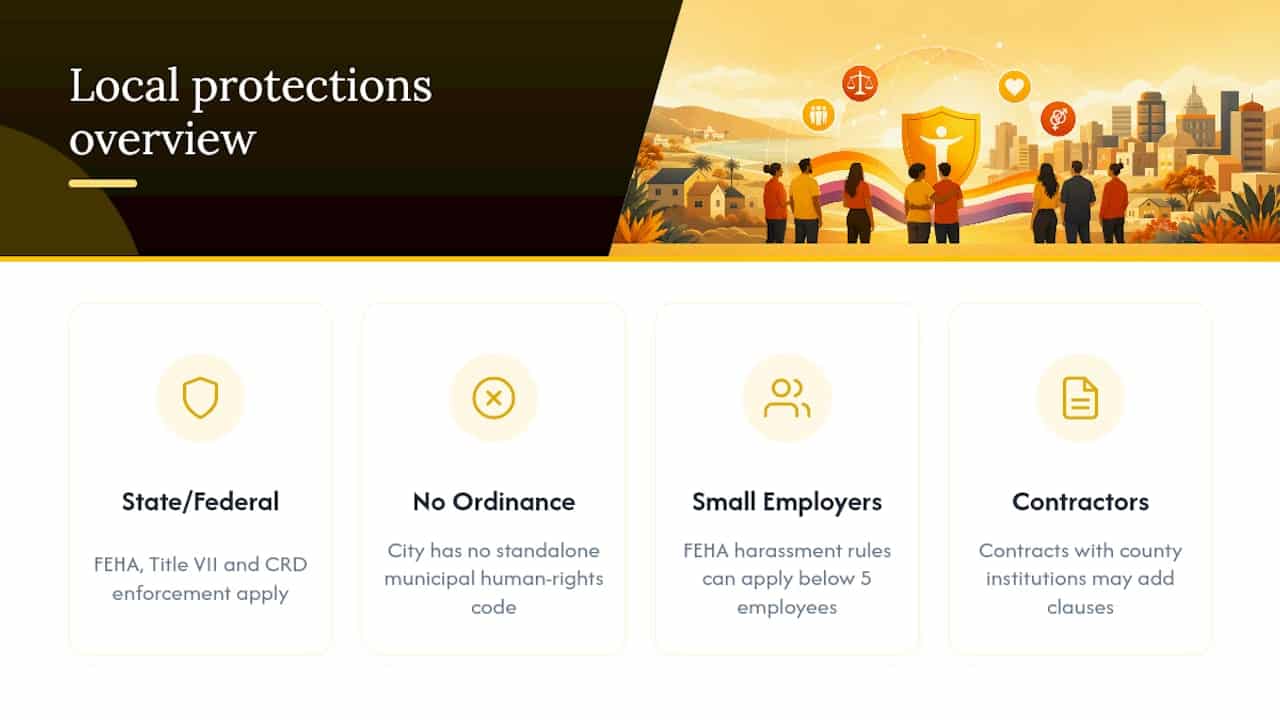
Employees working in Orange are covered by the same statewide FEHA and federal Title VII protections that apply everywhere in California, but the local context still matters. Orange sits within Orange County, where a dense mix of retail, healthcare, and professional service employers means workplace discrimination complaints often involve smaller businesses that may not realize FEHA’s harassment rules apply even below the five-employee threshold that triggers general discrimination coverage.
Orange doesn’t currently maintain a standalone municipal human rights ordinance separate from county or state law, which means your legal protections come primarily from FEHA, Title VII, and CRD enforcement rather than a city-specific code. That’s actually simpler for most workers: you don’t need to figure out which of several overlapping local rules applies. Instead, the state framework, layered with California Attorney General guidance on restroom access and accommodation, sets the floor for every employer in the city, from a small Old Towne Orange retail shop to a large healthcare system near The District.
If you work for a government contractor or a company doing business with Orange County institutions, additional nondiscrimination clauses sometimes appear in contract terms, adding another layer of leverage in a dispute. A lawyer reviewing your specific employer type can flag those extra protections quickly, something workers rarely think to check on their own.
Discrimination rarely arrives in a single, clean category. A woman of color who is also a lesbian may face bias that blends racism and homophobia in ways that are hard to separate into one legal box, and the law recognizes this. Courts increasingly look at intersectional claims, where multiple protected characteristics combine to create a distinct form of mistreatment that wouldn’t exist if you only had one of those traits.
This matters practically because it changes how you document an incident. If a supervisor makes comments that reference both your race and your gender identity, or your sex and your disability, record both elements rather than picking the one that feels “more obvious.” A complaint that captures the full picture, race, sex, sexual orientation, age, disability, gives your case more strength than one that narrows the story down to a single characteristic out of habit.
Transgender workers of color, older LGBTQ employees facing age bias layered with identity bias, and employees with disabilities who also experience gender identity discrimination all fall into this intersectional category. If your situation involves more than one protected trait, say so explicitly when you report internally and when you file with the CRD or EEOC. Investigators and courts can only weigh what’s actually in the record, so leaving out a layer of the discrimination you experienced weakens the claim rather than simplifying it.
The way you raise a concern with HR can shape the entire trajectory of your case, so it’s worth doing deliberately rather than reactively.
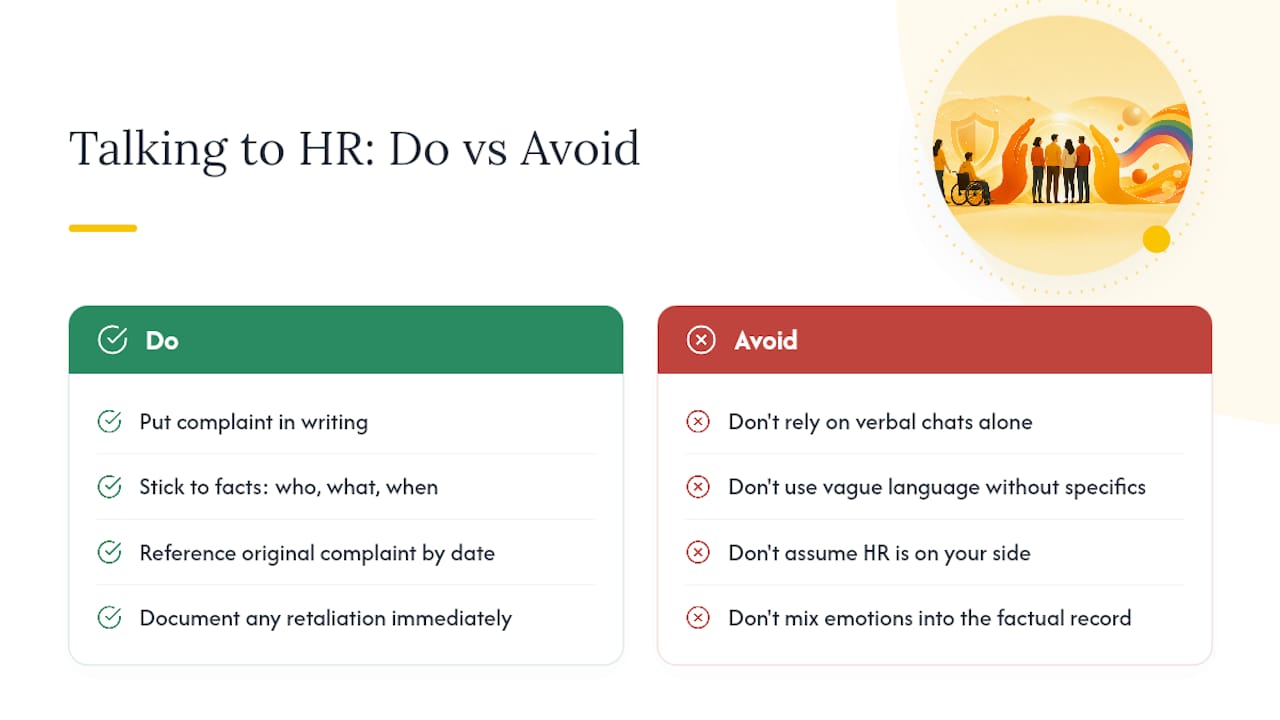
Put your complaint in writing, even if you’ve already had a verbal conversation. An email that says “Following up on our conversation this morning about the comments made by [name] on 10-22-2026” creates a timestamp that a casual hallway chat never will. Stick to facts: what was said, who was present, when it happened. Save the emotional impact for a separate conversation or your own notes rather than mixing it into the factual record, which reads more credibly to an investigator later.
Avoid vague language like “I felt uncomfortable” without specifics. Instead, describe the exact words used and the context. If HR’s response is dismissive or slow, follow up in writing again, referencing your original complaint by date. This creates a pattern that matters enormously if the case later shows the employer knew and did nothing.
Never assume HR is neutral in your favor. HR’s legal duty is to the company, not to you personally, even when individual HR staff are sympathetic. That doesn’t mean you skip internal reporting. In most cases, you’re still required to report internally before certain legal claims can proceed, but go in with realistic expectations and a paper trail as backup. If retaliation follows your complaint, such as a sudden negative review or exclusion from projects, document that separately and immediately, since retaliation itself is independently unlawful regardless of how the original discrimination claim resolves.
Orange County has several channels employees can use in parallel with legal action. County-level social services and LGBTQ community centers in the broader Orange County area, including organizations serving Orange directly, offer counseling and peer support for workers dealing with the stress of ongoing discrimination. The ACLU of Southern California’s know-your-rights page breaks down FEHA protections into plain language checklists specifically for LGBTQ workers, which is useful before you even decide whether to file a formal complaint.
For employees in Orange dealing with harassment tied to sex or sexual orientation more broadly, background resources on California sexual harassment law explain how these claims typically unfold procedurally. Local mental health resources, including county behavioral health services, can also help you manage the toll discrimination takes, which research on the effects of harassment and exclusion has documented extends well beyond the workplace itself. None of these resources replace legal counsel, but they fill the gap while you decide your next step.
For the underlying law and complaint procedures, go straight to the source. The California Civil Rights Department handles state administrative complaints and statutory guidance. The EEOC covers federal filings. The California Attorney General’s office publishes specific guidance on restroom access and workplace accommodations for LGBTQ employees.
Optimum Employment Lawyers represents employees only, never companies, which means every strategy decision is built around your recovery, not an employer’s liability exposure. That’s a real difference from firms that handle both sides of employment disputes depending on who walks in the door. If you’re dealing with gender or sexual orientation discrimination in Orange, the firm’s gender and sexual orientation discrimination services cover everything from initial documentation review to filing with the CRD or EEOC and negotiating a settlement. Cases run on contingency, so there’s no upfront legal bill while you’re already dealing with lost income or a hostile workplace. If a termination feels close, or a filing deadline is approaching, schedule a consultation to get your specific timeline and documentation reviewed before you lose options.
This article is general information, not a substitute for advice from a qualified lawyer. Consult a qualified legal professional about your own circumstances before acting on anything here.

© 2026 Optimum Employment Lawyers, PC
Legal Disclaimer | Privacy Policy
 Share
Share
