
(949) 954-8181 Free Case Review No recovery, no fee.
(949) 954-8181 Free Case Review No recovery, no fee.
If you experienced sexual harassment at work in Costa Mesa, California’s Fair Employment and Housing Act (FEHA) gives you the right to file a complaint with the California Civil Rights Department (CRD) within three years of the last incident, and the single best thing you can do right now is write down exactly what happened, when, and who saw it. That record, more than anything else, determines how strong your case becomes later. Optimum Employment Lawyers works with Costa Mesa employees on exactly these cases, and the pattern is consistent: people who document early recover more and recover faster than people who wait.
Sexual harassment under California law covers two categories: quid pro quo (a demand for sexual favors tied to job benefits) and hostile work environment (conduct severe or pervasive enough to poison your workday). A single severe incident, like a groping or an explicit threat, can be illegal on its own. The intent behind the conduct doesn’t matter either. What matters is whether it was unwelcome and connected to sex.
Do this immediately:
Two deadlines matter more than any other fact in this article: you generally have three years from the last harmful act to file with the CRD, and if you also want to pursue a federal claim through the EEOC, that window is typically around 300 days.
Pro Tip: Don’t wait for your employer’s internal investigation to finish before contacting CRD or EEOC. Federal guidance is clear that you’re not required to exhaust an internal process first, and if the harassment involved physical assault, that’s a matter for the Costa Mesa Police Department, not just HR.
Costa Mesa employees have up to several years to file a FEHA harassment claim with the CRD, and documenting the last incident immediately protects that right.
| Point | Details |
|---|---|
| Document first | Record dates, messages, and witnesses before memory fades or evidence disappears. |
| Report if safe | Notify HR or another manager in writing and keep confirmation of that report. |
| Know your deadlines | File CRD intake within several years; EEOC guideline is roughly 300 days. |
| Get your right-to-sue | Request it from CRD when ready to move toward a lawsuit, then you generally have 1 year to sue. |
| Call Optimum Employment Lawyers | Contact the firm for a no-cost, contingency-fee consultation if deadlines are close or retaliation occurred. |
California employers with five or more workers carry specific legal duties, not just moral ones. FEHA and CRD’s Harassment Prevention Guide require a written anti-harassment policy, a clear complaint process, and prompt, fair investigations once management is on notice.

Training isn’t optional either. Under Government Code §12950.1, supervisors need sexual harassment prevention training every two years, and nonsupervisory employees need training as well. If your Costa Mesa employer never trained anyone or has no written policy, that gap itself can become evidence in your case.
Employers can also be liable for harassment by vendors, clients, or other non-employees if they knew or should have known and did nothing. Documenting that you told a manager about a client’s behavior matters just as much as documenting the behavior itself.
Retaliation is often the easier claim to prove, and it’s illegal even if your original harassment complaint doesn’t ultimately succeed. Retaliation can look like a sudden bad performance review, a demotion, a schedule change, exclusion from projects, or termination shortly after you reported harassment.
Timing is your biggest ally here. If you were a solid performer for two years and got written up a week after filing an HR complaint, that gap tells its own story. Keep every performance review from before and after your report, note who made the decision, and save any message that references your complaint, even indirectly.
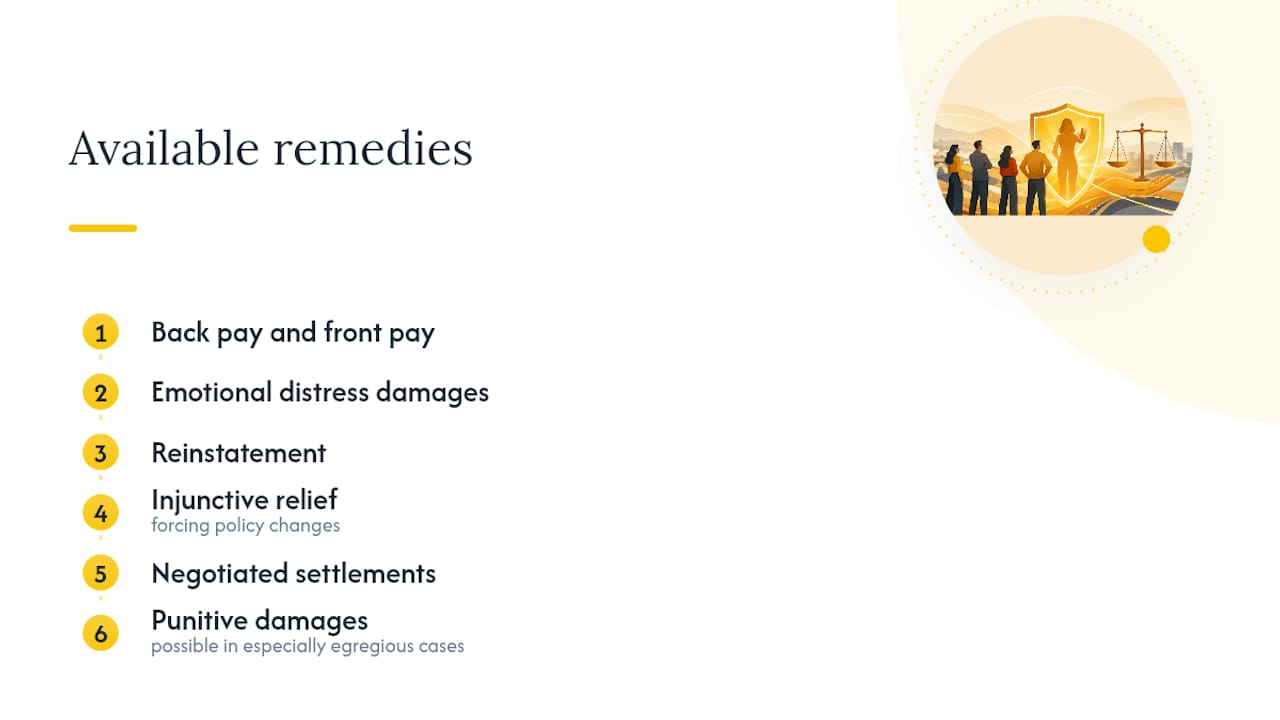
Remedies in California sexual harassment cases typically fall into a few buckets: back pay and front pay, emotional distress damages, reinstatement, injunctive relief forcing policy changes, and negotiated settlements. Punitive damages are possible in especially egregious cases.
Before you can file a lawsuit under FEHA, though, you need a right-to-sue notice from the CRD. You can request this immediately after filing your intake, which some employees do when they want to skip the agency investigation and head straight to court with an attorney. Once issued, you generally have one year to file suit.
Filing is the fast part. What follows is often a longer wait than people expect. The CRD screens your intake for jurisdiction first, meaning it checks whether your claim fits within the statutes it enforces before an investigation even begins. A declined intake at this stage usually reflects a jurisdictional issue, not a judgment on the merits of your story, and you can still request a right-to-sue letter afterward.
If CRD does investigate, timelines vary by case complexity and current caseload, but the agency has committed to promptly issuing right-to-sue letters when requested, sometimes within roughly 150 days of an immediate request. EEOC charges typically take longer to fully investigate, often many months, though you retain rights throughout that process.
Start with your direct chain, unless your harasser is in it. If your manager is the problem, go to HR directly, or to a manager one level up. Put your complaint in writing, even if you also report it verbally, and ask for written confirmation that HR received it.
If your Costa Mesa employer doesn’t respond within a reasonable window, typically a week or two for an initial acknowledgment, follow up in writing again and keep that email. Silence or a dismissive response isn’t just frustrating; it’s evidence that the employer failed its investigation duty under FEHA.
Costa Mesa doesn’t maintain a separate municipal sexual harassment ordinance that expands beyond FEHA’s protections, so state law is your primary shield here. What Costa Mesa employees do get, alongside every other California worker, is the full weight of FEHA, Government Code §12950.1’s training mandates, and CRD enforcement. Some cities layer on local minimum wage or paid sick leave ordinances, but for harassment claims specifically, California’s statewide framework governs.
The three-year clock generally starts from the date of the last harassing act, not the first one. If the harassment happened repeatedly over months, you’re not locked to the earliest incident. Each new act can potentially reset or extend your filing window, which is why keeping a running log matters more than trying to remember an exact start date months later.
If you didn’t realize certain conduct was illegal until later (sometimes called discovery), that can affect your timeline too, but don’t count on it. Treat the last incident date as your real deadline anchor.
You have the right to be interviewed without being pressured to change your story, and you can request that notes or a summary of your interview be kept for the record. FEHA and CRD guidance place an affirmative duty on employers to investigate fairly and promptly once notified, but confidentiality has limits: your employer generally can’t promise total secrecy since the accused typically has a right to respond.
Watch for retaliation disguised as “normal” management decisions during this window: sudden scrutiny of your work, exclusion from meetings, or a transfer framed as routine. These often surface right when an investigation is underway.
Call now if any of this applies: the harassment involved physical assault, you were fired or demoted after reporting, your case involves multiple victims or complicated evidence, or your three-year CRD window is closing fast. Waiting rarely helps in these situations, and evidence has a way of disappearing the longer it sits.
A consultation with Optimum Employment Lawyers starts with a no-cost review of your documentation and timeline. The firm represents employees exclusively on a contingency-fee basis, meaning you pay nothing upfront and nothing at all unless you recover. Optimum Employment Lawyers has secured significant results for California workers, including a $2.2 million settlement in a class action involving missed meal breaks, and applies that same aggressive approach to sexual harassment and retaliation cases for Costa Mesa employees.
Bring your written timeline, saved messages, and any HR correspondence to your consult; the firm can also help you request an immediate right-to-sue notice from CRD if your deadline is close. Everything you share stays confidential. To get started, contact Optimum Employment Lawyers for a consultation and find out where you stand.
The CRD complaint process page covers intake, jurisdiction screening, and right-to-sue requests. Filing is available online, by mail, or in person, but one detail trips people up constantly: unsubmitted online intake drafts expire after just 30 days in the CCRS system, so starting a form isn’t the same as protecting your deadline.
| Deadline or Rule | Detail | Source |
|---|---|---|
| CRD filing window | several years from the last harmful act | CRD Complaint Process |
| EEOC filing guideline | Approximately 300 days | DLSE/EEOC Worker Guidance |
| CRD intake draft expiration | 30 days unsubmitted | CRD Complaint Process |
| Supervisor training requirement | 2 hours every 2 years | Gov. Code §12950.1 |
If your deadline is approaching, don’t file the CRD intake alone and hope for the best. Contact Optimum Employment Lawyers before that window closes.
This article is general information, not a substitute for advice from a qualified lawyer. Consult a qualified legal professional about your own circumstances before acting on anything here.

© 2026 Optimum Employment Lawyers, PC
Legal Disclaimer | Privacy Policy
 Share
Share
