
(949) 954-8181 Free Case Review No recovery, no fee.
(949) 954-8181 Free Case Review No recovery, no fee.
Sexual harassment at work in Santa Ana is any unwelcome sexual conduct that creates a hostile work environment or conditions employment benefits on sexual submission, and it is explicitly prohibited under both California’s Fair Employment and Housing Act (FEHA) and federal Title VII of the Civil Rights Act of 1964. If you work in Santa Ana and have experienced inappropriate touching, sexual comments, repeated unwanted advances, or pressure tied to your job security, you are protected by some of the strongest workplace harassment laws in the country. The California Civil Rights Department (CRD) and the Equal Employment Opportunity Commission (EEOC) both enforce these protections. Understanding this isn’t just reassuring. It’s the first step toward doing something about it.
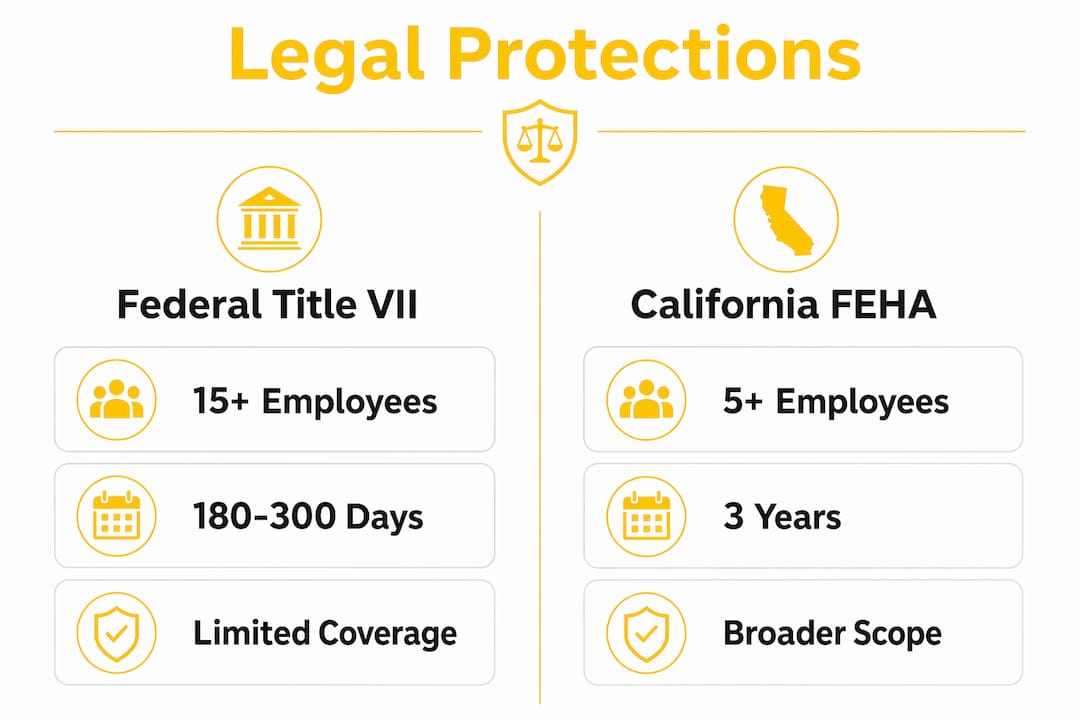
California law provides broader protection than federal law, and that difference matters directly for Santa Ana employees. Title VII and California FEHA prohibit workplace sexual harassment based on sex, sexual orientation, and gender identity. Federal law applies to employers with 15 or more employees, while California FEHA covers employers with as few as one employee. That means virtually every worker in Santa Ana has legal recourse, regardless of where they work.
Sexual harassment law recognizes two distinct legal categories. Quid pro quo harassment involves conditioning an employment benefit on submission to sexual conduct, with strict employer liability attached. A supervisor who implies your promotion depends on accepting sexual advances is committing quid pro quo harassment, and the employer is automatically liable. The second category, hostile work environment, requires showing that the conduct was severe or pervasive enough to alter the conditions of your employment. This is assessed both objectively (would a reasonable person find it hostile?) and subjectively (did you personally find it hostile?).

The severe or pervasive standard is a meaningful legal hurdle. A single extreme incident, such as a sexual assault at work, can qualify. Isolated minor incidents, like one off-color joke, typically do not. Frequency, severity, physical threat, and whether the conduct interfered with your work performance all factor into the analysis.
Employers in Santa Ana can raise what is known as the Faragher-Ellerth defense in hostile work environment cases. Under this doctrine, employers can defend claims by proving they exercised reasonable care to prevent and correct harassment and that the employee unreasonably failed to use available complaint procedures. This is why using your employer’s internal reporting system matters so much. If you skip internal reporting without good reason, you may inadvertently weaken your own claim.
Pro Tip: Review your employee handbook for the company’s anti-harassment policy and complaint procedure before filing anything externally. Documenting that you followed internal channels first strengthens your position significantly.
| Provision | Federal Title VII | California FEHA |
|---|---|---|
| Employer size covered | 15 or more employees | 1 or more employees |
| Protected characteristics | Sex, sexual orientation, gender identity | Sex, sexual orientation, gender identity, gender expression |
| Filing agency | EEOC | California Civil Rights Department (CRD) |
| Complaint deadline | 180 to 300 days from incident | 3 years from incident (as of 2020 amendment) |
| Remedies available | Back pay, compensatory, punitive damages | Back pay, emotional distress, punitive damages |
Proper documentation is the foundation of any successful Santa Ana harassment claim. Written complaint dates establish employer notice, which is a key element of employer liability. Without documentation, your case depends entirely on your word against your employer’s. With it, you create a factual record that is far harder to dismiss.
Follow these steps to document and report harassment correctly:
Pro Tip: Email yourself a summary of each incident from a personal account immediately after it happens. The email timestamp creates an independent, verifiable record that no employer can alter or delete.
Most individuals who experience harassment never file formal complaints, largely due to fear of retaliation, disbelief, and career concerns. That fear is understandable, but it also allows harassment to continue unchecked. Documenting your experience, even before you decide whether to report, puts you in control of the situation.
Retaliation is one of the most common consequences employees in Santa Ana face after reporting sexual harassment, and it is independently illegal. Retaliation is prohibited under 42 U.S.C. § 2000e-3(a) and California FEHA, protecting employees who report harassment or participate in investigations from adverse workplace actions. Retaliation claims require separate proof from the underlying harassment claim, which means you can win a retaliation case even if the harassment claim does not succeed on its own.
Retaliation in Santa Ana workplaces takes many forms. Watch for these warning signs after you report harassment:
A Santa Ana case illustrates how seriously courts examine retaliation claims. A jury initially awarded $2.9 million in a retaliation verdict, but a judge later vacated the award due to insufficient evidence directly linking the adverse actions to the protected activity. This outcome underscores a critical point: causation is everything in retaliation claims. You must be able to connect the dots between your complaint and the adverse action with concrete evidence.
To protect yourself, document every workplace change after you report harassment. Note the date, what changed, who communicated the change, and whether any reason was given. If a supervisor who previously praised your work suddenly begins writing you up for minor infractions the week after you file a complaint, that timing is evidence. Courts and agencies look at the proximity in time between protected activity and adverse action as one indicator of retaliation. You can learn more about your Santa Ana employee rights to understand the full scope of protections available to you.
Filing a harassment claim in California follows a specific procedural path, and missing a deadline permanently bars your right to sue. Statutory deadlines for EEOC complaints are 180 days from the last harassment incident for federal claims, extended to 300 days if you also file with a state agency like the California CRD. California’s own deadline under FEHA is three years from the incident, which gives Santa Ana employees significantly more time than federal law alone provides.
The process works in this sequence. You file an administrative complaint with either the CRD or the EEOC first. The agency investigates and may attempt mediation or conciliation between you and your employer. If the agency does not resolve the matter, it issues a right-to-sue notice. That notice is your authorization to file a civil lawsuit in court. Without completing this administrative step, no court will hear your case. Filing an administrative complaint with the California Civil Rights Department is mandatory to obtain a right-to-sue notice for state claims.
The EEOC reported over 11,000 sexual harassment charges in 2023, with $61.3 million awarded in benefits. Harassment charges made up over 35% of all charges filed with the EEOC in 2023. These numbers confirm that workplace sex discrimination and harassment claims are among the most actively pursued employment law matters in the country.
| Step | California CRD | Federal EEOC |
|---|---|---|
| Filing deadline | 3 years from last incident | 180 to 300 days from last incident |
| Agency investigation | CRD investigates and may mediate | EEOC investigates and may conciliate |
| Right-to-sue notice | Issued by CRD after process | Issued by EEOC after process |
| Lawsuit filing window | 1 year from right-to-sue notice | 90 days from right-to-sue notice |
| Court jurisdiction | California Superior Court | Federal District Court |
Consulting a Santa Ana employment lawyer before or during the filing process is the single most effective way to protect your claim. An attorney can identify which agency to file with first, gather evidence, and prevent procedural errors that could sink an otherwise strong case. Legal counsel also signals to your employer that you are serious, which often accelerates settlement discussions. For a deeper look at California harassment law, Optimum Employment Lawyers provides a detailed breakdown of the protections available to you.
Employees-lawyer, operating as Optimum Employment Lawyers, represents only employees. Never employers. If you are dealing with sexual harassment at work in Santa Ana, the firm’s attorneys evaluate your claim, explain your options under California FEHA and federal law, and build a case strategy focused on your specific situation. Optimum Employment Lawyers has secured significant results for California workers, including a $2.2 million class action settlement for missed meal breaks, demonstrating the firm’s ability to take on employers of any size. Contact the Santa Ana employment law team early. The sooner you get legal guidance, the more options you preserve. Do not wait until a deadline passes to find out what your case is worth.
Sexual harassment under California FEHA includes any unwelcome sexual conduct, whether verbal, physical, or visual, that is severe or pervasive enough to create a hostile work environment or that conditions employment benefits on sexual submission. California law applies to employers with even one employee, making it one of the broadest protections in the country.
California employees have three years from the last harassment incident to file a complaint with the California Civil Rights Department. For federal EEOC claims, the deadline is 180 to 300 days from the last incident, so acting quickly preserves the most options.
Firing an employee for reporting harassment is illegal retaliation under both California FEHA and federal law at 42 U.S.C. § 2000e-3(a). If you are terminated after filing a complaint, you may have both a harassment claim and a separate retaliation claim against your employer.
You are not required to have a lawyer to file an administrative complaint, but legal representation significantly improves your ability to meet deadlines, gather evidence, and avoid procedural errors that can permanently bar your lawsuit.
Employers are still liable for coworker harassment if they knew or should have known about the conduct and failed to take prompt corrective action. Report the behavior to HR in writing so the employer is on notice, which triggers their legal obligation to act.
Sexual harassment at work in Santa Ana is unlawful under both California FEHA and federal Title VII, and employees who document incidents, report through proper channels, and file within legal deadlines hold the strongest position for achieving justice.
| Point | Details |
|---|---|
| California FEHA covers all employers | Even employers with one employee must comply, giving Santa Ana workers broader protection than federal law alone. |
| Two harassment types carry different liability | Quid pro quo triggers automatic employer liability; hostile work environment requires proof of severe or pervasive conduct. |
| Documentation is your strongest asset | Record dates, times, witnesses, and communications immediately after each incident to establish employer notice. |
| Filing deadlines are strict | California CRD allows three years; EEOC requires action within 180 to 300 days. Missing either deadline ends your case. |
| Retaliation is a separate, independent claim | Adverse actions after reporting harassment can support a retaliation lawsuit even if the harassment claim faces challenges. |

© 2026 Optimum Employment Lawyers, PC
Legal Disclaimer | Privacy Policy
 Share
Share
