
(949) 954-8181 Free Case Review No recovery, no fee.
(949) 954-8181 Free Case Review No recovery, no fee.
Unwanted sexual advances at work can violate California law, whether they take the form of quid pro quo demands or a hostile work environment, and unwanted touching can also be a crime. San Clemente employees can file an internal complaint, report to a state or federal agency, call police for assault, or contact a lawyer. Some employment lawyers evaluate these claims on contingency, meaning you owe nothing upfront to find out where you stand.
TL;DR:
- A single severe incident, such as groping or explicit threats, can establish a hostile work environment claim in California without requiring repeated behavior.
- Victims should document incidents immediately, including texts, emails, and witness statements, and file complaints in writing to create a solid paper trail.
- Report unwanted touching or assault to law enforcement separately, as criminal and civil processes proceed independently and simultaneously.
- Retaliation for reporting harassment is illegal and can include demotion, termination, or schedule reductions, which should be documented and challenged through proper channels.
- An employment lawyer working on contingency can evaluate and pursue claims without upfront costs, guiding victims through negotiations, complaints, and potential litigation.
California recognizes two main legal categories for workplace sexual harassment, and knowing which one fits your situation shapes what happens next.
Quid pro quo harassment happens when a supervisor or manager ties job benefits to sexual favors. Picture a shift supervisor at a San Clemente restaurant hinting that better hours or a promotion depend on going along with advances, or a manager threatening reduced hours after a rejection. That link between a sexual demand and a job outcome is the entire claim.
Hostile work environment claims work differently. They require conduct that is “severe or pervasive,” but California law is clear that a single incident can meet that bar if it’s serious enough. Government Code §12923 affirms that one severe act, like groping or an explicit threat, can create a hostile environment without a pattern of repeated behavior.
A few things to keep in mind:
If your experience involved quid pro quo pressure tied to a promotion or schedule, that’s often the clearest kind of claim to build.
The first hours and days matter more than most people realize, because memory fades and messages get deleted.
If you were physically threatened or touched without consent, call 911 first. A police report creates an official record independent of your employer, and if you sought medical treatment, keep every record from that visit.
Beyond immediate safety, here’s a practical order of operations:
Pro Tip: Email yourself a timestamped summary of what happened the same day, even before deciding whether to file a formal complaint. That message alone can become one of the strongest pieces of evidence in a later investigation.
Each reporting path serves a different purpose, and using more than one often strengthens your position rather than complicating it.
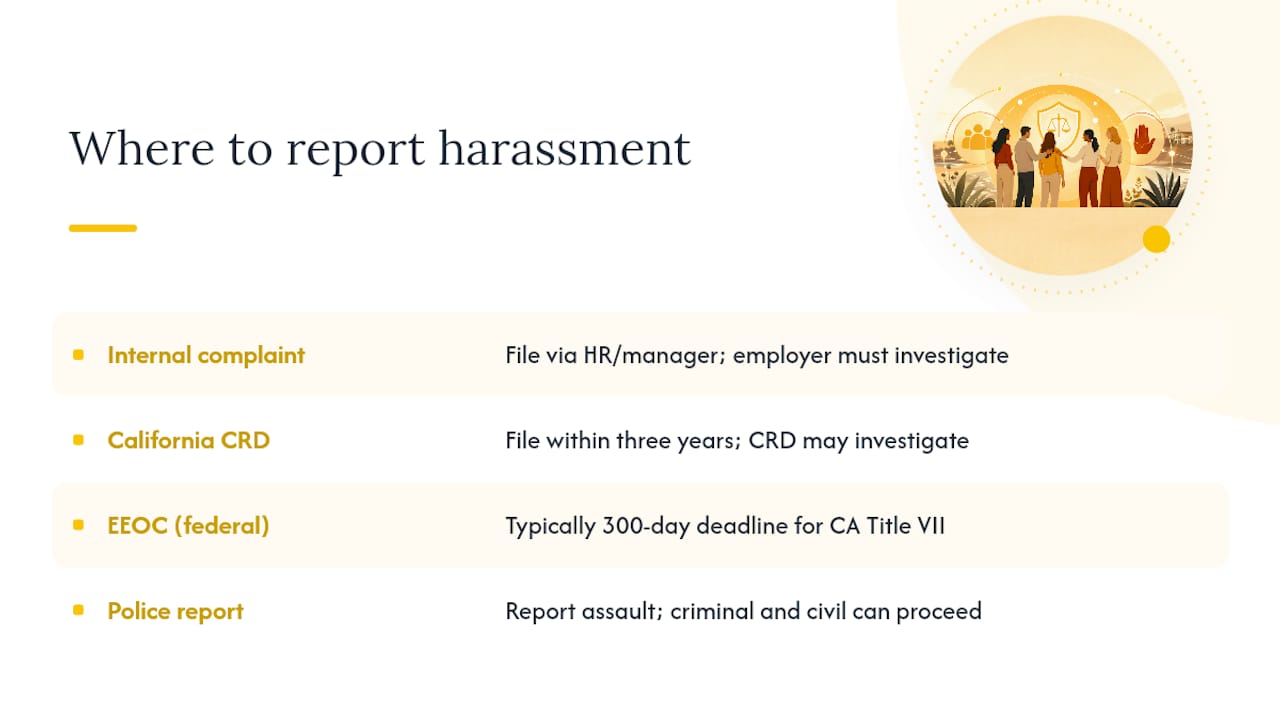
Internal complaint. Most California employers are required to maintain a written policy and a complaint process that doesn’t force you to report only to your direct supervisor, per CRD guidance. File through HR, another manager, or a hotline, and ask for written confirmation that your complaint was received. Employers are obligated to investigate promptly.
California Civil Rights Department (CRD, formerly DFEH). You generally have up to three years from the last harassing act to file with the CRD, which can investigate and attempt resolution before you go to court.
EEOC. For federal Title VII claims, the deadline is typically 300 days from the incident in California, since the state has its own fair employment agency.
Police. Report unwanted touching or sexual assault to law enforcement regardless of what you decide about a workplace complaint. Criminal and civil processes run on separate tracks and can proceed at the same time, so filing a police report doesn’t use up your window to also pursue a CRD complaint or a civil suit.
Yes. California law protects “protected activity,” which includes filing a complaint, participating in an investigation, refusing sexual advances, or supporting a coworker’s complaint. Punishing an employee for any of that is unlawful, even if the underlying harassment claim is never proven.
Retaliation doesn’t always look dramatic. Watch for:
If any of this happens, document every incident with dates and details, save every related email or text, and report the retaliation internally in writing. You can also file a retaliation claim with the CRD, and it stands on its own with its own filing deadlines, separate from the original harassment complaint.
Cases rarely turn on one dramatic piece of proof. They usually come down to a pile of small, consistent details that back up your account.
Useful evidence includes saved texts and emails, call logs, photos, timecards showing shift changes that followed a complaint, security camera footage if available, and the names of coworkers who witnessed anything relevant. Written statements from those witnesses, even informal ones, carry real weight later.
Pro Tip: Ask your employer for its harassment policy and a written investigation timeline as soon as you report. It creates a paper trail and puts them on notice that they’re expected to act, not sit on your complaint.
A lawyer can go further than you can on your own, using discovery or subpoenas to obtain internal emails, HR files, and complaint histories your employer might not hand over voluntarily. That access often determines whether a case settles quickly or needs to go further.
Optimum Employment Lawyers represents employees exclusively, never employers, and works on a contingency fee basis, so you pay nothing upfront to have your situation reviewed. That matters if you’re already dealing with reduced hours or the stress of reporting a supervisor.
For San Clemente workers facing unwanted sexual advances, the firm’s role typically covers evaluating whether your facts support a quid pro quo or hostile work environment claim, drafting and filing complaints with the CRD or EEOC, negotiating directly with your employer, and pursuing litigation when negotiation stalls. Some law firms have secured significant results for employees, including a $2.2 million class action settlement over missed meal breaks, and take a personalized approach to each case.
If you’re in San Clemente and dealing with harassment, retaliation, or a hostile workplace, the firm’s sexual harassment services page outlines how claims like yours typically get handled. To get a straightforward read on your options, reach out for a consultation and walk through what happened with someone who handles these cases for a living.
Save these resources before you need them under pressure.
This article is general information, not a substitute for advice from a qualified lawyer. Consult a qualified legal professional about your own circumstances before acting on anything here.
Yes. Under Government Code §12923, one severe incident, such as groping or an explicit threat tied to your job, can meet the standard for a hostile work environment claim without needing a pattern of repeated conduct.
California generally allows up to three years from the last incident to file with the Civil Rights Department. Federal Title VII claims through the EEOC typically carry a 300 day deadline instead, so check both if you’re unsure which applies.
Yes. Criminal reporting for assault and civil or agency complaints for harassment are separate processes that can move forward at the same time. Filing one doesn’t cancel your right to pursue the other.
Optimum Employment Lawyers works on contingency, taking 40% for a pre-trial settlement or 42% for other wins, with no upfront cost to you. You only pay if the case results in a settlement or award.
No. Firing, demoting, or cutting hours because you reported harassment or refused advances is illegal retaliation. If it happens, document it immediately and consider filing a separate retaliation claim with its own deadline.

© 2026 Optimum Employment Lawyers, PC
Legal Disclaimer | Privacy Policy
 Share
Share
