
(949) 954-8181 Free Case Review No recovery, no fee.
(949) 954-8181 Free Case Review No recovery, no fee.

Race discrimination in the workplace is defined as any adverse treatment of an employee based on race, color, ancestry, or ethnic background, and it is explicitly illegal under California’s Fair Employment and Housing Act (FEHA) and federal Title VII of the Civil Rights Act of 1964. Seal Beach employees who face racial bias at work have clear legal protections and real remedies available to them. The California Civil Rights Department (CRD) enforces these laws statewide, and employees can file complaints at no cost. Understanding race discrimination in Seal Beach, what California employees need to know, starts with recognizing that the law is firmly on your side.
Race discrimination covers a wider range of conduct than most employees realize. The legal definition includes any adverse employment action taken because of an employee’s race, color, ancestry, national origin, or ethnic group. Termination, demotion, denial of promotion, unequal pay, and exclusion from training programs all qualify. So does a hostile work environment created by racial slurs, offensive jokes, or repeated racially charged comments.

California law recognizes two main categories of evidence. Direct evidence includes explicit racial slurs, written statements, or a manager saying outright that race influenced a decision. Circumstantial evidence covers situations where an employee of one race is treated differently from a similarly situated employee of another race, without a legitimate business reason. Both types can support a strong legal claim.
Retaliation is also prohibited. If you report racial discrimination or assist a coworker in filing a complaint, your employer cannot legally punish you for it. Retaliation includes demotions, schedule changes designed to harm you, increased scrutiny, or termination. California’s workplace discrimination protections treat retaliation as a separate and serious violation.
Pro Tip: Keep a private log of every discriminatory incident. Record the date, time, location, what was said or done, and who witnessed it. This log can become critical evidence if you file a complaint.
Proving racial discrimination in California follows a structured legal framework. To establish a prima facie case, you must show four elements: you belong to a protected class, you performed your job competently, you suffered an adverse employment action, and the circumstances suggest a discriminatory motive. Establishing these elements is the foundation of every successful race discrimination claim.
Once you establish a prima facie case, the burden shifts to your employer to provide a legitimate, non-discriminatory reason for the action. You then have the opportunity to show that the reason is a pretext, meaning it is false or not the real reason. California applies the “substantial motivating factor” standard, established in Harris v. City of Santa Monica, which means race does not have to be the only reason for the adverse action. It only needs to be a substantial motivating factor.
Documentation is the most powerful tool in a discrimination case. Personnel files frequently contain performance reviews, disciplinary records, and internal communications that reveal inconsistencies in how employees of different races are treated. Employees can request their own personnel files, and California law requires employers to provide access within 30 days of a written request under Labor Code § 1198.5. Many employees skip this step and lose access to evidence their employer will later use against them.
The continuing violation doctrine allows employees to include discriminatory acts that fall outside the standard three-year filing window, as long as those acts are part of an ongoing pattern. This doctrine is complex and requires legal guidance to apply correctly.
Steps to build your evidence base:
| Evidence type | What to collect |
|---|---|
| Personnel file | Performance reviews, disciplinary records, promotion history |
| Communications | Emails, texts, written warnings with racial bias indicators |
| Witness accounts | Names and contact details of coworkers who observed the conduct |
| Comparative data | Records showing different treatment of employees of other races |
Pro Tip: Request your personnel file in writing and keep a copy of the request. If your employer fails to provide it within 30 days, that failure itself can be used as evidence of bad faith.
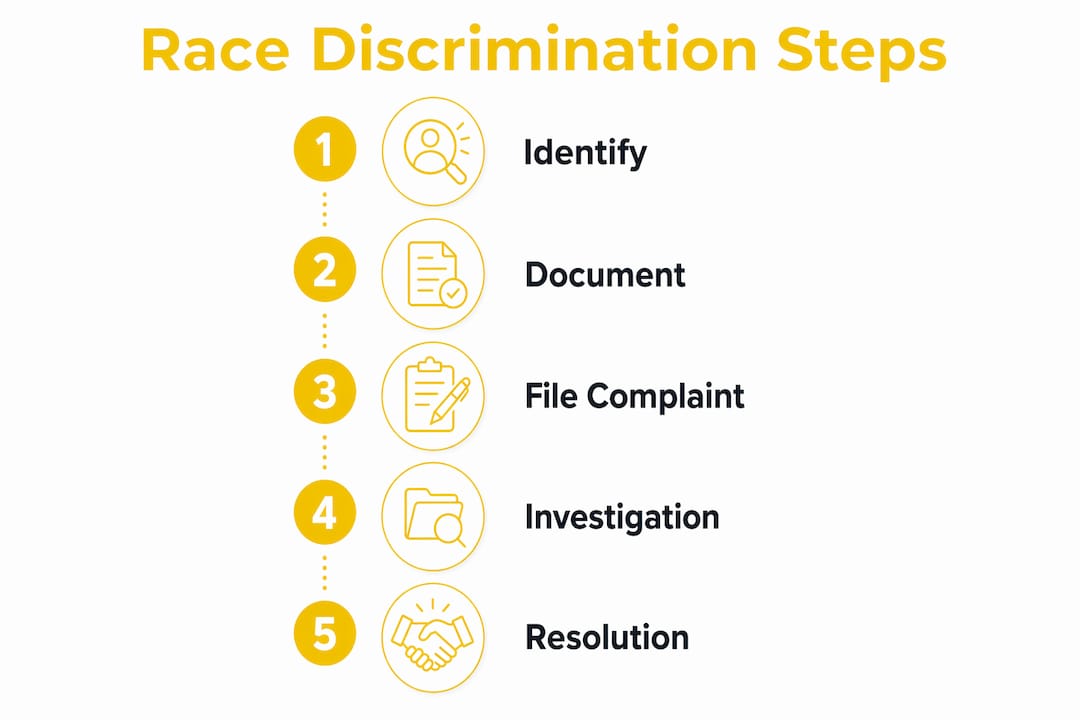
Acting quickly and strategically matters. California’s standard filing deadline for a CRD complaint is three years from the date of the discriminatory act, but waiting too long can weaken your case. The steps below give you the clearest path forward.
The CRD complaint process is not a barrier. It is a procedural step designed to give both parties a chance at resolution before litigation. Legal counsel can help you navigate it without sacrificing your rights.
California law provides some of the strongest remedies for race discrimination in the country. If you prove your claim, you can recover back pay for wages lost from the date of the discriminatory act. You can also recover front pay, which covers future lost earnings when reinstatement is not practical. Emotional distress damages compensate for the psychological harm caused by the discrimination. In cases involving especially egregious conduct, courts can award punitive damages to punish the employer and deter future violations.
Attorney fees are recoverable when an employee prevails. This matters because it removes the financial barrier that stops many employees from pursuing valid claims. Recoverable damages include back pay, front pay, emotional distress, punitive damages, and attorney fees, making litigation a realistic option even for employees without significant savings.
Employer retaliation after a complaint filing is prohibited and creates an additional legal claim. If your employer demotes you, cuts your hours, or terminates you after you file with the CRD, that retaliation is a separate violation with its own remedies. The CRD also offers mediation services, which can resolve cases without a full investigation or trial.
Pro Tip: If your employer retaliates after you file a complaint, document it immediately and report it to the CRD as a separate retaliation claim. Retaliation evidence often strengthens the original discrimination case.
| Remedy type | What it covers |
|---|---|
| Back pay | Wages lost from the date of the discriminatory act |
| Front pay | Future lost earnings when reinstatement is not feasible |
| Emotional distress | Compensation for psychological harm and suffering |
| Punitive damages | Additional award for especially harmful employer conduct |
| Attorney fees | Legal costs recovered when the employee wins |
Seal Beach operates under both California state law and its own municipal policies. The City of Seal Beach prohibits race discrimination and harassment against employees and job applicants under its local employment policies. This means employees in Seal Beach have protections at the municipal, state, and federal levels simultaneously.
California’s CROWN Act, which took effect in 2020, expanded race discrimination protections to cover hairstyles historically associated with race, including braids, locs, twists, and knots. Before the CROWN Act, employers could enforce grooming policies that disproportionately affected Black employees without it being classified as race discrimination. That is no longer legal in California. If your employer has disciplined you or denied you a job because of your natural hairstyle, that conduct may constitute race discrimination under current law.
Enforcement trends in Orange County, where Seal Beach is located, show increased CRD activity and a growing number of civil suits filed after immediate Right-to-Sue notices. Employees in the area have successfully pursued claims involving racial harassment, discriminatory termination, and unequal pay. The legal environment in 2026 is more favorable to employees than at any prior point in California history.
California employees in Seal Beach facing race discrimination have enforceable rights under FEHA, Title VII, and local municipal policy, and the legal system provides concrete remedies including back pay, emotional distress damages, and attorney fees.
| Point | Details |
|---|---|
| Race discrimination is illegal | FEHA, Title VII, and Seal Beach municipal policy all prohibit racial bias in employment. |
| Four elements establish your case | Show protected class, job competence, adverse action, and discriminatory motive. |
| Personnel files are critical evidence | Request yours under Labor Code § 1198.5; employers must respond within 30 days. |
| CRD complaints are free | File through the online CCRS portal before pursuing a civil lawsuit. |
| Remedies include attorney fees | Prevailing employees can recover back pay, emotional distress, punitive damages, and legal costs. |
Facing racial discrimination at work is serious. You should not have to navigate the legal process alone.
Optimum Employment Lawyers focuses exclusively on employee-side cases throughout California, including Seal Beach and the broader Orange County area. The firm handles race discrimination claims under FEHA and the CROWN Act, guiding employees through CRD complaints, Right-to-Sue requests, and civil litigation. Optimum Employment Lawyers works on a contingency basis, so you pay nothing upfront. The firm has secured significant results for California employees, including a $2.2 million settlement in a class action case. If you believe your employer has treated you differently because of your race, contact an employment lawyer today for a confidential case evaluation.
The standard deadline to file a complaint with the California Civil Rights Department is three years from the date of the discriminatory act. The continuing violation doctrine may extend this window for ongoing patterns of discrimination.
No. California law requires employees to file a CRD complaint before pursuing a civil lawsuit. You can request an immediate Right-to-Sue notice to move to court faster, but this bypasses the administrative investigation process.
Yes. California’s CROWN Act classifies discrimination based on hairstyles linked to race, such as braids, locs, and twists, as race discrimination under FEHA. Employers cannot legally enforce grooming policies that target these hairstyles.
Retaliation after a CRD complaint is a separate legal violation. Document every retaliatory act and report it to the CRD immediately. Retaliation evidence also tends to strengthen the original discrimination claim.
A race discrimination lawyer can evaluate whether your situation meets the four-element prima facie standard: protected class membership, job competence, adverse action, and evidence of discriminatory motive. Most employment attorneys offer free initial consultations.

© 2026 Optimum Employment Lawyers, PC
Legal Disclaimer | Privacy Policy
 Share
Share
