
(949) 954-8181 Free Case Review No recovery, no fee.
(949) 954-8181 Free Case Review No recovery, no fee.
If you’re facing race discrimination at work in Lake Forest, here’s the short version: both California and federal law protect you, you can file a complaint with the California Civil Rights Department (CRD) or the U.S. Equal Employment Opportunity Commission (EEOC), and the clock is already running on your deadline to act. The Fair Employment and Housing Act (FEHA) makes this illegal in California workplaces, and waiting to document what happened is the single biggest mistake employees make.
Before you do anything else, take these steps:
Lake Forest employees facing race discrimination have three years to file a CRD intake and one year to sue after receiving a Right-to-Sue notice, so acting early protects both evidence and legal options.
| Point | Details |
|---|---|
| Two laws apply | FEHA covers California employers with 5+ workers; Title VII adds federal protection through the EEOC. |
| Harassment threshold is lower | FEHA harassment rules can apply even in workplaces with a single employee. |
| Deadlines are strict | CRD intake is due within three years of the last unlawful act; lawsuits must follow within one year of Right-to-Sue. |
| Evidence decays fast | Save emails, reviews, and witness names immediately, not after you’ve been let go. |
| Legal help costs nothing upfront | Optimum Employment Lawyers offers free consultations and contingency-fee representation for Lake Forest employees. |
This article is general information, not a substitute for advice from a qualified lawyer. Consult a qualified legal professional about your own circumstances before acting on anything here.
FEHA is the main law shielding you. It bans discrimination based on race, color, and national origin, and it covers public and private employers with five or more employees. Title VII of the Civil Rights Act adds a federal layer, enforced by the EEOC, which matters if your employer operates across state lines or you want a federal charge on record alongside your state claim.

Here’s a detail a lot of employees miss: even if your employer has fewer than five workers, you’re not automatically unprotected. FEHA’s harassment rules apply to nearly every California workplace, even ones with a single employee or an independent contractor on staff.
Quick facts on coverage:
Discrimination rarely announces itself. It shows up as patterns, and recognizing the pattern is often the hardest part.
A real complaint needs specifics: who said or did what, on what date, and who else was in the room. “My supervisor treats me unfairly” is a feeling. “On March 3, 2026, my supervisor told me in front of two coworkers that I only got hired to fill a quota” is a fact you can prove.
Cases get won or lost on paper trails, not memory. Start collecting now, even if you haven’t decided whether to file.
Pro Tip: Forward important work emails to a personal account the moment they happen, not weeks later. If you wait until after you’ve been terminated, you may lose access entirely, and recreating a timeline from memory alone weakens your credibility.
For a deeper walkthrough of what a strong evidence file looks like, see how to prove discrimination in employment lawsuits.
This is where timing becomes unforgiving. Miss a deadline, and you can lose your right to sue entirely, regardless of how strong your evidence is.
The deadline that trips people up most: CRD intake for employment cases generally must happen within three years of the last unlawful act. That sounds generous until you realize evidence disappears long before three years pass.
A few practical notes:
Outcomes vary case by case, but California and federal law allow for a range of relief:
Most cases move through a rough sequence: intake, then investigation or mediation, then a Right-to-Sue and formal filing if needed, then discovery, and finally settlement or trial. Timelines shift depending on how contested the case is. What damages actually apply to your situation depends on the specific facts, which is exactly what an intake conversation with counsel is meant to sort out.
Retaliation often follows a complaint faster than people expect, and it’s illegal on its own, separate from the underlying discrimination.
Watch for a sudden demotion, an unexplained schedule change, disciplinary write-ups with no clear basis, or termination shortly after you reported an issue. Document every one of these with dates and witnesses, tied to the timeline of when you complained or participated in an investigation. Firing an employee for filing a CRD complaint is retaliation under FEHA, plain and simple. Learn more about how retaliation claims work in California.
Not every situation needs a lawyer on day one, but certain signs mean it’s time to stop handling it alone.
Call counsel when your employer is large and has legal representation on retainer, when the evidence is complicated or spread across years, when you’re facing a threatened termination, when you see a pattern affecting multiple employees, or once you’ve received a Right-to-Sue notice and are ready to litigate.
Here’s what a lawyer actually does for you at each stage:
Optimum Employment Lawyers works on contingency for the vast majority of employment cases, meaning no upfront fees. You pay nothing unless there’s a recovery, and any advanced costs are explained clearly before they happen. For a firsthand look at how this applies locally, review wrongful termination rights in Lake Forest.
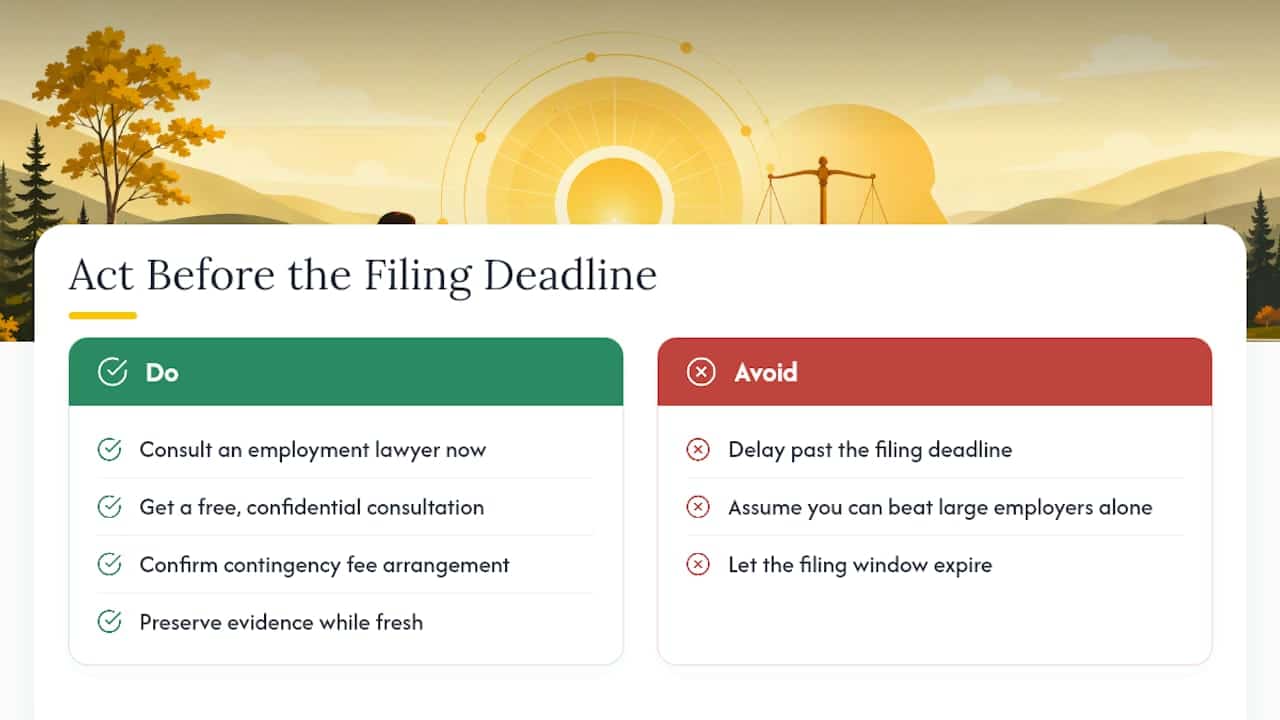
Filing an intake with CRD or the EEOC is something you can technically do alone, but the moment your case involves lost wages, a pattern of discrimination, or a large employer with its own legal team, the gap between “technically possible” and “actually winnable” gets wide fast. Optimum Employment Lawyers focuses exclusively on employee-side cases across California, and that focus shows in results, including a substantial settlement in a class action involving missed meal breaks. If you’re a Lake Forest employee dealing with race discrimination, a free, confidential consultation costs you nothing, and you pay no fee unless the firm wins your case. Don’t let a three-year filing window quietly become a one-year window, then close entirely. Contact Optimum Employment Lawyers today to review your situation while your evidence is still fresh.

© 2026 Optimum Employment Lawyers, PC
Legal Disclaimer | Privacy Policy
 Share
Share
