
(949) 954-8181 Free Case Review No recovery, no fee.
(949) 954-8181 Free Case Review No recovery, no fee.
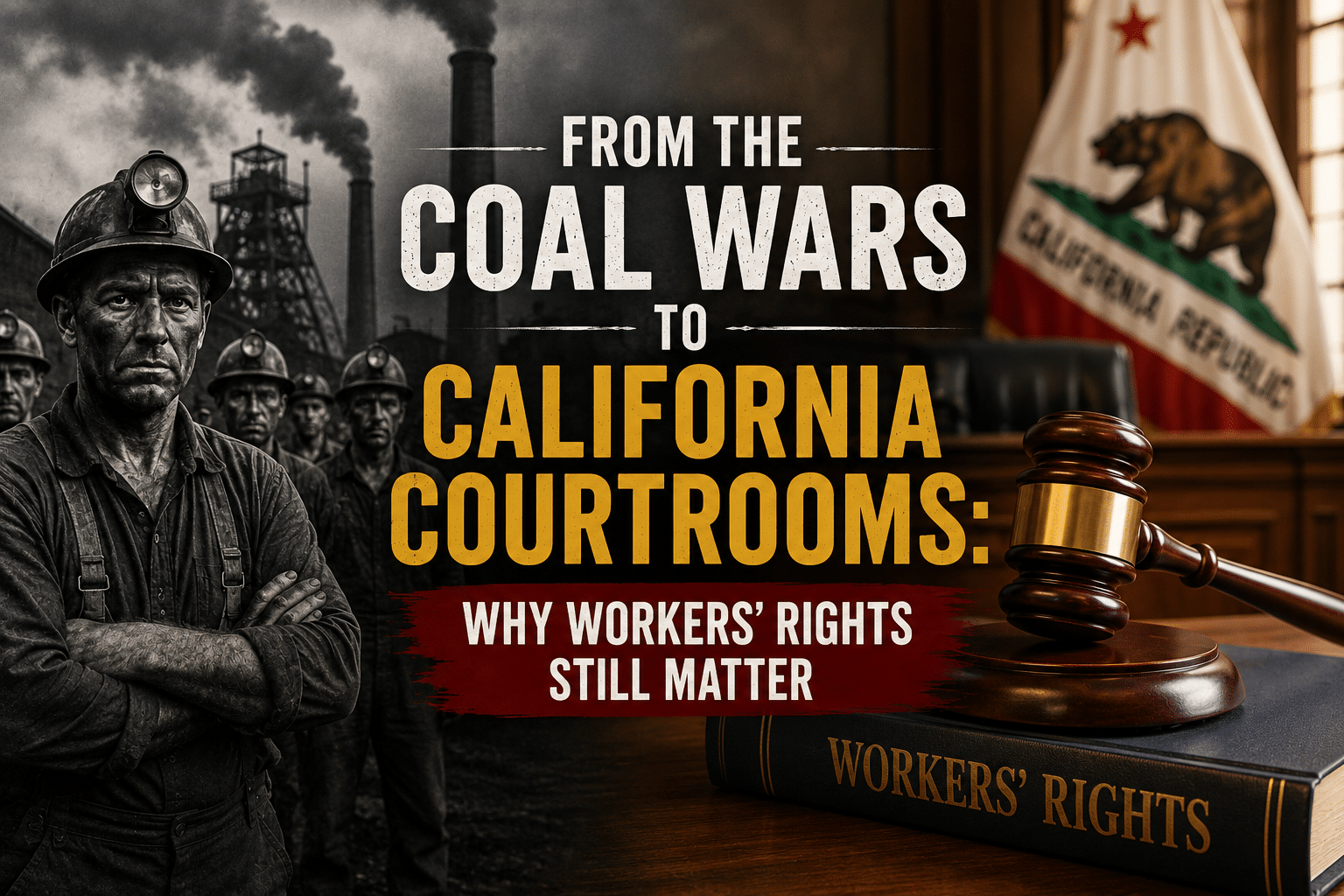
The Coal Wars of Appalachia can feel distant from modern California employment law. They should not. The methods have changed, but the central truth remains: work is inseparable from dignity, security, family, and a person’s ability to build a life.
In the early twentieth century, coal miners in Appalachia faced dangerous working conditions, company control over housing and commerce, anti-union repression, and severe retaliation for organizing. Those conflicts culminated in events such as the 1921 Battle of Blair Mountain, when thousands of miners mobilized in an effort tied to union recognition and the treatment of workers in southern West Virginia. Federal intervention ultimately ended the confrontation.
Today, employees should never have to risk violence—or their lives—to insist on being paid lawfully, treated fairly, or heard when something is wrong at work. But asserting workplace rights can still carry real risks. A worker may fear termination, reduced hours, exclusion, a poor reference, lost advancement, or other forms of retaliation. For many people, even a single missed paycheck or sudden job loss can put rent, food, health care, and a family’s stability at risk.

Employment disputes are often described in legal terms: wage-and-hour violations, retaliation, discrimination, whistleblower claims, misclassification, meal and rest period violations, or wrongful termination.
Those labels matter. They identify legal duties and remedies. But behind every claim is a person confronting a practical crisis:
For an employer, a payroll practice or personnel decision may be routine. For the employee affected by it, the consequences can be immediate and profound.
The Appalachian coal conflicts were shaped by a very different legal and economic world. The miners’ struggle involved extraordinary danger and open violence that has no place in a functioning society. Still, the history carries an enduring lesson: meaningful workplace rights do not protect anyone unless workers can exercise them without fear.
That principle remains central today.
California law recognizes that employees need protection not only for their wages, but also for speaking up. For example, Labor Code section 98.6 prohibits retaliation against employees who file or threaten to file wage claims or otherwise assert certain rights under the Labor Code. California’s whistleblower protections likewise prohibit retaliation against employees who disclose reasonably believed legal violations to appropriate persons or government bodies.
The point is not that every workplace disagreement becomes a lawsuit. It is that an employee should be able to ask for lawful pay, report unsafe or unlawful conduct, oppose discrimination, or refuse participation in illegal conduct without being punished for it.
Modern workplace disputes are resolved through demands, administrative claims, agency proceedings, arbitration, mediation, and litigation—not armed conflict. That is progress.
But legal processes can still feel intimidating, particularly when an employee faces a company with a human-resources department, lawyers, payroll systems, policies, documents, and financial resources. Workers often wait to seek advice because they are unsure whether what happened was unlawful, fear retaliation, or assume they cannot afford legal help.
A consultation can help clarify the situation. Depending on the facts, important questions may include:
The answer depends on the facts, the documents, the timing, and the applicable law. Early legal advice can preserve evidence, clarify deadlines, and help a worker make informed decisions before signing an agreement or taking the next step.
The people involved in the Coal Wars understood that employment was not merely an economic arrangement. It affected whether families could survive, whether workers could have a voice, and whether people could live with basic dignity.
That remains true.
No employee should have to choose between earning a living and enforcing the law. California employees have legal tools to address unpaid wages, retaliation, discrimination, misclassification, and other workplace violations. Using those tools is not disloyalty. It is an effort to ensure that the promises embodied in workplace laws apply in real life.
If you believe your employer has violated your rights, experienced employment counsel can evaluate the facts, explain potential options, and help you decide what comes next.
For further context on California's statutory protections against workplace retaliation, you can view the complete text of California Labor Code Section 98.6 on Justia Law.
Optimum Employment Lawyers serves employees throughout Orange County and surrounding communities, including Irvine, Newport Beach, Costa Mesa, Santa Ana, Tustin, Lake Forest, Mission Viejo, Anaheim, Huntington Beach, Orange, Laguna Niguel, Laguna Hills, Aliso Viejo, Rancho Santa Margarita, Yorba Linda, Fullerton, Garden Grove, Westminster, Fountain Valley, Brea, Dana Point, Laguna Beach, San Clemente, Seal Beach, and Cypress, serving employees and professionals throughout Orange County and surrounding Southern California communities.

© 2026 Optimum Employment Lawyers, PC
Legal Disclaimer | Privacy Policy
 Share
Share
