
(949) 954-8181 Free Case Review No recovery, no fee.
(949) 954-8181 Free Case Review No recovery, no fee.
Yes, California law protects you if your employer punishes you for taking medical or family leave. Both the California Family Rights Act and the Fair Employment and Housing Act make this kind of retaliation illegal, and federal FMLA rules often apply too. If you suspect Aliso Viejo medical leave retaliation employee rights violations at your job, your first move is simple: preserve every record you have and contact a California employment lawyer before you say anything else to HR.
TL;DR:
- Employees often have separate claims under CFRA, FEHA, and FMLA, which can be pursued simultaneously if they meet the criteria for employer size and tenure.
- Retaliation typically manifests as termination, demotion, or unfavorable performance reviews within weeks of leave, often disguised as routine management decisions.
- Accurate documentation of leave requests, medical certifications, and employer responses is crucial for establishing a strong retaliation claim, especially when timing is suspicious.
- Filing deadlines for retaliation claims are generally three years from the adverse action for FEHA and CFRA, making prompt reporting essential to preserve evidence.
- Consulting a qualified employment lawyer early increases the chances of identifying applicable claims, gathering evidence, and navigating dispute resolution options effectively.
Three overlapping legal systems cover Aliso Viejo employees who take medical or family leave, and knowing which one applies to your situation shapes everything about how you file a claim.
CFRA and FEHA are California’s own protections, and they cast a wider net than most people realize. FEHA’s anti-retaliation rules generally apply to employers with five or more employees, while CFRA leave rights kick in once a company has 50 or more employees. Both guarantee job restoration to the same or a comparable position, continued health benefits during leave, and a flat ban on punishing you for using either.
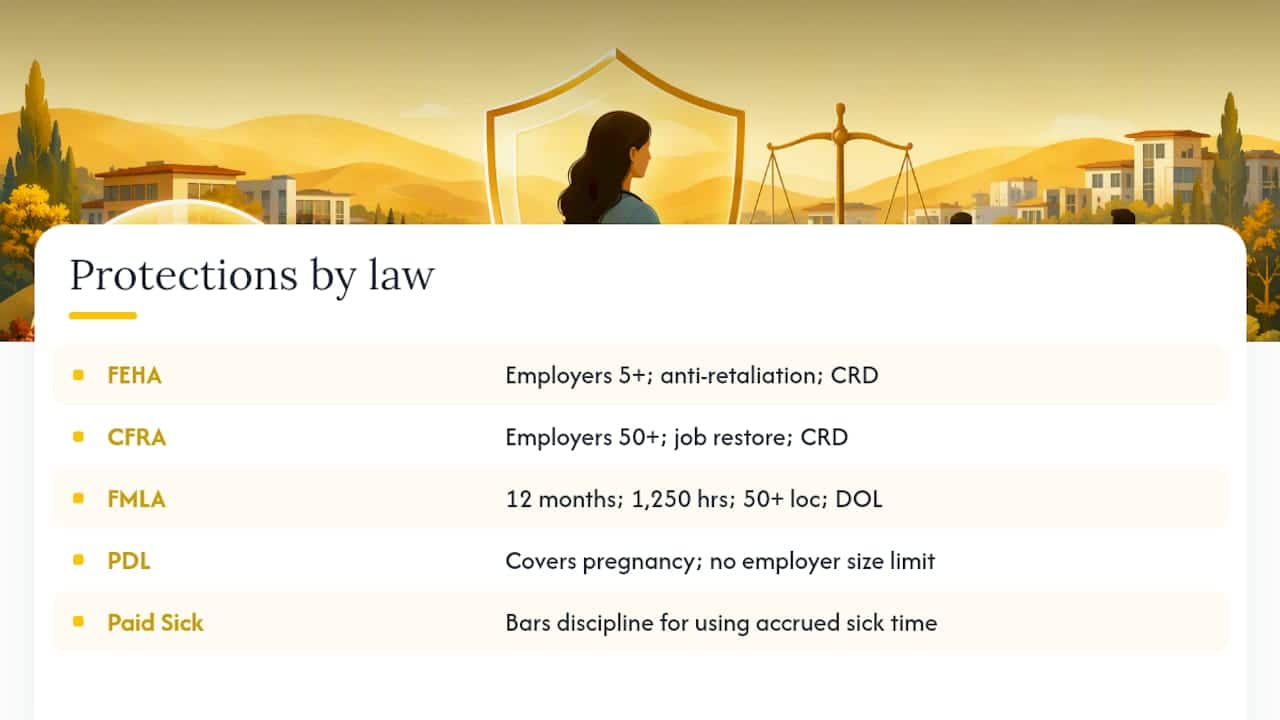
FMLA, the federal counterpart, covers employees who have worked for their employer at least 12 months, logged 1,250 hours in the past year, and work at a location with 50 or more employees within 75 miles. Where CFRA and FMLA overlap, you may actually have two separate legal claims running side by side.
Beyond those two, California’s Pregnancy Disability Leave (PDL) protects pregnant employees regardless of company size in many cases, and the state’s paid sick leave law bars employers from disciplining anyone for using accrued sick time.
Pro Tip: Effective January 1, 2026, SB 590 expanded California’s paid family leave to cover care for a “designated person,” not just a spouse, parent, or child. That means more employees than ever qualify for protected leave categories than before this year.
If your employer retaliates, two agencies handle complaints: California’s Civil Rights Department (CRD) for FEHA and CFRA violations, and the U.S. Department of Labor for FMLA issues.
Before you file anything, run through three quick questions:
Once you’ve answered those, understand the legal distinction that matters most: interference versus retaliation. Interference means your employer denied or restricted your leave rights outright, and you don’t need to prove intent to win that claim. Retaliation is different. It requires showing a causal connection between your protected leave and a punishment that followed, whether that’s a firing, a demotion, or a sudden pay cut. Many Aliso Viejo employees actually have both claims available, and a medical and family leave lawyer can help sort out which one fits your facts.
Retaliation rarely announces itself. It shows up disguised as ordinary management decisions, which is exactly why documentation matters so much.
Timing is often the strongest signal you have. If an adverse action lands immediately after you request or return from leave, that timing alone builds powerful circumstantial evidence. Add a manager’s offhand comment about your leave being “inconvenient,” and you’ve got a pattern worth documenting closely.
Evidence built in real time beats evidence reconstructed from memory. Start collecting the moment you sense something is off.
Once you have that foundation, decide where to report:
CRD filing deadlines are generally three years from the retaliatory act for FEHA and CFRA claims, but don’t wait. Evidence fades, and witnesses forget details fast.
A successful retaliation claim can put real money and real job security back on the table. Typical remedies include:
Timelines vary widely. A CRD investigation can take several months before a right-to-sue letter issues, and a subsequent lawsuit can run a year or longer depending on court schedules and whether the case settles. FMLA claims through the Department of Labor follow a similar rhythm.
Employers commonly defend these cases by pointing to documented performance issues that predate the leave request, or a restructuring plan announced before anyone knew about the leave. That’s exactly why your own timeline and saved communications matter so much. To win a retaliation claim, you generally need to show you engaged in protected activity, suffered a materially adverse action, and that the leave was a substantial motivating factor behind it. Notably, your employer must have actually known about your protected leave for retaliation to apply. A private medical condition your employer never learned about can’t support a retaliation claim on its own, since there’s no communicated protected activity to retaliate against.
This law firm specializes in representing employees in California workplace disputes, including medical and family leave retaliation cases. Their approach centers on strategies that prioritize the employee’s interests.
A lawyer experienced in these cases typically helps by:
Bring your leave paperwork, medical notes, and any written communications to your first consultation. Representation may be provided on a contingency fee basis, meaning clients typically pay nothing upfront and fees are collected only if compensation is recovered.
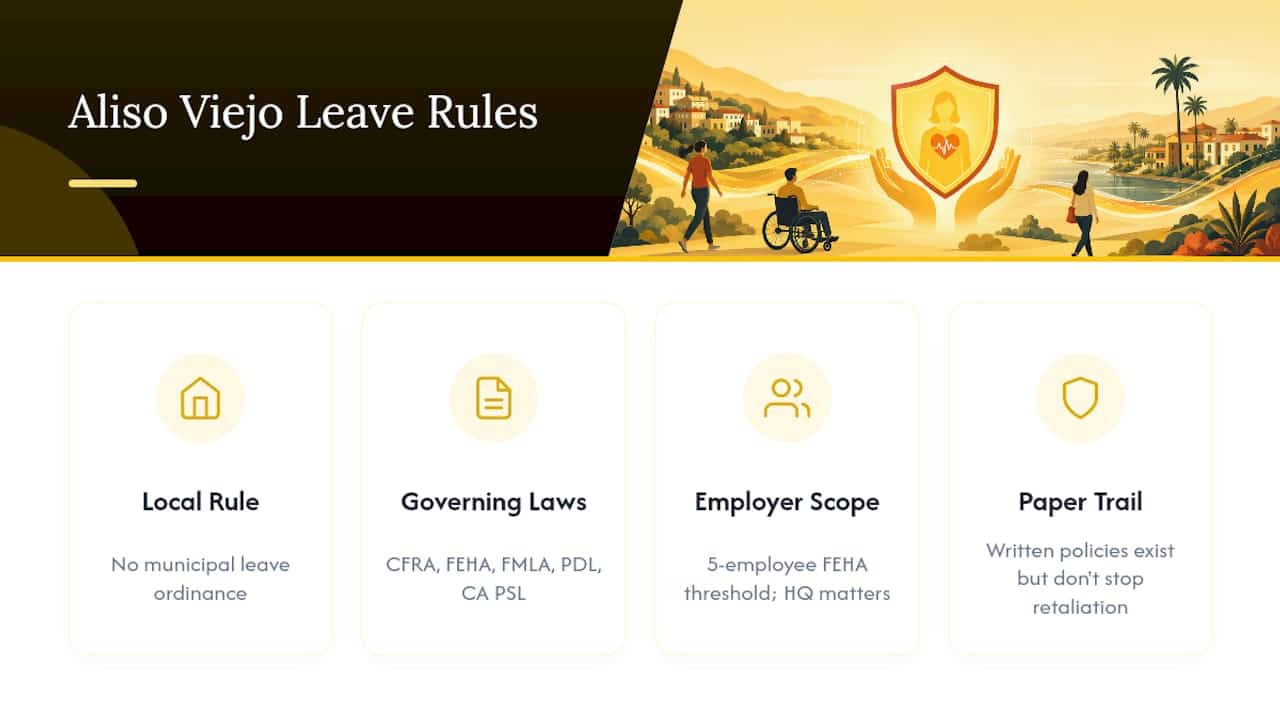
Aliso Viejo doesn’t maintain a separate municipal leave ordinance layered on top of state law, unlike some California cities with their own local sick leave mandates. That means your protections here come directly from CFRA, FEHA, FMLA, PDL, and California’s paid sick leave statute, applied the same way they would be anywhere else in Orange County.
That’s actually good news for clarity. You don’t need to cross-reference a city code on top of state and federal rules. What matters more locally is where your employer is headquartered and how many employees it has across all its California locations, since that determines whether CFRA or FEHA’s smaller five-employee threshold applies to your case.
Aliso Viejo’s employer base leans heavily toward corporate offices, tech companies, and healthcare-adjacent businesses clustered around the Aliso Viejo Town Center and the surrounding business parks. Many of these employers have HR departments with formal leave policies on paper, which sounds protective until you realize a written policy doesn’t stop retaliation from happening in practice. It just means there’s more paper trail to compare against your own documentation when something goes wrong.
If your employer operates in multiple Orange County cities, your rights don’t change from one city to the next, but the specific facts of your workplace, like who approved your leave and who made the retaliatory decision, still matter enormously to building your case.
The way you request leave can shape how strong your eventual claim looks if things go wrong later. Put your request in writing, even if your company allows verbal requests, and route it through HR rather than only your direct supervisor.
Include the reason for leave in general terms (a serious health condition, care for a family member) without oversharing private medical details you’re not required to disclose. Attach or reference your medical certification if your employer requires one, and note the anticipated start and return dates as clearly as you can, understanding those dates may shift.
Follow up with a short confirmation email if HR only responds verbally. Something as simple as “Confirming our conversation today, my leave begins March 3 and I’ll provide medical certification by March 10” creates a timestamped record without any confrontation.
Once you’re on leave, resist the urge to go silent completely. Occasional, brief check-ins signal good faith, but never let your employer pressure you into working during protected leave or into cutting your leave short. If you notice hostile comments, changed responsibilities, or exclusion from communications while you’re out, save them immediately rather than trusting your memory later. The employees who build the strongest retaliation claims are almost always the ones who documented consistently from day one, not the ones who scrambled to reconstruct events after getting fired.
California courts and the CRD have handled numerous cases illustrating exactly the patterns described above. A common fact pattern involves an employee who takes CFRA leave for a health condition, returns to find their position eliminated or filled, and is told the change was “unrelated” to their leave, despite the timing suggesting otherwise.
Regulatory guidance under Cal. Code Regs. Tit. 2, § 11094 specifically describes employer conduct that counts as either interference or retaliation, including refusing to reinstate an employee to an equivalent position, using leave as a negative factor in performance evaluations, and counting CFRA leave against attendance-based discipline systems. These aren’t hypothetical examples. They’re patterns regulators have seen often enough to write directly into the regulatory text.
Orange County has produced its share of these disputes too. Employees near Mission Viejo have pursued medical leave retaliation claims built on nearly identical evidence patterns: a leave request, a short gap, then an adverse action with a thin justification. The mechanics of proving these cases rarely change much from one Orange County city to the next. What changes is how quickly the employee started documenting and how completely they preserved that evidence.
Filing a formal complaint isn’t always your first move, and in some cases going straight to HR can resolve things faster than an agency filing would.
Start with a direct, written request to HR asking for clarification on the adverse action you experienced. Frame it factually: “I’d like to understand the specific reason for my schedule reduction, given that it occurred two weeks after I returned from CFRA leave.” This does two things at once. It gives your employer a chance to correct course, and it creates a written record of you raising the issue.
Many companies have an internal appeals or grievance process for exactly this kind of dispute. Use it, but keep your own copy of everything you submit, since some internal processes conveniently lose paperwork when it becomes inconvenient.
If HR’s response feels dismissive, contradicts the facts, or simply never comes, that’s usually your signal to escalate. Informal resolution works best when there’s a genuine misunderstanding or a lower-level manager acted without HR’s knowledge. It works far less often when the retaliation came from someone with the authority to override HR policy in the first place. Give it one clear attempt, document the response, and don’t let the process drag on for months while your filing deadline quietly gets closer.
Aliso Viejo employees have several avenues for support beyond a private attorney. The California Civil Rights Department accepts complaints online and by phone, and its intake staff can walk you through whether your situation fits FEHA or CFRA. The U.S. Department of Labor’s Wage and Hour Division handles the federal FMLA side, with a regional office serving Orange County.
For employees who want to understand their options before committing to a formal complaint, an Aliso Viejo employee rights law firm can review your documentation and explain realistic outcomes in plain language, often at no cost for the initial consultation. Local bar association referral services also connect employees with employment attorneys, though not all of those attorneys focus exclusively on employee-side representation the way a dedicated employment firm does.
Community resources matter too. Some employees find it useful to consult with a local worker’s rights nonprofit or legal aid organization before deciding whether to pursue a claim independently or hire counsel, particularly if cost is a concern. Since most employee-side retaliation representation runs on contingency, cost usually isn’t the barrier people assume it is.
If you’re dealing with Aliso Viejo medical leave retaliation employee rights concerns right now, waiting rarely helps your case. This firm represents California employees, focusing on strategies to support employee recovery through evidence-driven approaches, including pursuing fair settlements in employment cases.
Representation may often be arranged on a contingency fee basis, where no upfront payment is required and fees are contingent on case results. Bring your leave requests, medical certifications, HR communications, and any termination or disciplinary notices to your consultation so the team can evaluate your situation quickly. Given filing deadlines that can run as short as a few months for some claims, contact Optimum Employment Lawyers today through their free case review to find out exactly where you stand.
This article is general information, not a substitute for advice from a qualified lawyer. Consult a qualified legal professional about your own circumstances before acting on anything here.

© 2026 Optimum Employment Lawyers, PC
Legal Disclaimer | Privacy Policy
 Share
Share
