
(949) 954-8181 Free Case Review No recovery, no fee.
(949) 954-8181 Free Case Review No recovery, no fee.
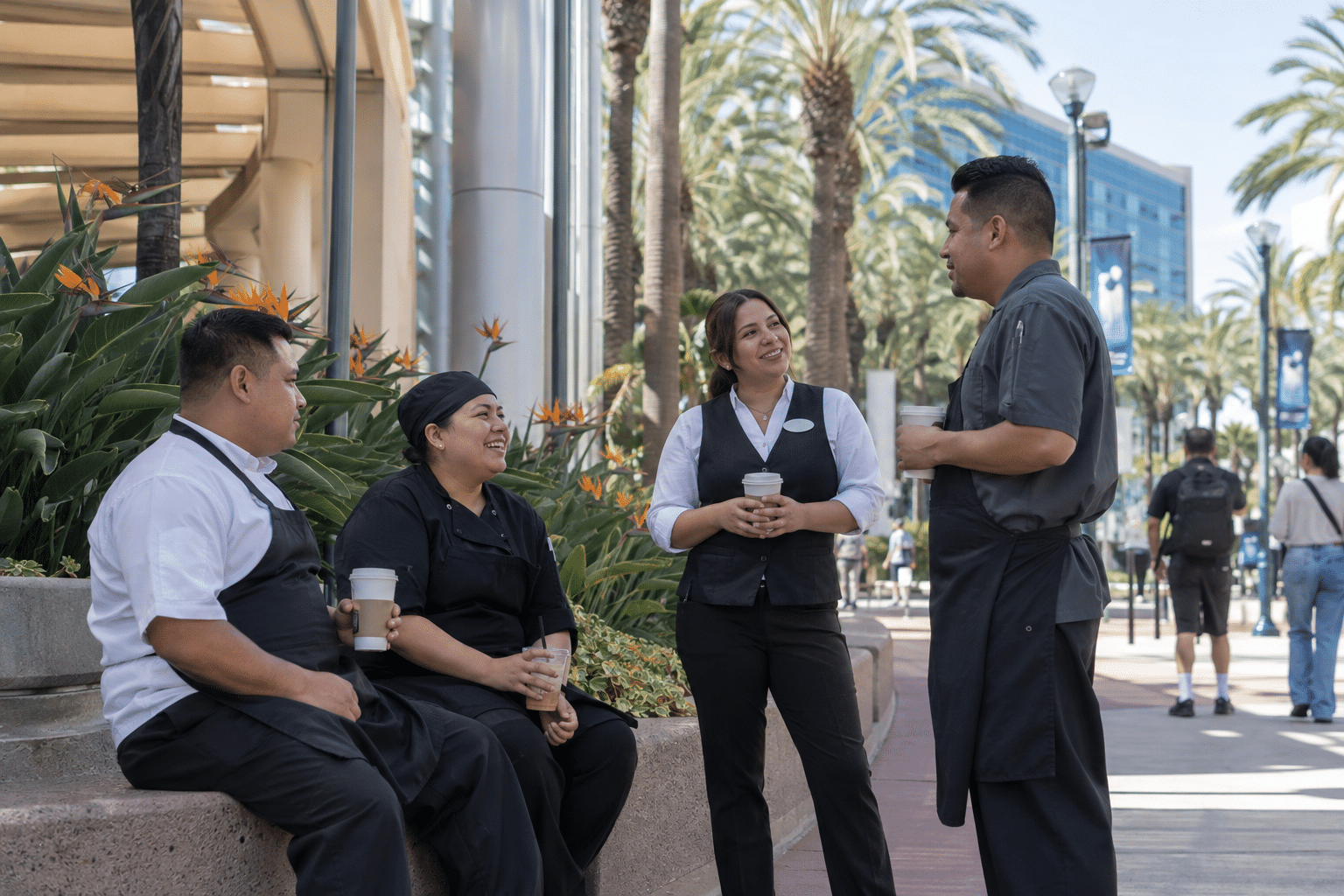
Working in Anaheim’s hotels, restaurants, warehouses, and shops often means fast-paced shifts and demanding schedules. California law still gives you clear rights to meal and rest breaks—and, if those rights are violated, to an extra hour of pay for each workday a compliant break is not provided.
Anaheim is a major employment hub in Orange County, especially in tourism and hospitality around Disneyland Resort, the Anaheim Convention Center, Angel Stadium, and Honda Center. Workers in food service, retail, hotels, and logistics often face customer-driven schedules and stacked events that make real breaks difficult.
California’s meal and rest break rules are designed for exactly these high-pressure environments. The law doesn’t disappear during rushes or short staffing. If your employer in the Anaheim Resort district, Platinum Triangle, or Downtown Anaheim regularly delays, interrupts, or denies your breaks, you may be entitled to premium pay for each affected workday.
Under California Labor Code section 512 and related guidance, most non-exempt (hourly and many salaried) employees must receive unpaid, off-duty meal periods on longer shifts:
Limited written waivers are allowed:
If your shift is no more than 6 hours, you and your employer can mutually agree in writing to waive the first meal period. If you work between 10 and 12 hours, you can waive the second meal period only if you took a timely, compliant first meal and the waiver is mutual and in writing.
Waivers are not automatic. Without a valid written waiver, you are still entitled to properly timed meal periods or premium pay.
DLSE guidance explains that a meal period is “off duty” only if your employer:
Relieves you of all duty; relinquishes control over your activities; gives you a reasonable opportunity for an uninterrupted 30 minutes; and does not impede or discourage the break.
If you must stay on premises, keep your radio or phone on, or respond to customers or supervisors during your “break,” it may not be a valid off-duty meal period. Then it may be treated as an “on-duty” meal, which is only lawful under narrow written-agreement conditions; if those conditions are not met, a premium is typically owed for that day.
This often affects Anaheim workers at hotel front desks, security posts, logistics operations, or ride-adjacent retail who are told to “eat at the desk” or “have lunch, but keep your radio on.” Those instructions can undermine your right to a genuine break.
Separate from meal periods, California’s wage orders and DLSE guidance require paid rest breaks. Employers must authorize and permit these duty-free breaks for most non-exempt workers:
Generally, you should receive:
One 10-minute paid rest break for shifts over 3.5 hours up to 6 hours; two for shifts over 6 up to 10 hours; and three for shifts over 10 up to 14 hours.
Rest breaks must be off duty, counted as hours worked, and scheduled, where practical, near the middle of each work period. DLSE guidance prohibits combining rest breaks into one long break or treating bathroom trips alone as your entire rest period. Employers also may not keep you “on call” during rest breaks or require you to stay ready to work.
In Anaheim, retail staff near the Platinum Triangle or Downtown Anaheim may be told there is no time for rests during busy hours, and restaurant workers near the Resort district may be expected to stay on the floor or clean during every lull. Those practices can violate California’s rest break rules.
California Labor Code section 226.7(c) requires employers to pay additional “premium” pay when they fail to provide compliant breaks.
Key points:
If a compliant meal period is not provided, the employer owes one extra hour of pay at your regular rate of compensation for that workday. If a compliant rest period is not provided, another extra hour is owed for that workday. You can receive both in the same day—one for meal violations and one for rest violations. Only one premium per type (meal or rest) is owed per day, even if several breaks are missed or shortened that day.
DLSE and courts emphasize that once a required break is missed, late, or not truly off duty, the premium for that day is generally owed. These premiums are treated as wages, not penalties, which affects how long you may be able to look back and whether derivative wage claims (such as waiting-time or wage-statement claims) may be available. See, for example, Labor Code section 226.7 at law.justia.com.
Wage-and-hour advocacy and DLSE materials describe recurring problem patterns across California, many of which appear in Anaheim’s hospitality, warehouse, and retail sectors:
Pressure to work through lunch. Warehouse and logistics workers supplying hotels and attractions may be told to skip lunch to meet quotas.
Auto-deducted meal periods. Timekeeping systems may automatically deduct 30 minutes whether or not you received a full, uninterrupted meal period.
Late or missing meals. Restaurants and hotels near Disneyland Resort may routinely push meals past the end of the 5th hour during rushes or fail to offer second meals after 10 hours.
Denied or shortened rest breaks. Retail workers near Angel Stadium or in busy shopping corridors may be told there is “no one to cover,” so they must skip or cut short rest breaks.
On-call rest breaks. Workers may be allowed to step away but must keep a headset on or answer calls, undermining the duty-free requirement.
Bathroom time as the only break. Supervisors may treat quick restroom trips as the complete rest break, contrary to DLSE guidance.
Anaheim’s tourism-driven demand and event-heavy calendar around Disneyland Resort, Angel Stadium, and Honda Center can increase the frequency and impact of these violations if staffing and policies are inadequate.
The premium is one hour of pay at your “regular rate of compensation” for each workday a required meal or rest period is not provided. The regular rate may, in some situations, include certain nondiscretionary pay, not just your base hourly rate.
Premiums are owed per workday per type of violation, not per individual missed break. If both a meal and rest period are not properly provided on the same day, you may be owed two hours of premium pay (one for each category).
Because premiums are wages, failing to pay them can affect your final paycheck when you leave and the accuracy of your wage statements. In some cases, those issues can support additional California wage claims beyond the unpaid premiums themselves.
The table below compares common compliant and non-compliant practices to help Anaheim workers quickly spot red flags in hotels, restaurants, warehouses, and retail stores.
| Issue | Compliant Practice | Potential Violation |
|---|---|---|
| First meal timing | 30-minute meal starts before end of 5th hour | Meal regularly starts after 5th hour or is skipped |
| Second meal timing | Second 30-minute meal offered when working over 10 hours | No second meal break offered on long shifts |
| Meal break duties | You are relieved of all duties and control | You must answer calls, radios, or help customers during meals |
| Rest break availability | 10-minute rest breaks scheduled near middle of work periods | Supervisor says there is no time for rest breaks on busy days |
| On-call expectations | You are free from work and not required to remain on call | You must stay reachable and ready to work during breaks |
| Timekeeping for meals | Time records reflect actual meal periods taken | System auto-deducts 30 minutes whether or not you eat |
| Written waivers | Limited, mutual written waivers used within legal limits | No written waivers, but meals are frequently skipped |

Because break premiums are wages, Anaheim employees usually have multiple enforcement options:
DLSE wage claim. You can file a wage claim with the California Labor Commissioner (DLSE) seeking unpaid meal and rest break premiums and related wages. DLSE materials and forms are available through the Department of Industrial Relations at dir.ca.gov.
Civil lawsuit. Some workers file lawsuits in court to recover unpaid premiums and derivative wage claims, sometimes together with coworkers subject to the same practices.
Negotiated resolution. With representation, workers sometimes resolve claims through settlement discussions or mediation instead of hearings or trial.
The right path for a server in a Harbor Boulevard restaurant may differ from that of a warehouse worker serving Resort hotels or a retail associate in a Platinum Triangle shopping center, depending on the strength of your evidence, how widespread the issues are, and your employment status.
For comparisons with nearby areas, you can review resources such as the firm’s Aliso Viejo rest break claims overview and Dana Point rest break violations guide. The core California rules are the same, but local industries and scheduling pressures resemble those in Anaheim.
Anaheim’s tourism-heavy economy and geography shape how break issues arise. High visitor volume around Disneyland Resort, the Convention Center, Angel Stadium, and Honda Center drives irregular hours and intense rush periods.
For example, theme-park–adjacent restaurants may schedule long or split shifts when parks open early and close late, increasing the need for timely meals and multiple rests. Hotels near the Resort and Convention Center may run tight housekeeping and banquet schedules during conventions and sports seasons, tempting supervisors to delay or skip breaks. Retail and food vendors around major venues may face pre- and post-event surges that require staffing plans allowing legally compliant breaks.
Because many large Anaheim employers also operate in other states, they must adapt national policies to California’s stricter standards. Federal Fair Labor Standards Act rules are generally less protective, so Anaheim employees should look primarily to California’s Labor Code, wage orders, and DLSE guidance when evaluating their rights. See, for example, DLSE’s rest-period FAQ at dir.ca.gov.
Optimum Employment Lawyers, PC, based in Orange County, works with employees throughout the region. To learn more about Anaheim-focused services, visit the firm’s Anaheim employee rights law firm page or see how similar issues arise for workers in nearby Orange and Fullerton.
Because break rules interact with other wage protections, it can be hard to evaluate your case alone. A knowledgeable employment lawyer can:
Review time records, pay stubs, schedules, and policies to identify potential violations.
Analyze whether your meal and rest breaks were truly off duty, timely, and compliant.
Estimate premium pay that may be recoverable based on your work patterns.
Explain possible additional wage-related claims, such as late final wages or wage-statement issues, depending on your facts.
Help you decide whether a DLSE wage claim, lawsuit, or negotiated approach best fits your goals.
For Anaheim workers with long, unpredictable shifts in restaurants, hotels, warehouses, and retail tied to the city’s tourism and events, having counsel familiar with both California law and local workplace realities can be important.
Disclaimer: This article provides general information about California meal and rest break rules and how they may apply to Anaheim workers. It is not legal advice and does not create an attorney-client relationship. Laws and legal interpretations can change, and how they apply to you may depend on specific facts. For advice about your particular situation, consult directly with a qualified employment attorney.
Yes. Under California law, your first 30-minute meal period must begin no later than the end of your 5th hour of work, and a second meal must generally begin no later than the end of the 10th hour when your shift is long enough. Rest breaks should be scheduled, when practical, near the middle of each work period. These timing rules apply statewide, including Anaheim workplaces in the Resort district, Platinum Triangle, and other commercial areas.
For a meal period to be considered off duty and unpaid, your employer must relieve you of all duty and give up control over your activities. If you must remain on duty or under significant employer control, the meal may be considered “on duty” and must satisfy strict written-agreement requirements or else trigger premium pay. Rest breaks must also be duty-free; on-call or interrupted breaks are generally not compliant.
The law focuses on whether the employer provided a real opportunity for a timely, off-duty break and did not interfere with or discourage it. In some situations, if you truly choose to skip a break after the employer has met its obligations, a premium may not be owed. But heavy workloads, staffing shortages, or supervisor expectations can blur the line between “choice” and pressure. If you feel you cannot realistically take breaks, discuss your situation with an employment lawyer.
Because break premiums are wages, time limits depend on the specific legal theories and forum used. Some claims may allow recovery over a longer period than others, and rules can change. To understand what time periods may apply in your case, you should speak directly with a California employment attorney about your work history and potential claims.
California law protects workers from retaliation for raising concerns about wages and working conditions, including meal and rest breaks. Nonetheless, employees often worry about hours being cut or other subtle responses. An employment lawyer can help you plan how to raise concerns, what evidence to keep, and what options you may have if your employer reacts negatively.
Yes. Rights to meal and rest breaks depend on hours worked per day, not full-time versus part-time status. For example, you may be entitled to a rest break on shifts over 3.5 hours and a meal period when you work more than 5 hours, even as a part-time employee at an Anaheim restaurant, shop, or venue. The number of required breaks depends on shift length.
The California Division of Labor Standards Enforcement (DLSE) publishes guidance and FAQs on meal and rest periods. You can review official rest-period information on the Department of Industrial Relations website at https://www.dir.ca.gov/dlse/faq_RestPeriods.htm, and additional details on meal and rest periods are available at https://www.dir.ca.gov/dlse/RestAndMealPeriods.pdf.

© 2026 Optimum Employment Lawyers, PC
Legal Disclaimer | Privacy Policy
 Share
