
(949) 954-8181 Free Case Review No recovery, no fee.
(949) 954-8181 Free Case Review No recovery, no fee.
If you’re facing sexual harassment at work in Laguna Hills, California law is on your side. Document everything, report it through your employer’s internal process, and know you can file with the California Civil Rights Department or the EEOC if that doesn’t resolve things. Talk to a California employment lawyer early so you don’t lose ground on deadlines or evidence.
TL;DR:
- Sexual harassment claims under California law include repeated comments, unwanted touching, explicit images, or a single severe incident like groping.
- Document incidents immediately with dates, times, witnesses, and save all digital evidence to strengthen your case.
- File a complaint within three years with the CRD or EEOC, and request a Right-to-Sue notice to pursue a private lawsuit.
- Employers must provide harassment prevention training and cannot make settlement agreements that limit your discussion rights without legal review.
- Retaliation after reporting is illegal and includes demotions, exclusion, or negative reviews, requiring parallel documentation and prompt reporting.
California’s Fair Employment and Housing Act (FEHA) sets a broader standard than most people expect. It’s not limited to unwanted touching or explicit propositions. The law recognizes two main categories: quid pro quo harassment, where a job benefit is tied to accepting unwanted advances, and hostile work environment, where conduct is severe or pervasive enough to make the workplace abusive. Same-sex harassment counts too, and so does harassment from a customer or vendor your employer fails to address.
Real-world examples that meet the legal threshold include:
The CRD’s harassment prevention guide makes clear that FEHA requires employers to take reasonable steps to prevent and correct this conduct, not just react after a complaint lands on someone’s desk. Courts weigh severity, frequency, and the total pattern of behavior, not isolated comments in a vacuum.
Waiting rarely helps. The sooner you write things down, the stronger your position if the situation escalates or your employer drags its feet.
Employers in California with a sufficient number of employees must provide sexual harassment prevention training to supervisors and nonsupervisory staff regularly, in accordance with state law requirements. If your employer never provided that training, note it. It can matter later.
Pro Tip: Never sign anything your employer calls a “confidentiality agreement” or informal settlement without reading it closely first. Some gag requests can limit your ability to discuss ongoing harassment, and a lawyer can flag problem language before you sign away rights you didn’t know you had.
Once internal reporting hasn’t fixed the problem, or you’d rather skip straight to an outside agency, you have two administrative paths, and the details matter.
CRD provides step-by-step filing instructions and intake forms if you want to start the process yourself before or alongside speaking with counsel.
Outcomes vary case by case, but California law recognizes several categories of relief:
A note on numbers: the size and structure of any award depends heavily on the facts of your case. Optimum Employment Lawyers secured a $2.2 million settlement in a class action involving missed meal breaks, which shows the scale employer-side violations can reach when they affect entire teams over time. Attorney fees are often recoverable in successful FEHA cases, which is part of why contingency arrangements exist. Settlements through CRD conciliation typically resolve faster than a jury trial, though jury awards can run higher when a case goes the distance.
Retaliation is illegal under the same FEHA framework that bans the harassment itself, and it’s disturbingly common after someone reports. Watch for:
If any of this happens, document it the same way you documented the original harassment: dates, specifics, and copies of anything in writing. Report the retaliation separately and immediately. This is often the point where employees decide it’s time to bring in a lawyer, since retaliation cases frequently strengthen the underlying harassment claim rather than replace it.
Some situations you can navigate through HR alone. Others need a lawyer from day one, particularly when the harassment is severe, your employer ignores your complaint, retaliation starts, or the facts are complicated enough that you’re not sure what your options even are.
A California employment lawyer handles the parts that trip most people up: reviewing your evidence, filing CRD or EEOC paperwork correctly and on time, negotiating with your employer’s counsel, and taking the case to litigation if a fair settlement isn’t on the table. Optimum Employment Lawyers represents employees exclusively, never employers, which shapes how aggressively a case gets pursued from the start.
Before your first consultation, gather:
Pro Tip: Bring your timeline typed up, not scribbled on a napkin. Lawyers can assess a case far faster, and more accurately, when the facts are already organized instead of buried in memory.
Evidence has a way of disappearing. Group chats get deleted, coworkers change jobs, and memories fade. Prioritize saving:
If a coworker is willing to describe what they witnessed, ask them to put it in writing, even a short email to you works, rather than relying on a verbal promise to “back you up later” if it comes to that. For general workplace prevention strategies employers should already have in place, this overview of harassment prevention covers the training and policy side from a workplace safety perspective.
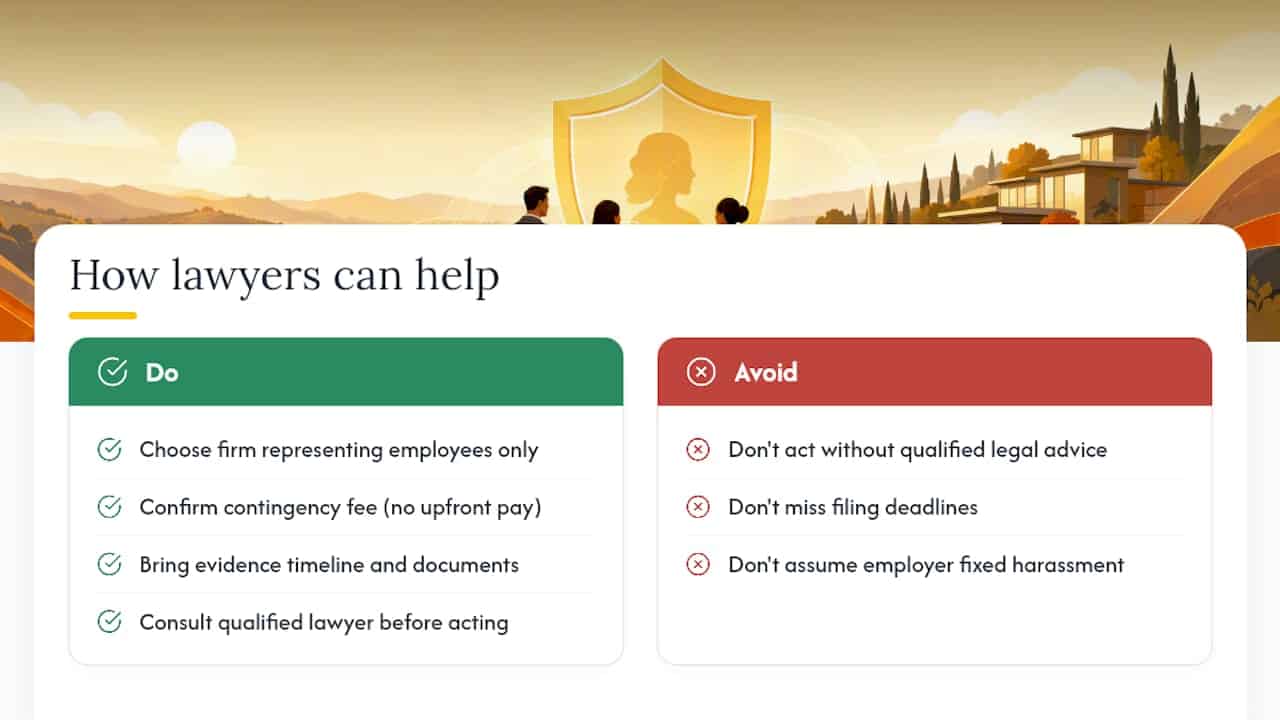
Some employment law firms represent employees only and handle sexual harassment, retaliation, wrongful termination, and wage disputes on a contingency basis, so clients pay nothing upfront and only if the case results in a settlement or court award.
If you’re dealing with harassment in Laguna Hills and your employer hasn’t fixed it, or you’re being retaliated against for speaking up, these are the kinds of cases employment lawyers often handle. Bring your evidence timeline and documents to a consultation, and find out where you actually stand before deadlines start working against you.
This article is general information, not a substitute for advice from a qualified lawyer. Consult a qualified legal professional about your own circumstances before acting on anything here.

© 2026 Optimum Employment Lawyers, PC
Legal Disclaimer | Privacy Policy
 Share
Share
