
(949) 954-8181 Free Case Review No recovery, no fee.
(949) 954-8181 Free Case Review No recovery, no fee.
Yes — a same-sex hostile work environment is unlawful in Westminster under California’s Fair Employment and Housing Act (FEHA), and it can also be actionable under Title VII of the Civil Rights Act at the federal level. If you work in Westminster and you’re being harassed by someone of the same sex, you have real legal options. The California Civil Rights Department (CRD) handles state-level complaints, the U.S. Equal Employment Opportunity Commission (EEOC) handles federal ones, and Optimum Employment Lawyers represents Westminster employees on a contingency fee basis, meaning no money out of your pocket to get started.
Your immediate priorities:
Under FEHA, same-sex harassment is explicitly prohibited — and critically, the harassment does not need to be motivated by sexual desire to be actionable. That distinction matters because many employees assume same-sex conduct only counts if the harasser is gay or attracted to them. California law says otherwise.

The U.S. Supreme Court settled the federal question in Oncale v. Sundowner Offshore Services, 523 U.S. 75 (1998), holding that same-sex sexual harassment is cognizable under Title VII. Federal appellate courts have since clarified the reach of that ruling. In Roberts v. Glenn Industrial Group, Inc., 998 F.3d 111 (4th Cir. 2021), the court confirmed that same-sex harassment grounded in gender stereotyping — not just overt sexual conduct — is actionable.
California’s standard under Government Code §12923 is notably employee-friendly. A single severe incident can be enough to establish a hostile work environment if it unreasonably interferes with work or creates an intimidating or offensive environment. That’s a meaningful departure from older federal standards that required a pattern of conduct.
Courts and agencies look at these factors when evaluating a claim:
Westminster employees benefit from overlapping state and federal protections, but FEHA is generally the stronger shield.
FEHA (California):
Title VII (Federal):
CRD vs. EEOC — which do you file with?
Key protections at a glance:
Employees sometimes hesitate to pursue a claim because they’re not sure their experience “counts.” Here are common examples of same-sex hostile conduct that can support a legal claim in Westminster:
That last category is worth emphasizing. A same-sex hostile work environment does not require overtly sexual conduct. A male supervisor who relentlessly mocks a male employee for being “too feminine” is engaging in gender-stereotyping harassment that is actionable under both FEHA and Title VII, even if nothing sexual is ever said.
Pro Tip: A single incident can be enough in California. If a coworker or supervisor did something severe — a physical assault, an explicit threat, or a graphic sexual act — document it in detail immediately. Under Government Code §12923, one serious incident may establish your claim without needing a pattern.
The legal test has two parts, and both must be satisfied. First, the conduct must be objectively hostile — a reasonable person in your circumstances would find it created an abusive work environment. Second, you must have subjectively experienced it as hostile. Courts look at the totality of the circumstances, not individual incidents in isolation.
Here’s how an investigator or judge works through a same-sex harassment fact pattern:
California’s standard focuses on whether a reasonable person in the victim’s circumstances would find the conduct altered employment conditions — not whether productivity measurably declined. That framing matters. You don’t have to prove you stopped performing well; you have to show the environment itself was hostile.
Applied example: A male warehouse worker in Westminster is repeatedly called slurs by a male coworker, who also leaves explicit images at his workstation. The worker reports it to a supervisor, who tells him to “toughen up.” Under FEHA, that single report to management triggers the employer’s duty to investigate and correct. The supervisor’s dismissal of the complaint — combined with the severity of the conduct — would likely satisfy both the objective and subjective prongs of the hostile environment test.

Evidence quality often determines whether a claim succeeds. Start building your record the same day you decide to pursue this.
Evidence checklist:
Keep a contemporaneous incident log in a personal email account or a document stored outside company systems. If you use a work laptop or company email to store evidence, your employer may be able to access or delete it.
Pro Tip: Export email threads and download message attachments before you report internally. Once an employer knows a complaint is coming, some will restrict system access. Preserve metadata where possible — timestamps and sender information strengthen your record.
On retaliation: California law prohibits employers from retaliating against employees who report harassment or file a complaint. If your hours get cut, you get demoted, or your supervisor suddenly starts writing you up after you report, document that too. Retaliation is a separate claim and can significantly increase your recovery.
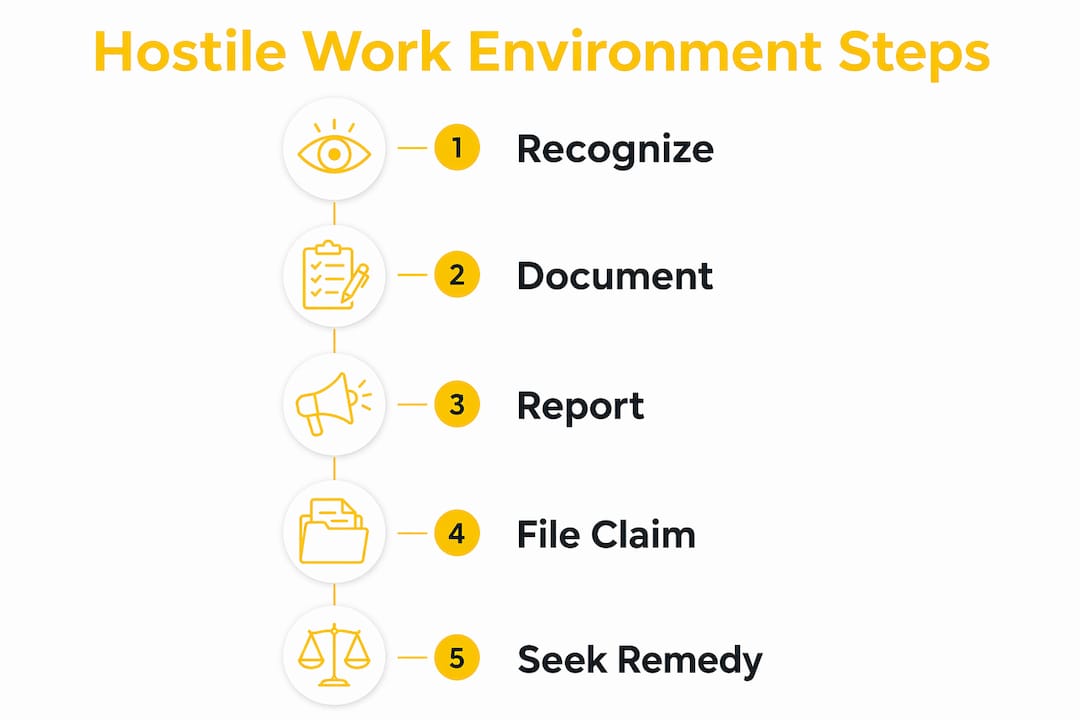
Missing a filing deadline ends your case before it starts. Here are the key steps and timelines for Westminster employees.
| Step | Agency | Deadline / Notes |
|---|---|---|
| Internal complaint | Employer HR / supervisor | As soon as possible; triggers employer’s duty to investigate |
| CRD intake (state) | California Civil Rights Department | File before the statute of limitations expires (generally 3 years for FEHA harassment claims) |
| EEOC intake (federal) | U.S. Equal Employment Opportunity Commission | — |
| Right-to-Sue notice | CRD or EEOC | Request when ready to litigate; one year to file a lawsuit after receiving the CRD notice |
| File lawsuit | Superior Court or federal district court | Within one year of CRD Right-to-Sue; within 90 days of EEOC Right-to-Sue |
Filing steps in plain terms:
One strategic note: allowing the CRD to investigate can produce evidence and findings that strengthen a later lawsuit. Jumping straight to a Right-to-Sue is sometimes the right call, but not always.
A successful same-sex hostile work environment claim in California can produce a range of remedies. The specific outcome depends on the facts, the employer’s size, and how the case is resolved.
Damage amounts vary widely. A case involving a single incident with minimal employer response will look different from one involving years of documented harassment, supervisor involvement, and a retaliatory termination. Getting counsel early preserves your options and helps you build the record that maximizes recovery.
California employers in Westminster have affirmative duties under FEHA, not just a prohibition on harassment.
Employer obligations include:
The most common employer defense is prompt, effective corrective action. If an employer can show it investigated quickly, disciplined the harasser, and took steps to prevent recurrence, it may limit its liability. The key word is effective — a written warning that changes nothing doesn’t satisfy the standard.
Your documentation of the employer’s response (or failure to respond) directly undermines this defense. If you reported harassment and management ignored it, minimized it, or retaliated against you, that record is powerful evidence. Per CRD guidance, employers must take reasonable steps to prevent and correct harassment before it rises to unlawful levels — evidence of insufficient corrective steps strengthens your claim.
Optimum Employment Lawyers represents employees in Westminster and throughout Orange County on a contingency fee basis — no upfront cost, and the firm is paid only from a recovery. The firm works exclusively on the employee side, which means every strategy is built around your interests, not the employer’s.
The firm’s approach to a same-sex hostile work environment case typically follows this path:
The firm has secured significant results for California employees, including a $2.2 million settlement in a class action involving missed meal breaks. Same-sex harassment cases are handled with the same level of preparation and commitment to the individual client’s outcome.
Westminster employees can reach Optimum Employment Lawyers directly through the firm’s Westminster practice page for an initial consultation.
Same-sex hostile work environment claims are fully actionable in Westminster under FEHA and Title VII, and California law’s single-incident standard gives employees stronger protections than many realize.
| Point | Details |
|---|---|
| FEHA covers same-sex harassment | California law explicitly prohibits same-sex harassment regardless of sexual desire or orientation. |
| Single incident can be enough | Under Government Code §12923, one severe incident may establish a hostile work environment claim. |
| Filing deadlines are strict | CRD complaints must be filed within the FEHA limitations period; lawsuits must follow within one year of a CRD Right-to-Sue notice. |
| Document everything immediately | Dates, exact words, witnesses, and screenshots are the foundation of a strong claim. |
| Optimum Employment Lawyers | Westminster employees can consult the firm on a contingency fee basis — no upfront cost, fee from recovery only. |
If you’re dealing with a hostile work environment in Westminster, you don’t need to figure out the legal system alone. Optimum Employment Lawyers focuses exclusively on employee-side cases in California, which means the firm’s entire practice is built around getting results for workers, not defending employers.
The firm works on contingency: you pay nothing unless there’s a recovery. That structure matters when you’re already dealing with the stress of a hostile workplace. An initial consultation costs you nothing and gives you a clear picture of your options, your deadlines, and what your case may be worth.
Optimum Employment Lawyers has secured meaningful results for California employees, including a substantial class action settlement. The firm brings that same preparation to same-sex harassment claims in Westminster and across Orange County.
Contact Optimum Employment Lawyers through the firm’s consultation page to schedule your initial case review.
This article provides general legal information, not legal advice. Filing deadlines and legal standards can vary based on your specific circumstances. Consult a qualified California employment attorney or contact the CRD or EEOC directly to confirm the rules that apply to your situation.

© 2026 Optimum Employment Lawyers, PC
Legal Disclaimer | Privacy Policy
 Share
Share
