
(949) 954-8181 Free Case Review No recovery, no fee.
(949) 954-8181 Free Case Review No recovery, no fee.
Unlawful workplace harassment in Orange, CA crosses a legal threshold the moment conduct tied to a protected characteristic creates a hostile, intimidating, or offensive work environment under California’s Fair Employment and Housing Act (FEHA). You do not need to prove your productivity dropped. You do not need to endure months of abuse. Under California Government Code § 12923, even a single severe incident can qualify if a reasonable person would find it altered the conditions of employment. That standard is more protective than federal law, and it matters enormously for employees in Orange County.
Here is what FEHA protects against harassment based on:
One critical distinction: not every offensive comment or unfair treatment rises to unlawful harassment. A rude manager, a thoughtless joke, or a personality conflict generally stays in company policy territory. The law targets conduct that is both tied to a protected category and severe or pervasive enough to alter your working conditions. Employers covered by FEHA are legally required under Government Code § 12940(k) to take reasonable steps to prevent and correct harassment, not just respond after the fact.

California law recognizes two primary forms of unlawful workplace harassment, and understanding the difference between them shapes how your case gets built.
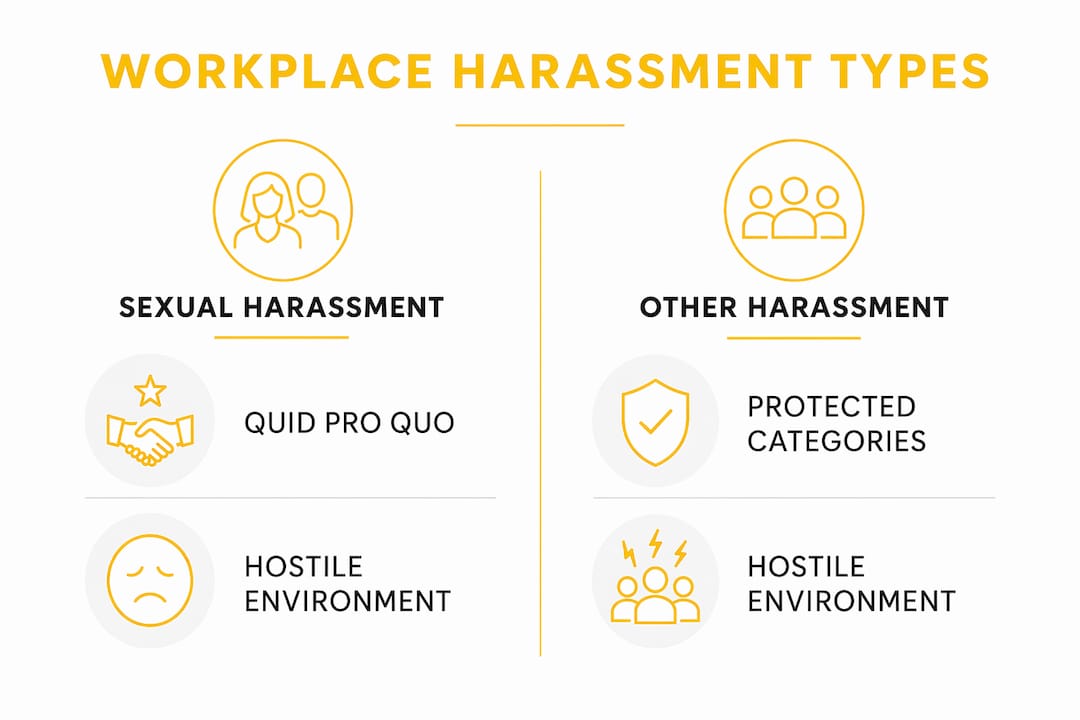
Sexual harassment covers two distinct patterns. The first is quid pro quo: a supervisor conditions a job benefit, promotion, or continued employment on sexual favors. The second is a hostile work environment created by sexual conduct. Examples include unwanted touching, sexually explicit comments during meetings, repeated requests for dates after a clear refusal, or displaying graphic images in shared workspaces. A single incident of physical assault or an explicit threat can meet the legal standard on its own.
Harassment does not have to be sexual to be unlawful. Racial slurs, mocking an employee’s national origin, ridiculing someone’s disability, or making repeated derogatory comments about a person’s religion all create a hostile work environment when the conduct is severe or pervasive. Under California Government Code § 12923, courts look at the totality of circumstances, including the frequency of the conduct, its severity, whether it was physically threatening, and how it affected the employee’s ability to work.
Pro Tip: Document every incident with dates, times, locations, witnesses, and the exact words used. Courts and the California Civil Rights Department (CRD) rely heavily on contemporaneous records, and a detailed log built close to the events is far more persuasive than recollections assembled months later.
For a deeper look at illegal harassment conduct under California law, Optimum Employment Lawyers has published a detailed breakdown of what crosses the legal line.
Liability under FEHA extends further than most employees realize, and knowing who can be held accountable changes your options significantly.
Under Government Code § 12940, the following parties face legal exposure:
The employer’s obligation under Government Code § 12940(k) goes beyond reacting to complaints. California law requires employers to proactively prevent harassment through written policies, training, and clear reporting channels. An Orange County employer that skips mandatory sexual harassment prevention training, for example, is already in violation before a single complaint is filed.
One scenario worth understanding: if your harasser is a client or a vendor representative who visits your worksite, your employer can still be held responsible if management was aware of the behavior and did nothing. The hostile work environment standard does not care whether the harasser is on the payroll.
Filing correctly and on time is the difference between having legal options and losing them entirely. Here is the process.
Before you submit anything, collect the following:
The California Civil Rights Department (CRD) is the state agency that enforces FEHA. The fastest way to start is through the California Civil Rights System (CCRS) online portal, which lets you save a draft for up to 30 days. You can also submit by mail or email. The intake form triggers a formal intake interview with a CRD representative who evaluates whether your complaint falls within the agency’s jurisdiction.
In employment harassment cases, you must file your intake form with the CRD within three years of the date you were last harmed. Missing this deadline typically ends your ability to pursue a FEHA claim. Do not wait to see if the situation resolves itself.
Once your intake form is submitted, you have two routes:
Employees in Orange County can also file a parallel complaint with the U.S. Equal Employment Opportunity Commission (EEOC) for federal claims, though California’s FEHA protections are generally broader and the CRD is the more powerful venue for most Orange County employees.
Pro Tip: Filing with the CRD does not prevent you from also pursuing a private lawsuit. Many employees do both. Talk to a California employment attorney before choosing a path, because the Right-to-Sue route has its own timelines once issued.
California law gives employees facing unlawful harassment a meaningful set of tools, both to stop the conduct and to recover for the harm it caused.
Retaliation after you report harassment is itself an independent violation of FEHA. Firing you for filing a CRD complaint is explicitly illegal. But retaliation takes subtler forms too: a sudden negative performance review, a heavier workload, being excluded from meetings, reassignment to a less desirable shift, or social ostracism from colleagues. Under the DFEH Workplace Harassment Guide, employers are required to actively monitor for retaliation after a complaint is filed, including checking back with you after the investigation closes. If you experience any of these after reporting, document it immediately and report it as a separate violation.
For employees in Orange who have faced retaliation, whistleblower protections under California law provide additional legal grounds for a claim.
If your harassment claim succeeds, California law authorizes a range of remedies:
Even when conduct does not quite reach the legal threshold for unlawful harassment, California law still requires employers to act. The DFEH Harassment Prevention Guide 2025 makes clear that employers must address misconduct before it escalates, using proportionate responses: verbal counseling for minor incidents, formal discipline or termination for serious ones. An employer that ignores low-level misconduct and lets it build into a hostile work environment has failed its legal duty at every step.
Optimum Employment Lawyers works exclusively on the employee side of California employment law, and the patterns they see in Orange County harassment cases reveal a few things that standard legal guides tend to understate.
An employer’s internal investigation might conclude that a harasser “violated company policy” without making any determination about whether the conduct was unlawful. That distinction matters for your case. Internal investigators are trained to reach factual conclusions, not legal ones. A finding that a policy was violated does not automatically mean the legal standard was met, and a finding that no policy was violated does not mean you have no legal claim. The legal analysis belongs to the CRD, a court, or your attorney, not your HR department.
Employees sometimes wait, hoping the situation will improve or fearing retaliation. That hesitation is understandable, but it creates real legal risk. The three-year filing window under FEHA sounds long, but evidence fades, witnesses leave companies, and emails get deleted. Reporting internally as soon as possible also creates a record that your employer knew about the problem. If the employer then fails to act, that inaction becomes part of your legal case.
A warehouse supervisor in Orange repeatedly singles out a Latino employee with comments about his accent and immigration status, even after the employee asks him to stop. That pattern, tied to national origin, almost certainly meets the hostile work environment standard under FEHA. A retail manager in Orange County who denies a female employee a promotion after she rejects his advances has committed quid pro quo sexual harassment. A coworker who sends a single graphic sexual image to a colleague via the company messaging system may have created a legally actionable incident on its own, depending on severity and context.
Optimum Employment Lawyers has secured significant settlements for California workers, and the firm brings that same aggressive, employee-focused approach to individual harassment claims in Orange. If you are facing harassment at work and are not sure whether it crosses the legal line, the right move is to get a legal opinion before the situation worsens or the filing window closes. You can reach a California employment lawyer at Optimum Employment Lawyers to discuss your situation directly.
For employees in Orange specifically, the firm’s Orange County legal team handles harassment claims from intake through resolution, including CRD filings, Right-to-Sue requests, and civil litigation when necessary.
Unlawful workplace harassment in Orange, CA requires conduct tied to a protected characteristic that is severe or pervasive enough to alter working conditions, and California law gives employees three years to file a complaint with the CRD.
| Point | Details |
|---|---|
| Single incident can qualify | Under California Government Code § 12923, one severe act can create a legally actionable hostile work environment. |
| Three-year filing deadline | Employees must submit an intake form to the CRD within three years of the last harmful act. |
| Personal liability applies | Any employee who harasses a coworker is personally liable under FEHA, regardless of employer knowledge. |
| Two complaint pathways | Employees can pursue a CRD investigation or request a Right-to-Sue notice for immediate civil litigation. |
| Retaliation is a separate violation | Any adverse action taken after a harassment report, including negative reviews or reassignment, violates FEHA independently. |

© 2026 Optimum Employment Lawyers, PC
Legal Disclaimer | Privacy Policy
 Share
Share
